
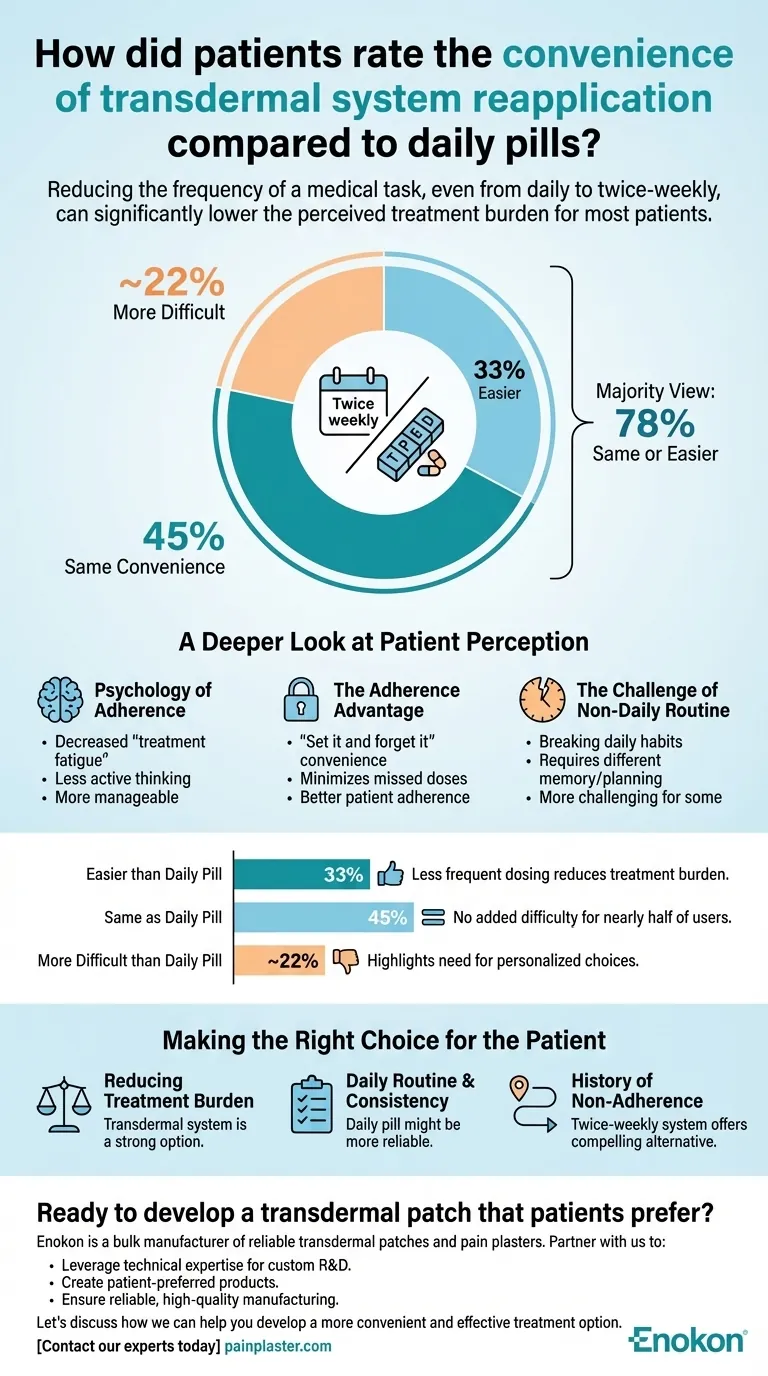
When compared to a daily pill, a significant majority of patients found the convenience of reapplying a twice-weekly transdermal system to be either the same or easier. Specifically, 45% of users rated it as the same, and another 33% rated it as easier.
The core insight is that reducing the frequency of a medical task, even from daily to twice-weekly, can significantly lower the perceived treatment burden for most patients, which is a critical factor in long-term adherence.
A Deeper Look at Patient Perception
Understanding the numbers behind patient preference reveals why less frequent dosing schedules are often a key goal in drug development and clinical practice.
The Majority View: Same or Easier
The data shows that a combined 78% of patients did not find the twice-weekly patch to be more difficult than a daily pill.
This is a powerful finding. It suggests that for over three-quarters of users, the cognitive load of remembering a twice-weekly application is not a significant barrier and is often seen as an improvement.
The Minority View: More Difficult
By extension, this implies that approximately 22% of patients did find remembering to reapply the transdermal system more difficult than the routine of taking a daily pill.
This is an important subgroup to acknowledge. Not every patient benefits from a less frequent schedule, especially if they rely on rigid daily habits.
The Psychology of Adherence
Reducing the number of times a patient must actively think about their medication can decrease "treatment fatigue."
A daily task can become a chore, whereas a twice-weekly action can feel like a more manageable, less intrusive part of one's life.
Understanding the Trade-offs
While the convenience rating is high, it's crucial to consider the complete picture of different delivery systems.
The Adherence Advantage
For many, the primary benefit of a transdermal system is "set it and forget it." This convenience often translates directly into better patient adherence, as it minimizes the chances of a missed daily dose.
The Challenge of a Non-Daily Routine
For the 22% who found it more difficult, the issue often lies in breaking a daily habit. A daily pill can be tied to a routine like brushing teeth or eating breakfast.
A twice-weekly schedule (e.g., Monday and Thursday) requires a different kind of memory and planning, which can be more challenging for some individuals.
Physical Factors of Transdermal Systems
Beyond remembering, transdermal patches come with their own set of considerations not present with oral medication. These can include skin irritation at the application site, issues with patch adhesion (especially with water or sweat), and visible application sites.
Making the Right Choice for the Patient
The decision between a daily pill and a transdermal system should be based on the individual's lifestyle, habits, and medical needs.
- If the primary goal is reducing treatment burden: The transdermal system is a strong option, as a clear majority of patients perceive it as less demanding than a daily pill regimen.
- If a patient thrives on daily routine and consistency: A daily pill might be the more reliable choice, as a notable minority found the less frequent schedule harder to manage.
- If a patient has a history of non-adherence with daily medication: A twice-weekly system offers a compelling alternative that may dramatically improve their ability to stick with their treatment plan.
Ultimately, tailoring the delivery method to the patient's personal preferences is key to achieving the best possible health outcomes.
Summary Table:
| Patient Perception | Percentage | Key Takeaway |
|---|---|---|
| Easier than Daily Pill | 33% | Less frequent dosing reduces treatment burden. |
| Same as Daily Pill | 45% | No added difficulty for nearly half of users. |
| More Difficult than Daily Pill | ~22% | Highlights the need for personalized treatment choices. |
Ready to develop a transdermal patch that patients prefer?
Enokon is a bulk manufacturer of reliable transdermal patches and pain plasters for healthcare and pharma distributors and brands. We understand that patient convenience is directly linked to adherence and treatment success.
Partner with us to:
- Leverage our technical expertise for custom R&D and development of patches with optimal dosing schedules.
- Create patient-preferred products that reduce treatment burden and improve long-term health outcomes.
- Ensure reliable, high-quality manufacturing for your branded transdermal solutions.
Let's discuss how we can help you develop a more convenient and effective treatment option. Contact our experts today to start your project.
Visual Guide
Related Products
- Far Infrared Heat Pain Relief Patches Transdermal Patches
- Icy Hot Menthol Medicine Pain Relief Patch
- Silicone Scar Sheets Patch Transdermal Drug Patch
- Menthol Gel Pain Relief Patch
- Mugwort Wormwood Pain Relief Patch for Neck Pain
People Also Ask
- Why is the selection of matrix materials critical when developing customized transdermal patches? Optimize Efficacy
- What are the physical impacts of external heat exposure on the performance and safety of transdermal patches? - Guide
- What are the clinical advantages of local transdermal delivery systems? Unlock Safer, More Effective Pain Relief Solutions
- What role does a skin tolerance scoring system play in the safety evaluation of transdermal patches? Key Safety Metrics
- How does high-purity far-infrared ceramic powder contribute to the efficacy of far-infrared physical therapy patches?



















