
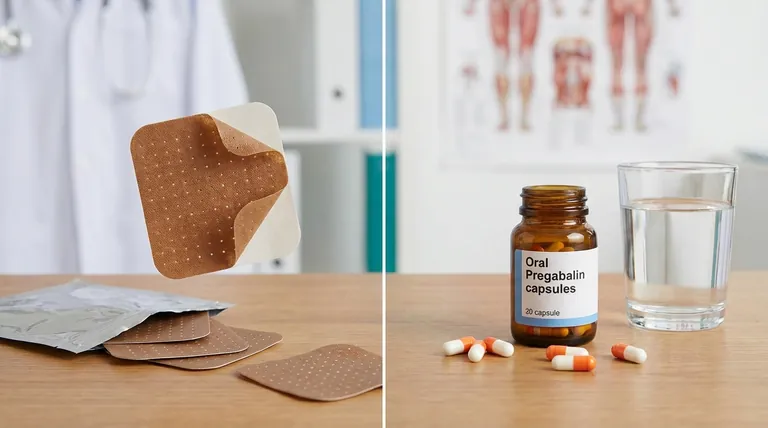
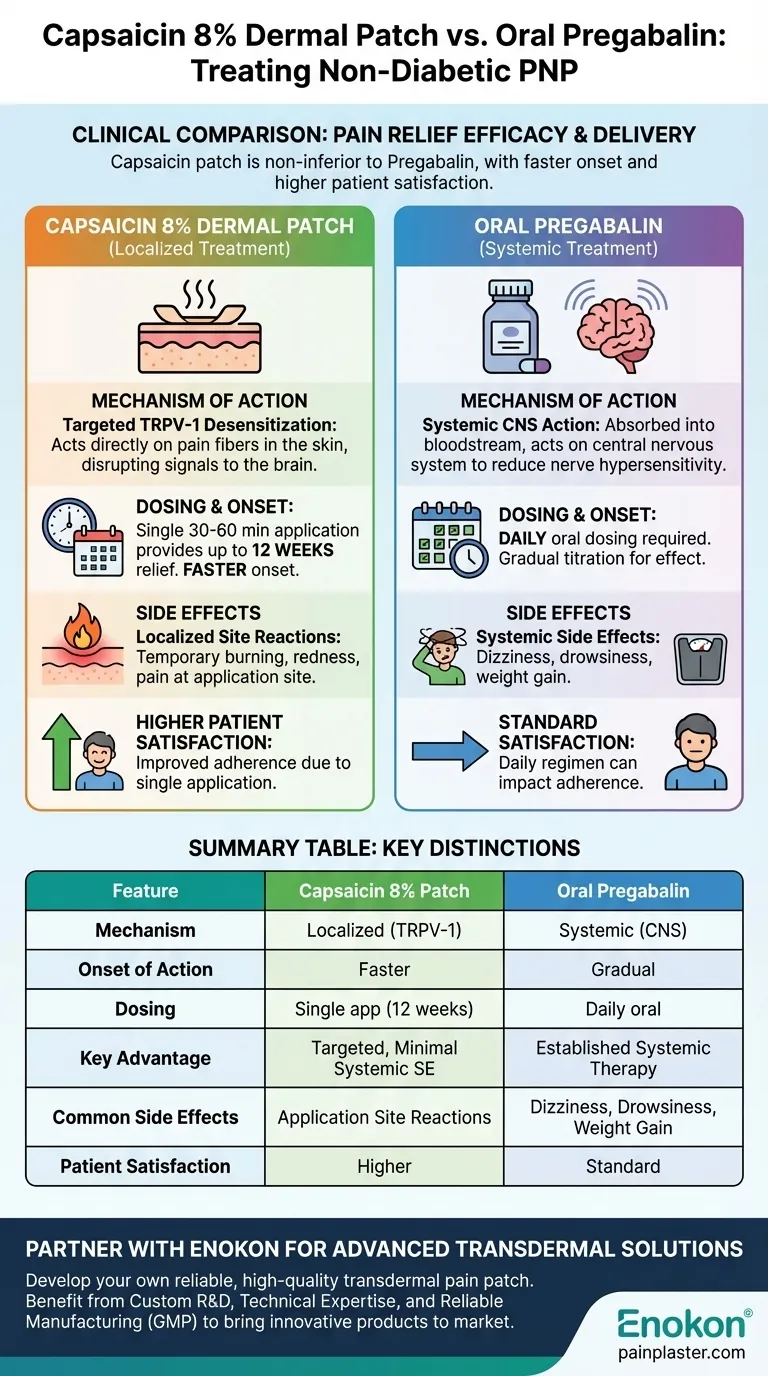
For treating non-diabetic peripheral neuropathic pain (PNP), the capsaicin 8% dermal patch is clinically non-inferior to oral pregabalin for pain relief. Crucially, the patch demonstrates a faster onset of action and achieves greater treatment satisfaction among patients, positioning it as a strong therapeutic alternative.
The core difference is not in the degree of pain relief, but in the method of delivery. The capsaicin patch offers a targeted, localized treatment with a rapid effect, while oral pregabalin provides systemic relief that requires daily dosing and carries a different side effect profile.
How Capsaicin Delivers Targeted Relief
To understand the comparison, we must first appreciate the distinct mechanism of the capsaicin patch. It represents a fundamentally different approach to managing neuropathic pain.
The Mechanism of Action
The patch contains a high concentration (8% w/w) of synthetic capsaicin.
This compound is a highly selective agonist for the transient receptor potential vanilloid-1 (TRPV-1), a receptor found on pain-sensing nerve fibers in the skin.
By applying the patch directly to the painful area, it first over-stimulates and then desensitizes these nerve endings, effectively disrupting the transmission of pain signals to the brain.
Localized vs. Systemic Treatment
This mechanism is entirely localized. The drug acts directly at the site of pain and is not absorbed into the bloodstream in significant amounts.
Oral pregabalin, by contrast, is a systemic treatment. It is taken by mouth, absorbed into the bloodstream, and acts on the central nervous system to reduce nerve hypersensitivity.
This systemic action means it affects the entire body, not just the specific area of pain.
Application and Dosing Schedule
A single application of the capsaicin 8% patch, often for just 30-60 minutes in a clinical setting, can provide pain relief for up to 12 weeks.
This contrasts sharply with oral pregabalin, which must be taken daily, often multiple times per day, to maintain its therapeutic effect.
A Direct Comparison: Efficacy, Speed, and Satisfaction
Clinical evidence shows a direct comparison between these two treatments reveals several key distinctions beyond their mechanism.
Pain Relief Efficacy
The capsaicin 8% patch was found to be non-inferior to oral pregabalin. This means it provides a comparable level of pain reduction for patients with non-diabetic PNP.
Onset of Action
A significant advantage of the capsaicin patch is its faster onset of action. Patients experience relief more quickly than with the gradual titration required for oral pregabalin.
Patient Treatment Satisfaction
The combination of faster relief and a more convenient dosing schedule (one application vs. daily pills) leads to greater overall treatment satisfaction for patients using the capsaicin patch.
Long-Term Viability
Studies have shown that repeat treatments with the patch over a 52-week period provide sustained pain relief without evidence of negative neurological effects, confirming its viability as a long-term treatment option.
Understanding the Trade-offs
Choosing between a localized patch and a systemic oral medication involves weighing their distinct profiles and potential downsides.
Application Site Reactions
As a high-concentration topical agent, the capsaicin patch can cause temporary, localized reactions at the application site. These may include a burning sensation, pain, or redness, which typically resolve on their own.
Systemic Side Effects
Oral pregabalin is associated with potential systemic side effects due to its action on the central nervous system. Common side effects include dizziness, drowsiness, and weight gain, which are not concerns with the localized capsaicin patch.
Patient Adherence
The single-application nature of the patch simplifies treatment and can dramatically improve adherence. For patients who struggle with the demands of a daily medication regimen, the patch offers a clear advantage.
Making the Right Choice for Your Goal
The evidence shows that the capsaicin 8% patch is a valuable and effective addition to the therapeutic options for peripheral neuropathic pain. The choice depends on the specific clinical goal and patient profile.
- If your primary focus is rapid pain relief and minimizing systemic side effects: The capsaicin 8% patch is a compelling option due to its fast, localized action.
- If your primary focus is improving patient adherence or simplifying the treatment regimen: The patch's single-application, long-duration profile offers a significant advantage over daily oral medication.
- If your primary focus is a well-established oral therapy or if the pain is widespread and not well-localized: Oral pregabalin remains a standard and effective systemic treatment for neuropathic pain.
Ultimately, the capsaicin 8% patch provides a powerful, non-systemic alternative that can be tailored to meet specific patient needs.
Summary Table:
| Feature | Capsaicin 8% Dermal Patch | Oral Pregabalin |
|---|---|---|
| Mechanism | Localized (TRPV-1 desensitization) | Systemic (CNS action) |
| Onset of Action | Faster | Gradual (requires titration) |
| Dosing | Single application, lasts up to 12 weeks | Daily oral dosing |
| Key Advantage | Targeted relief, minimal systemic side effects | Established systemic therapy |
| Common Side Effects | Application site reactions (e.g., redness, burning) | Dizziness, drowsiness, weight gain |
| Patient Satisfaction | Higher | Standard |
Ready to Develop Your Own Advanced Transdermal Pain Patch?
As a trusted partner for pharmaceutical distributors and healthcare brands, Enokon specializes in the bulk manufacturing of reliable, high-quality transdermal patches and pain plasters. Our technical expertise in custom R&D and formulation development can help you bring innovative, patient-centric solutions like a capsaicin patch to market efficiently.
Benefit from our capabilities:
- Custom R&D: Tailor formulations for specific active ingredients and release profiles.
- Technical Expertise: Leverage our deep knowledge of transdermal delivery systems.
- Reliable Manufacturing: Scale up from prototype to high-volume GMP production.
Let's collaborate to create a superior pain management product for your patients.
Contact our experts today to discuss your project
Visual Guide
Related Products
- Capsaicin Chili Medicated Pain Relief Patches
- Heat Relief Capsicum Patch for Lower Back Pain Relief
- Menthol Gel Pain Relief Patch
- Lidocaine Hydrogel Pain Relief Patch for Pain Relief
- Icy Hot Menthol Medicine Pain Relief Patch
People Also Ask
- What conditions should be reported to a care team before using capsaicin patches? Ensure Safe Pain Relief
- What conditions can capsaicin creams and patches help relieve? Find Targeted Pain Relief for Nerves & Joints
- What are the uses of nonprescription capsaicin patches? Natural Pain Relief for Muscles & Joints
- What should be avoided while using capsaicin patches? Essential Safety Tips for Effective Pain Relief
- How are capsaicin patches administered? A Guide to Clinical vs. At-Home Use





