
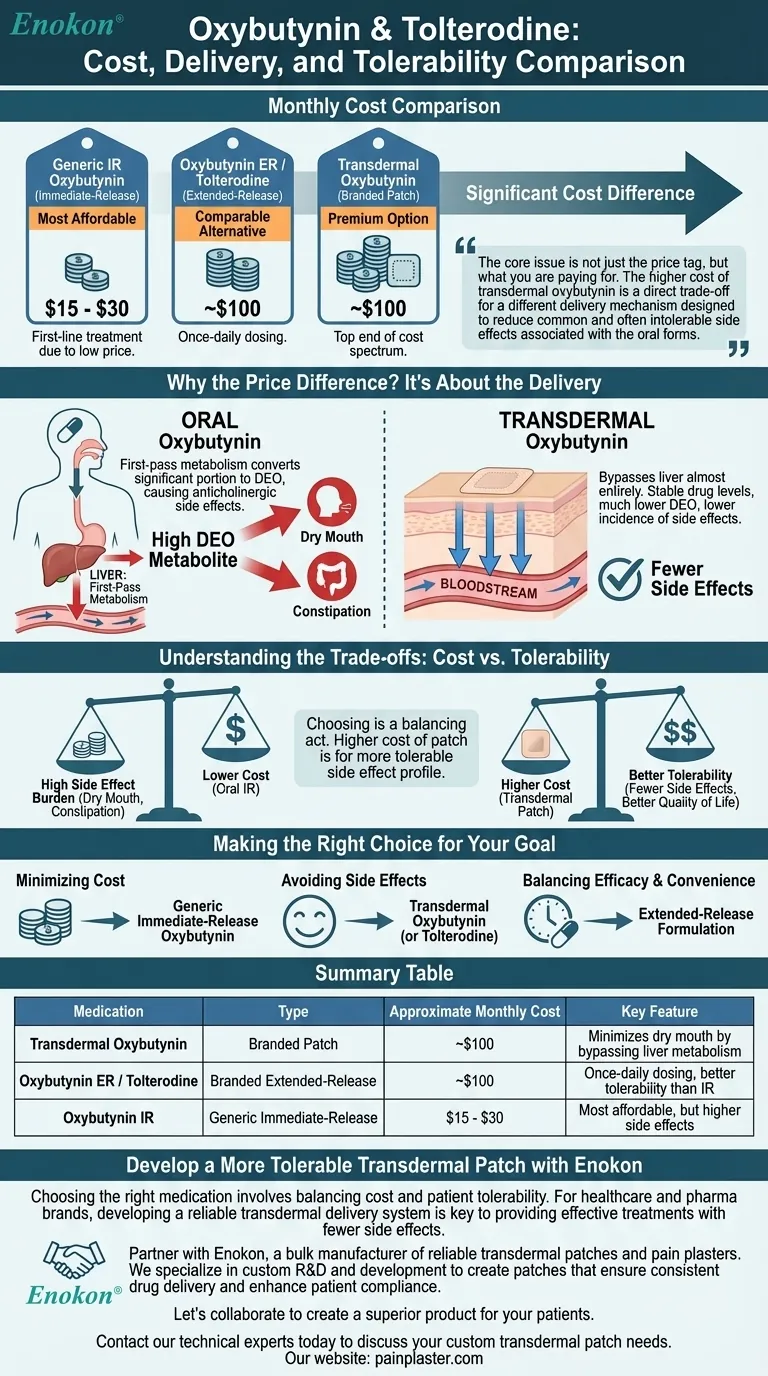
On a monthly basis, transdermal oxybutynin costs approximately $100. This is comparable to the cost of branded extended-release medications like oxybutynin ER and tolterodine, but it is significantly more expensive than the generic immediate-release form of oxybutynin, which typically costs between $15 and $30 per month.
The core issue is not just the price tag, but what you are paying for. The higher cost of transdermal oxybutynin is a direct trade-off for a different delivery mechanism designed to reduce common and often intolerable side effects associated with the oral forms.
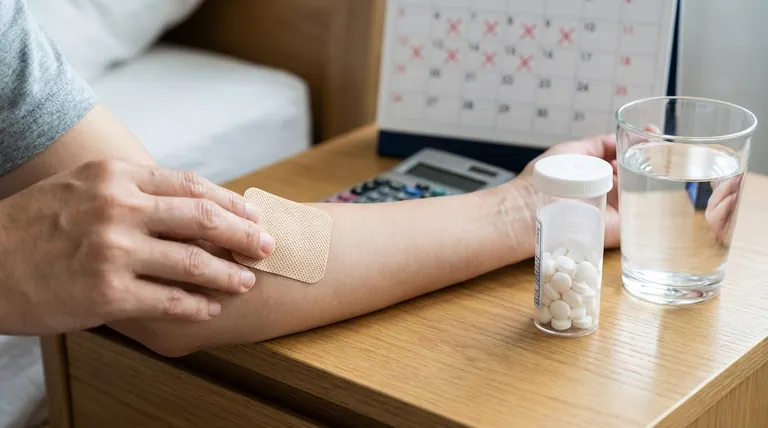
A Clear Cost Breakdown
To make an informed decision, it's essential to see the cost of each option side-by-side. The medications fall into distinct price tiers based on their formulation and patent status.
The Premium Option: Transdermal Patch
Transdermal oxybutynin is a branded medication that consistently costs patients around $100 per month. This places it at the top end of the cost spectrum for this class of drugs.
The Comparable Alternatives: Extended-Release
The cost of the transdermal patch is very similar to other branded, extended-release (ER) oral medications. This includes both oxybutynin ER and tolterodine, which are designed for once-daily dosing.
The Most Affordable Choice: Immediate-Release
Generic, immediate-release (IR) oxybutynin is by far the most economical option. With a typical monthly cost of $15 to $30, it is often the first-line treatment due to its low price point.
Why the Price Difference? It's About the Delivery
The significant price gap between the generic oral pills and the transdermal patch is rooted in how the drug enters your body. This delivery method directly impacts the drug's metabolism and, crucially, its side effects.
How Oral Oxybutynin is Processed
When you take oxybutynin orally, it is absorbed through your digestive system and passes through the liver before circulating throughout your body. This "first-pass metabolism" in the liver converts a significant portion of the drug into a metabolite known as N-desethyloxybutynin (DEO).
This specific metabolite is largely responsible for the anticholinergic side effects—most notably dry mouth and constipation—that cause many patients to stop taking the medication.
The Advantage of the Transdermal System
The transdermal patch delivers oxybutynin directly through the skin into the bloodstream. This route bypasses the liver's first-pass metabolism almost entirely.
The result is a more stable level of the parent drug in the body and, critically, much lower levels of the DEO metabolite. This directly translates to a lower incidence of side effects like dry mouth.
Understanding the Trade-offs: Cost vs. Tolerability
Choosing a medication for overactive bladder is a classic balancing act between price and patient experience. The higher cost of the patch is a direct payment for a more tolerable side effect profile.
The High Cost of Side Effects
For many, the dry mouth associated with oral oxybutynin isn't a minor nuisance; it can be severe enough to interfere with speaking, eating, and overall quality of life. This high "side effect burden" is a primary reason patients discontinue therapy.
The Value Proposition of the Patch
The patch's higher price tag is justified for patients who cannot tolerate the side effects of the oral forms. By minimizing dry mouth and constipation, it offers a way to get the therapeutic benefits of the medication without the disruptive downsides.
Where Tolterodine Fits In
It's worth noting that tolterodine, which is priced similarly to the patch, was also developed specifically to have a better side effect profile than immediate-release oxybutynin. It represents another premium option for patients seeking better tolerability than the cheapest generic.
Making the Right Choice for Your Goal
Your optimal choice depends entirely on your personal priorities regarding cost, convenience, and side effect sensitivity. Discuss these goals with your healthcare provider to find the best fit.
- If your primary focus is minimizing cost: Generic immediate-release oxybutynin is the undisputed starting point due to its very low price.
- If your primary focus is avoiding dry mouth and other side effects: Transdermal oxybutynin is often the most effective option, though tolterodine is also a strong alternative.
- If your primary focus is balancing efficacy with once-daily convenience: An extended-release formulation of either oxybutynin or tolterodine may provide a suitable middle ground.
Ultimately, the best medication is the one you can take consistently and tolerate well over the long term.
Summary Table:
| Medication | Type | Approximate Monthly Cost | Key Feature |
|---|---|---|---|
| Transdermal Oxybutynin | Branded Patch | ~$100 | Minimizes dry mouth by bypassing liver metabolism |
| Oxybutynin ER / Tolterodine | Branded Extended-Release | ~$100 | Once-daily dosing, better tolerability than IR |
| Oxybutynin IR | Generic Immediate-Release | $15 - $30 | Most affordable option, but higher side effects |
Develop a More Tolerable Transdermal Patch with Enokon
Choosing the right medication involves balancing cost and patient tolerability. For healthcare and pharma brands, developing a reliable transdermal delivery system is key to providing effective treatments with fewer side effects.
Partner with Enokon, a bulk manufacturer of reliable transdermal patches and pain plasters. We specialize in custom R&D and development to create patches that ensure consistent drug delivery and enhance patient compliance.
Let's collaborate to create a superior product for your patients.
Contact our technical experts today to discuss your custom transdermal patch needs.
Visual Guide
Related Products
- Silicone Scar Sheets Patch Transdermal Drug Patch
- Far Infrared Heat Pain Relief Patches Transdermal Patches
- Menthol Gel Pain Relief Patch
- Icy Hot Menthol Medicine Pain Relief Patch
- Mugwort Wormwood Pain Relief Patch for Neck Pain
People Also Ask
- What role does a silicone-based transdermal delivery system play in Parkinson's? Enhancing Early-Stage Patient Care
- What are common adverse effects of transdermal drug delivery? Risks & Prevention Tips
- What are the advantages of transdermal drug patches? Optimize Medication Delivery with Patches
- Why is silicone adhesive preferred for high-performance transdermal patches? Superior Delivery & Patient Comfort
- How does n-octanol/water partition coefficient assist transdermal patch R&D? Optimize Formulas for Mass Production



















