
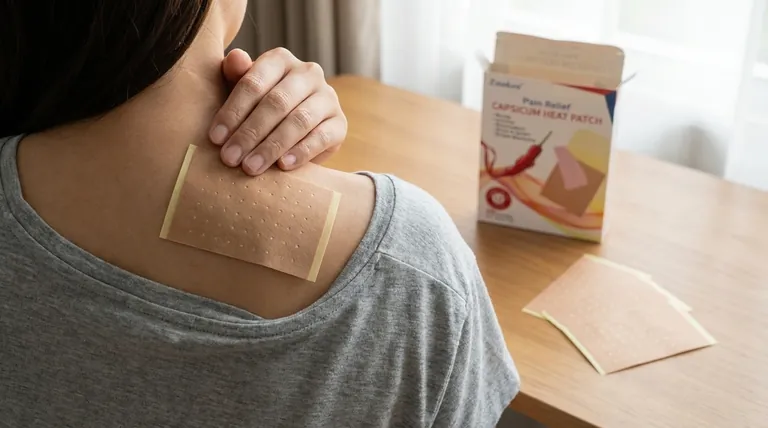
While there is no single "correct" way to wear the Signal Relief Patch in terms of which side faces your skin, the effectiveness of the patch is entirely dependent on its placement. Both sides of the patch are identical, so your focus should not be on its orientation, but on finding the precise location on your body that provides the most significant relief from discomfort.
The key to using the Signal Relief Patch is not just placing it on the area of pain, but strategically positioning it to best interrupt the specific pain signals traveling from that area to your brain. This often requires a few minutes of methodical exploration.
The Principle of Signal Interruption
To place the patch effectively, it's helpful to understand its core mechanism. It does not deliver any medication or electrical stimulation. Instead, it acts as a passive filter for your body's electrical signals.
How the Patch Functions
The patch contains patented technology designed to interact with your body's natural electrical field. When you experience discomfort, your nerves send signals to your brain. The patch works by being placed in the path of these signals, where it absorbs and diverts them, reducing the "volume" of the pain message that reaches your brain.
Why Location is Everything
Because the patch is a passive device, its precise location is the single most important factor for success. Think of it like adjusting an antenna to get a clear signal. Moving it just an inch or two can be the difference between minimal effect and profound relief, as you are fine-tuning its position along the nerve pathway.
A Systematic Method for Optimal Placement
Finding the ideal spot is an active process. Don't simply place the patch and hope for the best; take a few minutes to pinpoint the most effective location.
Step 1: Identify the Source
Before applying the patch, gently move in a way that activates the discomfort. This isn't about causing more pain, but about reminding your body where the tension or source of the ache is. Take note of your range of motion.
Step 2: Begin at the Point of Intensity
Place the patch directly on the area where the discomfort feels most concentrated. This is your starting point.
Step 3: Slowly Explore the Pain Pathway
Hold the patch in its starting spot for up to a minute. Then, slowly move it in small, one-inch increments away from the center of the pain, moving along the line of tension. Pause in each new spot for 30-60 seconds to gauge the effect. You are searching for the spot that best intercepts the pain signal.
Step 4: Confirm and Secure
Once you find a location that provides significant relief, you have found the optimal placement. You can then use an adhesive to secure it. For persistent issues, such as lower back discomfort, you can leave the patch on overnight.
Common Pitfalls and Best Practices
To ensure you are using the patch safely and effectively, keep these critical points in mind. This is where users often make mistakes that limit the patch's performance.
Assuming the First Spot is Best
The most common error is a lack of experimentation. If you don't feel relief within a minute or two, the solution is almost always to adjust the patch's location. The optimal spot may be slightly above, below, or to the side of where the pain feels most intense.
Altering the Patch in Any Way
The technology is embedded throughout the device. You must not cut or alter the patch, as this will damage its internal structure and render it ineffective. The patch is also intended for external use only.
Neglecting Underlying Conditions
The Signal Relief patch helps manage the sensation of pain, but it does not cure the underlying cause. If you have any concerns about your medical condition, it is always best to consult with a physician.
Making the Right Choice for Your Pain
Your approach to placement should adapt to the type of discomfort you are experiencing.
- If your primary focus is sharp, localized pain: Start directly on the most intense point and make very small, methodical adjustments in a circular pattern around it.
- If your primary focus is radiating pain (like from the back down the leg): Systematically test spots along the entire pathway of the discomfort, starting from the source and moving outward.
- If your primary focus is chronic, widespread discomfort: Identify the most consistently irritating area to use as your starting point and consider wearing the patch there for an extended period, such as overnight.
By systematically exploring placement, you empower yourself to find the most effective, drug-free relief for your specific needs.
Summary Table:
| Key Placement Principle | Why It Matters |
|---|---|
| Both Sides are Identical | Patch orientation does not affect function; focus on location. |
| Location is Critical | Effectiveness depends on intercepting the nerve signal pathway. |
| Requires Active Exploration | Moving the patch in small increments is necessary to find the "sweet spot." |
| Do Not Cut or Alter | Damaging the patch's structure will render it ineffective. |
Achieve consistent, high-quality pain relief for your customers. As Enokon, a bulk manufacturer of reliable transdermal patches and pain plasters, we provide healthcare and pharma distributors and brands with the technical expertise for custom R&D and development. Let us help you create a superior product that delivers on its promise. Contact our experts today to discuss your manufacturing needs.
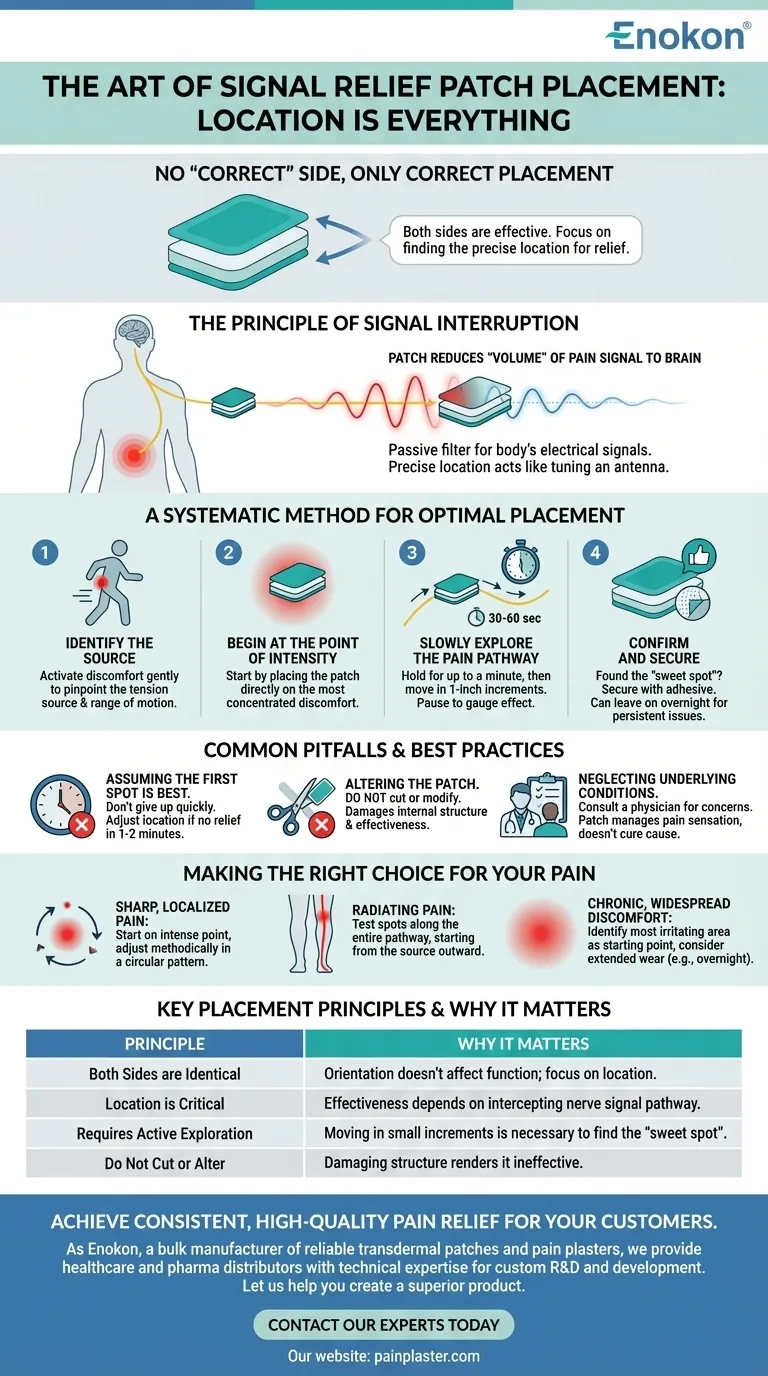
Visual Guide
Related Products
- Far Infrared Deep Heat Relief Patches Medicated Pain Relief Patches
- Far Infrared Heat Pain Relief Patches Transdermal Patches
- Far Infrared Pain Patch Relief Pain Reliever for Back
- Far Infrared Knee Pain Patch Heat Patches for Pain Relief
- Natural Herbal Patch for Motion Sickness and Car Sickness Relief
People Also Ask
- How do Deep Heat Pain Relief Patches provide pain relief? Discover the Drug-Free Mechanism
- How effective are pain relief patches for muscle pain? Target Localized Pain with Transdermal Delivery
- What are pain relief patches and how are they used? A Guide to Safe, Targeted Relief
- When should you consider using pain relief products like creams and patches? Optimize Comfort & Safety
- Why should one avoid harmful chemicals in pain relief patches? Risks & Safe Alternatives



















