
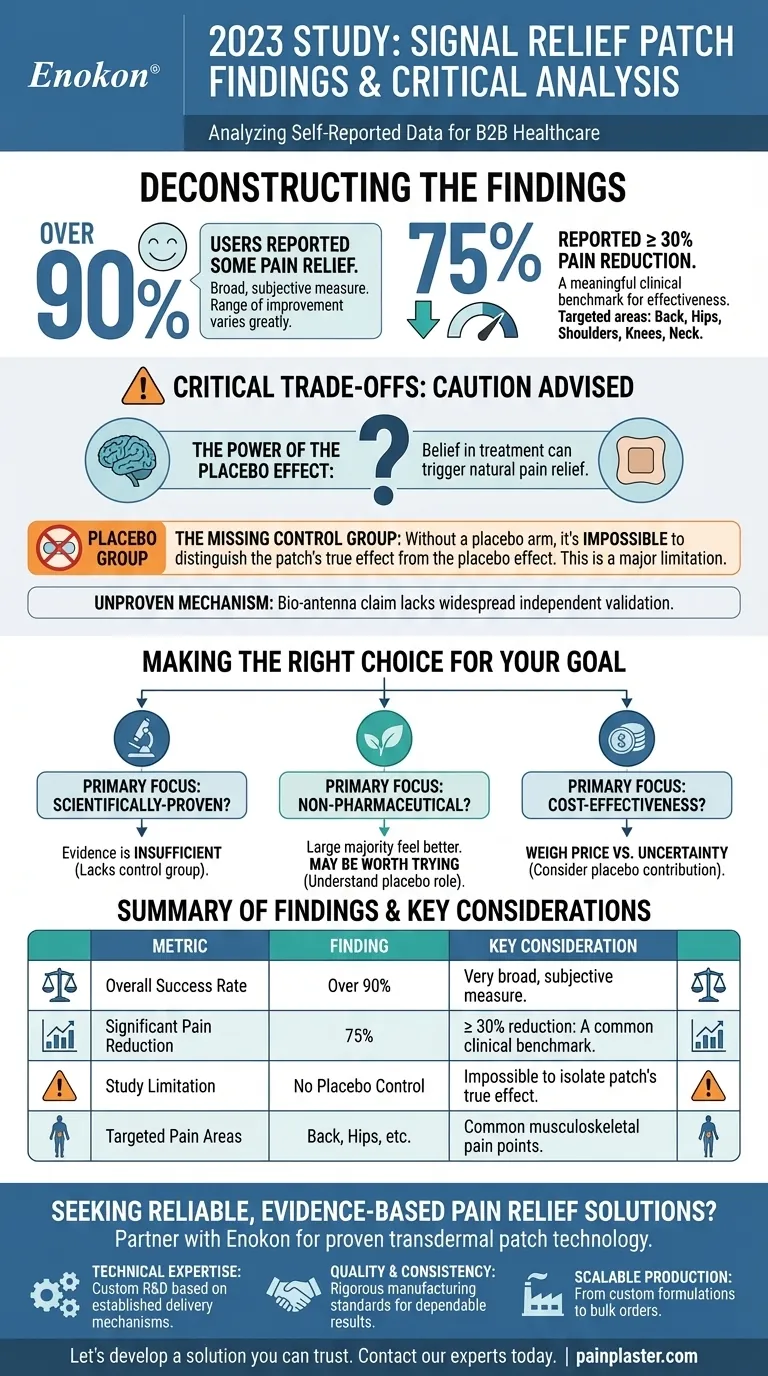
In a 2023 study on the Signal Relief patch, the findings indicated a high rate of self-reported success for users with specific types of musculoskeletal pain. The study found that over 90% of participants experienced some level of pain relief, and a significant majority—75%—reported at least a 30% reduction in their pain.
While the study's top-line numbers appear promising, the critical takeaway is that this data must be interpreted with caution. Without information on the study's design, particularly the inclusion of a placebo control group, it is impossible to distinguish the patch's true physiological effect from the powerful and well-documented placebo effect.

Deconstructing the Study's Findings
To make an informed decision, we need to look closer at what these numbers mean in the context of pain research.
The "90% Success" Metric
The finding that over 90% of users felt "some level of pain relief" is a positive but very broad indicator. This subjective measure can range from a barely noticeable change to a significant improvement.
The "30% Pain Reduction" Metric
The more specific finding is that 75% of participants reported at least a 30% reduction in pain. This is a more meaningful clinical benchmark. In many pain studies, a 30% improvement is considered the threshold for a treatment being classified as effective for an individual.
Targeted Pain Areas
The study specifically focused on common areas of musculoskeletal discomfort. The participant pool included individuals experiencing pain in their back, hips, shoulders, knees, or neck.
Understanding the Critical Trade-offs
The results of a study are only as reliable as its methodology. The most significant limitation here is the information we lack, which prevents us from drawing firm conclusions.
The Power of the Placebo Effect
Pain is a complex experience influenced by both physical and psychological factors. The placebo effect is a real, measurable phenomenon where a person's belief in a treatment can cause a genuine reduction in their symptoms. Simply applying a patch with the expectation of relief can trigger the brain to release its own natural pain-relieving chemicals.
The Missing Control Group
The gold standard for medical research is the randomized, placebo-controlled trial. In such a trial, one group gets the real treatment while another gets a "sham" version (a placebo).
Without a placebo group, we cannot know how much of the 75% who felt better did so because of the patch's technology and how much did so because of the placebo effect. This is the single most important missing piece of information.
The Question of Mechanism
Signal Relief claims its patch contains nanocapacitors that work as a bio-antenna to interrupt pain signals from the body's natural electrical field. This proposed mechanism is not widely validated by independent, peer-reviewed research, making it difficult to assess from a conventional scientific standpoint.
Making the Right Choice for Your Goal
Based on this analysis, here is how to apply these findings to your own situation.
- If your primary focus is a scientifically-proven treatment: The evidence from this study is insufficient to meet that standard, as it lacks the necessary control group to prove its effect is greater than a placebo.
- If your primary focus is exploring non-pharmaceutical options: The study suggests that a large majority of users do report feeling better, which may be a sufficient reason for you to try it, provided you understand the potential role of the placebo effect.
- If your primary focus is cost-effectiveness: You must weigh the price of the product against the uncertainty of its mechanism, acknowledging that a portion of its perceived benefit may stem from the placebo effect.
Ultimately, while many users self-report a positive experience, a critical evaluation of the evidence is essential to manage your expectations for pain relief.
Summary Table:
| Metric | Finding | Key Consideration |
|---|---|---|
| Overall Success Rate | Over 90% reported some pain relief | Very broad, subjective measure of effectiveness. |
| Significant Pain Reduction | 75% reported at least a 30% reduction in pain | A common clinical benchmark for an "effective" treatment. |
| Study Limitation | No placebo control group | Makes it impossible to distinguish the patch's effect from the powerful placebo effect. |
| Targeted Pain Areas | Back, hips, shoulders, knees, neck | Focused on common musculoskeletal pain points. |
Seeking Reliable, Evidence-Based Pain Relief Solutions?
While consumer-grade patches rely on user-reported data, healthcare distributors and brands need scientifically validated, consistent performance for their customers.
Partner with Enokon for proven transdermal patch technology. As a bulk manufacturer of reliable transdermal patches and pain plasters, we provide:
- Technical Expertise: Leverage our R&D team for custom development based on established delivery mechanisms.
- Quality & Consistency: Ensure every patch meets rigorous manufacturing standards for dependable results.
- Scalable Production: From custom formulations to bulk orders, we support your brand's growth.
Let's develop a pain management solution you can trust. Contact our experts today to discuss your project requirements.
Visual Guide
Related Products
- Far Infrared Deep Heat Relief Patches Medicated Pain Relief Patches
- Far Infrared Pain Patch Relief Pain Reliever for Back
- Far Infrared Heat Pain Relief Patches Transdermal Patches
- Far Infrared Knee Pain Patch Heat Patches for Pain Relief
- Natural Herbal Patch for Motion Sickness and Car Sickness Relief
People Also Ask
- How do Deep Heat Pain Relief Patches provide pain relief? Discover the Drug-Free Mechanism
- How effective are pain relief patches for muscle pain? Target Localized Pain with Transdermal Delivery
- What are pain relief patches and how are they used? A Guide to Safe, Targeted Relief
- When should you consider using pain relief products like creams and patches? Optimize Comfort & Safety
- Why should one avoid harmful chemicals in pain relief patches? Risks & Safe Alternatives



















