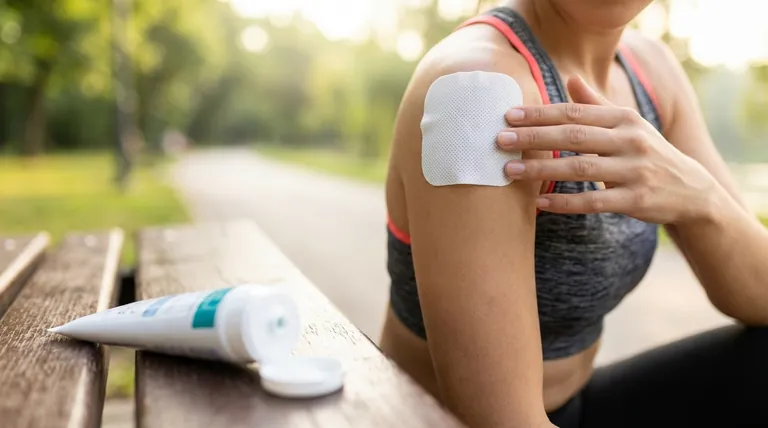
The Friction of Healing
Imagine a tennis player who lunges for a wide shot, feels a sharp pull in their calf, and ends up with a painful strain. The immediate problem is the injury. But a second, more subtle problem begins the moment they receive treatment: the burden of adhering to it.
A doctor might prescribe a topical anti-inflammatory gel to be applied three times a day. On day one, compliance is perfect. By day three, a morning application is missed in the rush to get to work. By day five, the midday dose is forgotten.
This isn't a failure of willpower; it's a failure of design. The friction of treatment—the cognitive load of remembering, the inconvenience of stopping your day to apply a messy gel—works directly against the process of healing. The most effective treatment is the one that gets used correctly.
The Clinical Question: Efficacy vs. Adherence
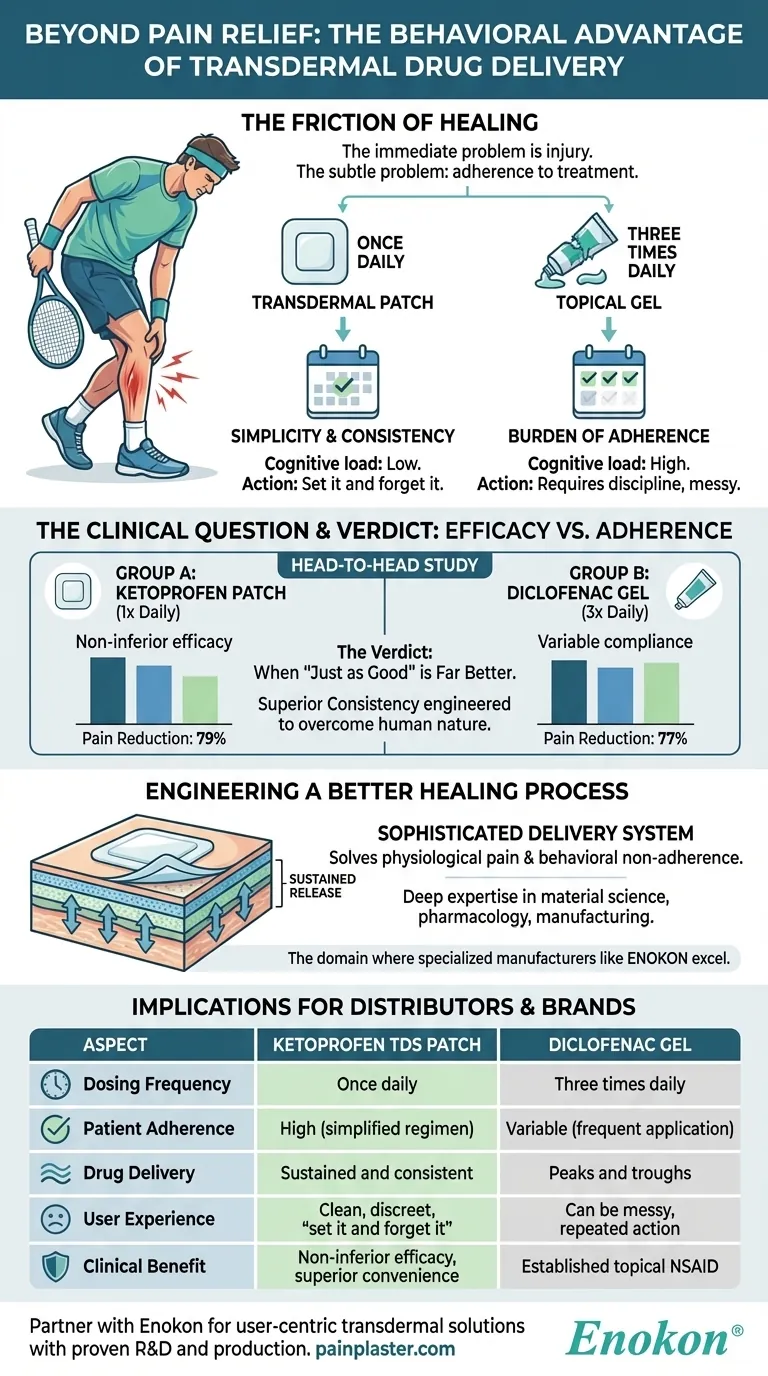
This very challenge was at the heart of a prospective, randomized study comparing two popular treatments for acute, sport-related soft-tissue injuries. It wasn't just a test of two different NSAIDs, but a test of two fundamentally different approaches to treatment delivery.
A Head-to-Head Comparison
- Group A: Received a once-daily Ketoprofen Transdermal Delivery System (TDS) patch.
- Group B: Received a Diclofenac gel, to be applied three times per day.
The primary goal was to measure pain reduction over a 7- to 14-day period. But the unspoken question was far more profound: Can a simpler application method deliver comparable—or even superior—results by eliminating the friction of treatment?
The Verdict: When "Just as Good" is Far Better
The clinical results were clear. The once-daily Ketoprofen patch was found to be statistically non-inferior to the thrice-daily Diclofenac gel.
The Data on Pain Reduction
After seven days, the difference in efficacy was minimal, with the patch showing a slight edge:
- Ketoprofen Patch: 79% reduction in baseline pain.
- Diclofenac Gel: 77% reduction in baseline pain.
On paper, this 2% difference seems negligible. But it hints at a more powerful underlying force.
The Hidden Variable: The Power of Simplicity
The most significant finding wasn't in the efficacy data, but in the design of the treatment itself. The patch required one action per day. The gel required three.
This is where human psychology enters the equation. A "set it and forget it" system removes the opportunity for error. It doesn't rely on memory, discipline, or scheduling. The patient applies the patch in the morning and the technology takes over, delivering a consistent, controlled dose of medication directly to the site of pain for the next 24 hours.
The gel, by contrast, delivers its dose in peaks and troughs, entirely dependent on the patient’s ability to adhere to a schedule. The patch’s slight performance advantage is likely a reflection of its superior consistency—a consistency engineered to overcome human nature.
Engineering a Better Healing Process
A transdermal patch is a marvel of quiet engineering. It’s not just an adhesive bandage with medicine on it; it's a sophisticated delivery system designed for passive, sustained release. It solves the physiological problem of pain while simultaneously solving the behavioral problem of non-adherence.
Mastering this technology requires deep expertise in material science, pharmacology, and manufacturing. It's about creating a product that is not only clinically effective but also reliably manufactured at scale to ensure every patch performs exactly as intended. This is the domain where specialized manufacturers like Enokon excel, providing the technical foundation for brands and distributors who want to offer their customers more than just a drug—they want to offer a better, simpler healing experience.
Implications for Distributors and Healthcare Brands
For distributors, pharmacies, and healthcare brands, the choice between a patch and a gel extends beyond clinical data. It impacts patient satisfaction, logistical efficiency, and brand perception.
| Aspect | Ketoprofen TDS Patch | Diclofenac Gel |
|---|---|---|
| Dosing Frequency | Once daily | Three times daily |
| Patient Adherence | High (simplified regimen) | Variable (frequent application required) |
| Drug Delivery | Sustained and consistent | Peaks and troughs based on application |
| User Experience | Clean, discreet, "set it and forget it" | Can be messy, requires repeated action |
| Clinical Benefit | Non-inferior efficacy with superior convenience | Established topical NSAID |
Ultimately, the most advanced medical solutions are those that seamlessly integrate into a person's life. The transdermal patch represents a move toward treatment systems designed for humans, not just for their symptoms. Developing and sourcing such user-centric solutions requires a manufacturing partner with proven R&D and production capabilities.
If you are looking to enhance your product line with reliable, patient-friendly transdermal solutions, Contact Our Experts.
Visual Guide
Related Products
- Menthol Gel Pain Relief Patch
- Lidocaine Hydrogel Pain Relief Patch for Pain Relief
- Icy Hot Menthol Medicine Pain Relief Patch
- Herbal Medicated Anti Diarrhea Patch for Digestive Relief
- Capsaicin Chili Medicated Pain Relief Patches
Related Articles
- Beyond Efficacy: The Psychology of Adherence in Topical Pain Relief
- The 60-Minute Architecture: Engineering Predictability in Topical Pain Relief
- More Than a Feeling: The Precise Engineering of Cold vs. Hot Pain Relief
- Beyond the Molecule: The Behavioral Science of the Simple Pain Patch
- The Human Interface of Pain Relief: Why Delivery Systems Define Success



















