The Allure of a Quick Fix
Imagine standing in a pharmacy aisle, confronted by a wall of options for your aching back. One box promises a cooling sensation, another a deep, warming heat. We instinctively reach for the one whose sensation seems most appealing.
This is a subtle psychological trap. We choose a therapy based on the immediate feedback it provides—a tingle, a warmth—believing that the sensation itself is the solution.
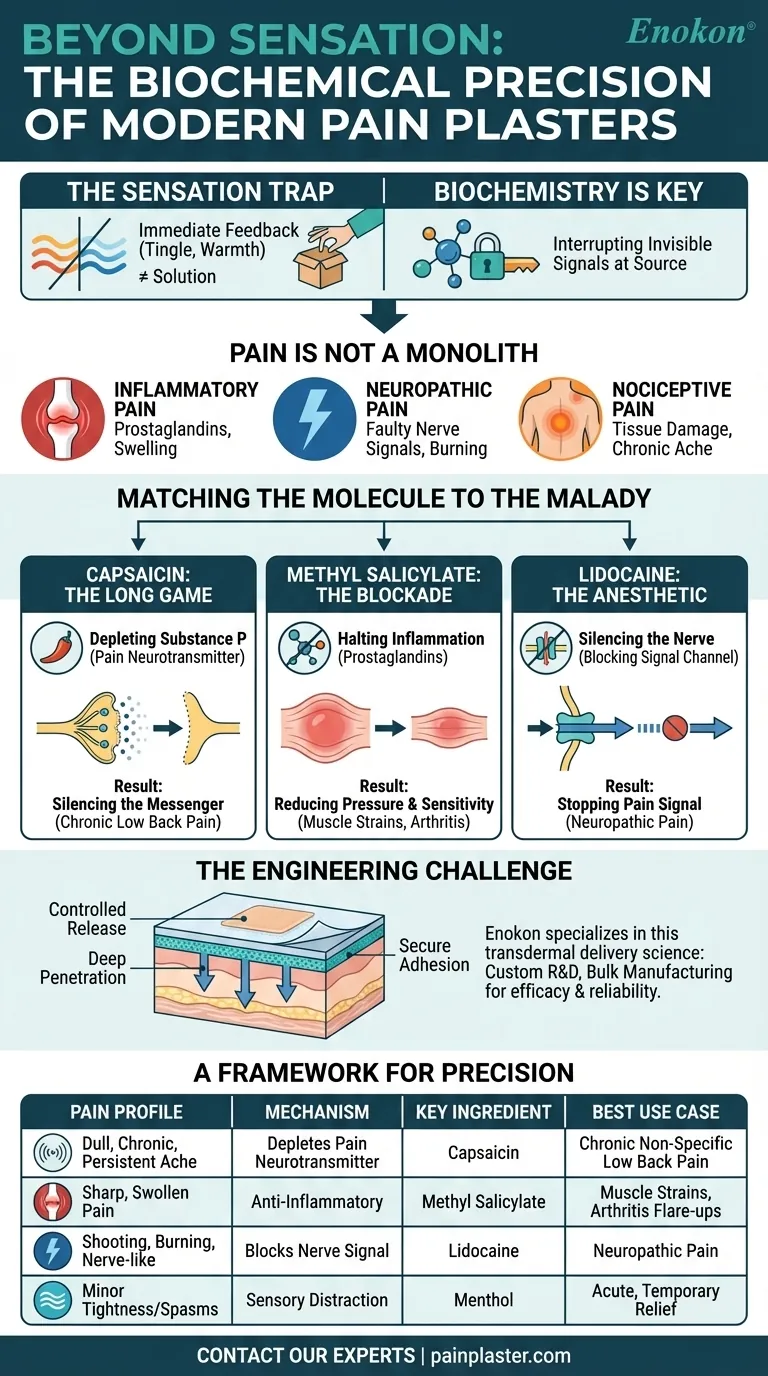
But effective pain relief is rarely about creating a new feeling. It’s about biochemistry. It’s about interrupting a specific, invisible signal at its source. The most effective pain plaster isn’t the one that feels the most active; it’s the one engineered to solve the right underlying problem.
Pain Is Not a Monolith
To choose the right tool, we must first understand the job. Back pain isn't a single condition; it's a symptom with diverse origins.
- Inflammatory Pain: Often follows an acute injury, like a muscle strain. The body releases chemicals called prostaglandins, which cause swelling and sensitize nerve endings.
- Neuropathic Pain: Stems from nerve damage or irritation. The signals themselves are faulty, leading to shooting, burning, or chronic aches.
- Nociceptive Pain: The most common type, resulting from tissue damage that activates pain receptors. A chronic, non-specific low backache often falls into this category.
A cooling patch designed for a simple muscle spasm will do little for deep-seated inflammatory or nerve pain. This is why a "try everything" approach often ends in frustration.
Matching the Molecule to the Malady
The genius of the modern pain plaster lies in its active ingredient. Each one is a key designed to fit a specific biochemical lock. Understanding their mechanism is the key to effective relief.
The Long Game: Depleting the Pain Signal with Capsaicin
For chronic, persistent pain, the problem is often an overactive pain transmitter called Substance P. Capsaicin, the compound found in chili peppers, works by a clever strategy of attrition.
- Mechanism: It initially causes a burning sensation by flooding the nerve endings, forcing them to release all their Substance P.
- Result: With continued use, the nerve endings are depleted of Substance P and can no longer send pain signals to the brain.
This isn’t about masking pain; it’s about silencing the messenger. It’s a long-term strategy, not an instant fix, making it ideal for chronic, non-specific low back pain.
The Blockade: Halting Inflammation with Methyl Salicylate
When back pain is caused by a strain or arthritis, the enemy is inflammation. Methyl Salicylate acts like a targeted aspirin, directly at the source.
- Mechanism: It inhibits the production of prostaglandins, the compounds that cause swelling and pain.
- Result: By reducing inflammation, it alleviates the pressure and sensitivity in the affected tissue.
This is the right choice for pain you can pinpoint to a specific event—the weekend gardening project or the wrong move at the gym.
The Anesthetic: Silencing the Nerve with Lidocaine
Sometimes, the nerve itself is the problem. Lidocaine is a local anesthetic that works by simply blocking the channel that nerve cells use to transmit signals.
- Mechanism: It temporarily numbs the nerve endings in the application area.
- Result: The pain signal is stopped dead in its tracks before it can even reach the brain.
Crucially, lidocaine only masks the signal; it doesn't reduce the underlying inflammation. It's a specialist tool for nerve-related pain.
The Engineering Challenge: From Molecule to Medicine
Choosing the right molecule is only half the battle. The plaster itself is a sophisticated transdermal delivery system. The true challenge lies in engineering a patch that can:
- Release the active ingredient at a steady, controlled rate over many hours.
- Penetrate the skin barrier to reach the target tissue effectively.
- Adhere securely and comfortably without causing skin irritation.
Creating a stable, effective patch for oil-soluble methyl salicylate requires a completely different formulation and adhesive technology than one for capsaicin. This is where manufacturing expertise becomes paramount. As bulk manufacturers of transdermal patches, Enokon specializes in this exact science—partnering with healthcare brands and distributors to develop custom R&D solutions that ensure reliability and efficacy from the lab to the patient.
A Framework for Precision
Instead of choosing based on sensation, reframe the question around the source of your pain. This simple shift in perspective makes the choice clear.
| Pain Profile | Plaster Mechanism | Key Ingredient | Best Use Case |
|---|---|---|---|
| Dull, chronic, persistent ache | Depletes Pain Neurotransmitter | Capsaicin | Chronic non-specific low back pain |
| Sharp, swollen pain from an injury | Anti-Inflammatory | Methyl Salicylate | Muscle strains, arthritis flare-ups |
| Shooting, burning, or nerve-like pain | Blocks Nerve Signal | Lidocaine | Neuropathic pain |
| Minor muscle tightness or spasms | Sensory Distraction | Menthol | Acute, temporary relief |
The future of topical pain relief is precision. It’s about moving beyond blunt instruments and embracing solutions engineered for specific biological targets.
Developing a product that delivers this level of targeted relief requires deep expertise in both formulation and manufacturing. If you are a healthcare brand or distributor looking to create a genuinely effective pain management solution, the right partner is essential. Contact Our Experts
Visual Guide
Related Products
- Heat Relief Capsicum Patch for Lower Back Pain Relief
- Natural Herbal Wormwood Patch Pain Plaster
- Capsaicin Chili Medicated Pain Relief Patches
- Far Infrared Pain Patch Relief Pain Reliever for Back
- Mugwort Wormwood Pain Relief Patch for Neck Pain
Related Articles
- Beyond Efficacy: The Psychology of Adherence in Topical Pain Relief
- More Than a Sticker: The Hidden Engineering of a Safe Pain Patch
- More Than Skin Deep: The Critical Difference Between a Pain Plaster and a Wound Dressing
- Beyond Pain Relief: The Compounding Returns of Restored Mobility
- The Architecture of Relief: Deconstructing the Modern Pain Patch