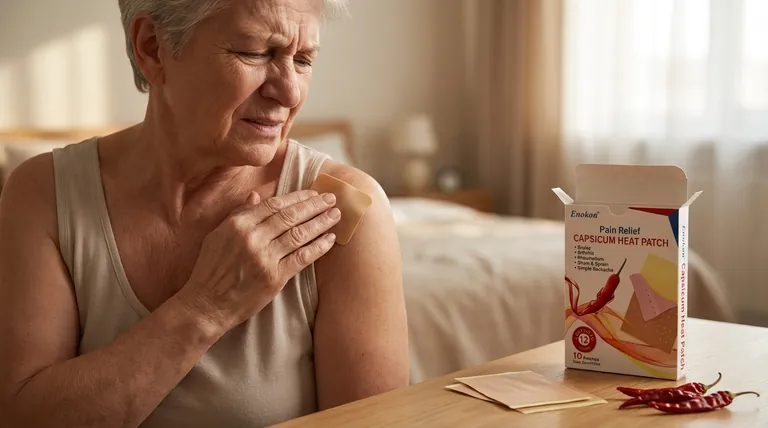
The Promise of a Fiery Cure
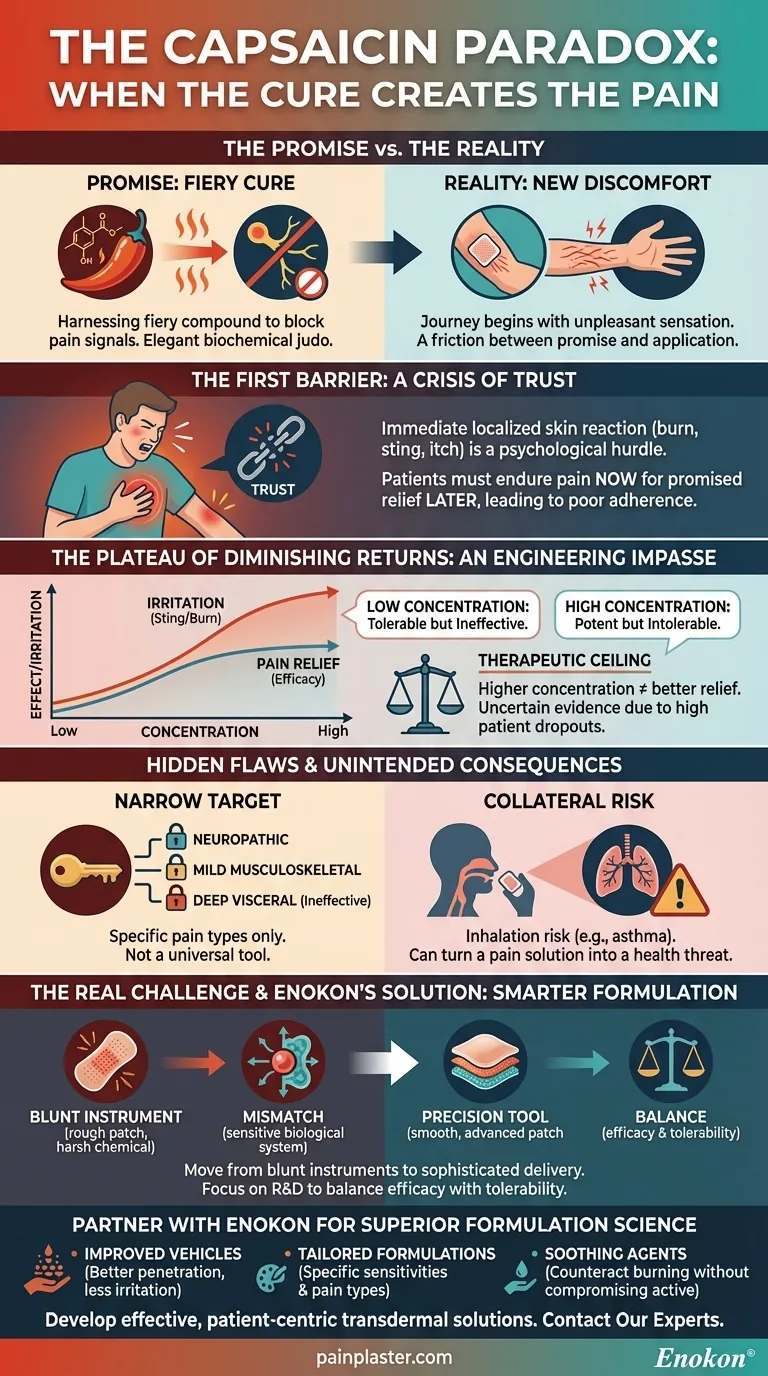
There's an engineering elegance to the idea of a capsaicin patch. Harnessing the fiery compound from chili peppers—the very thing that causes a sensation of heat—to ultimately block pain signals is a clever piece of biochemical judo.
The user experience seems just as simple: apply a patch, wait for relief.
But for many, the reality is far more complicated. The journey often begins not with relief, but with a new kind of discomfort. This friction between a therapy's promise and its real-world application reveals a deeper challenge in transdermal drug delivery.
The First Barrier: A Crisis of Trust
The most immediate and common limitation of a capsaicin patch is the localized skin reaction. It burns, stings, and itches.
From a clinical perspective, this is an expected side effect. But from a human perspective, it's a psychological hurdle. We instinctively recoil from things that cause us pain. A treatment that initiates a new, unpleasant sensation creates a crisis of trust. The patient is asked to endure pain now for the promise of less pain later.
This is a fragile bargain. For those with sensitive skin or chronic conditions requiring consistent use, the upfront cost of discomfort is often too high. The result isn't just a failed treatment; it's a loss of faith in the solution, leading to poor adherence before the patch has a chance to work.
The Plateau of Diminishing Returns
Even for patients who push through the initial discomfort, the results can be underwhelming. The evidence for capsaicin's efficacy is often moderate, and sometimes, poor.
More revealing is the concept of a therapeutic ceiling. The logical assumption is that a higher concentration of capsaicin would yield better pain relief. Yet studies show this isn't consistently true. A 1.25% formulation may not perform significantly better than a lower dose, but it will almost certainly increase the intensity of skin irritation.
This creates an engineering impasse:
- Low concentrations may be tolerable but ineffective.
- High concentrations may be more potent but intolerable.
Compounding this is the fragility of the clinical evidence. Many studies are hampered by small sample sizes and high patient dropout rates—often due to the very side effects we've discussed. This leaves clinicians and manufacturers navigating a landscape of uncertainty.
Hidden Flaws and Unintended Consequences
Beyond the primary challenges of pain and efficacy lie a set of secondary, but significant, design flaws.
A Narrowly Defined Target
Capsaicin patches are not a universal tool. They are designed for specific types of pain, primarily neuropathic pain or mild musculoskeletal aches. They are largely ineffective for the deep, visceral pain that plagues many patients. It is a key that only fits a few locks.
A System with Collateral Risk
The risk of respiratory irritation from inhaling capsaicin particles during application or removal is a serious usability issue. For a patient with asthma, this "minor" risk can be a significant health threat, turning a pain solution into a respiratory one.
The Real Challenge: From a Blunt Instrument to a Precision Tool
The limitations of the capsaicin patch are not failures of the molecule itself. They are failures of the delivery system. The standard patch is a blunt instrument, delivering a potent compound without enough nuance to account for the complexities of human biology and psychology.
The core problem is a mismatch: a harsh chemical meeting a sensitive biological system.
Solving this doesn't require abandoning the concept, but rather elevating the engineering. The path forward lies in creating smarter formulations and more sophisticated delivery mechanisms. It requires a deep R&D focus on balancing efficacy with tolerability.
This could mean:
- Developing vehicles that improve skin penetration without causing severe irritation.
- Creating formulations tailored to specific skin sensitivities and pain types.
- Integrating soothing agents that counteract the burning sensation without compromising the active ingredient.
At Enokon, we believe that effective pain management is born from superior formulation science. Moving beyond the limitations of standard products requires a partner with the technical expertise to customize and innovate. If you're looking to develop transdermal solutions that are both effective and patient-centric, we can help. Contact Our Experts
Visual Guide
Related Products
- Capsaicin Chili Medicated Pain Relief Patches
- Heat Relief Capsicum Patch for Lower Back Pain Relief
- Menthol Gel Pain Relief Patch
- Icy Hot Menthol Medicine Pain Relief Patch
- Asthma Cough and Pain Relief Patch for Adults and Kids
Related Articles
- The Capsaicin Paradox: How a Pain-Inducer Becomes a Pain-Reliever
- Beyond Efficacy: The Psychology of Adherence in Topical Pain Relief
- More Than a Sticker: The Hidden Engineering of a Safe Pain Patch
- The Architecture of Relief: Deconstructing the Modern Pain Patch
- The Unseen Engineering Behind a Simple Medicated Patch



















