
The Unspoken Contract of a Pain Patch
A person in pain reaches for a medicated plaster. They peel back the film, apply it to an aching joint, and wait. In that simple act, a contract is formed. It's a psychological agreement between the user and the product: "I trust you to provide relief without causing harm."
The duration printed on the box—"apply for 8 to 12 hours"—is the central clause in this contract. But this simple instruction masks a complex balancing act. Too short, and the dose is insufficient. Too long, and the risk of skin irritation turns a source of relief into a source of new discomfort. When this contract is broken, trust erodes.
The Dose is in the Duration
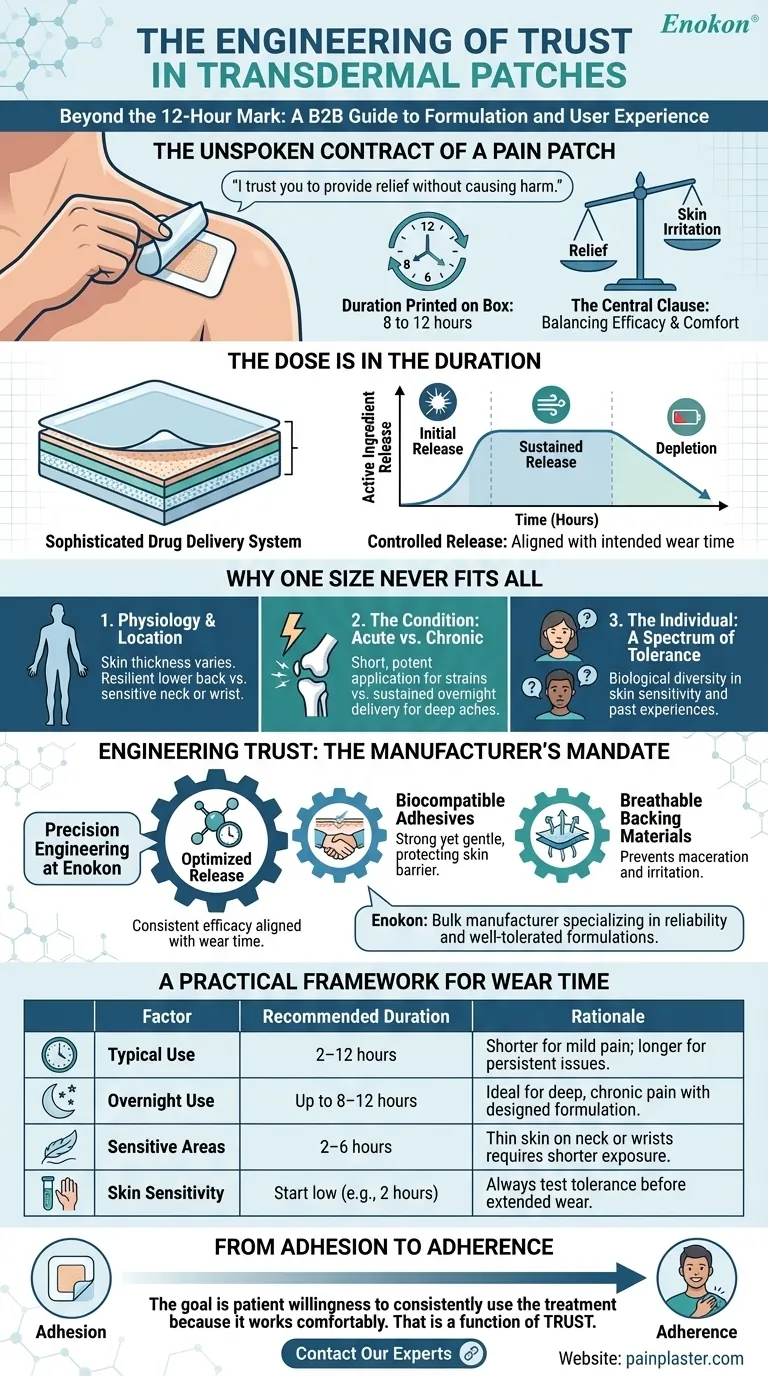
A transdermal patch is a sophisticated drug delivery system. It’s not just a medicated sticker; it’s a reservoir designed for controlled release. The recommended wear time, typically between 2 and 12 hours, is determined by its chronopharmacology—how the active ingredients are released and absorbed over time.
- Initial Release: Delivers an immediate dose to begin addressing symptoms.
- Sustained Release: Maintains a steady therapeutic level in the local tissue.
- Depletion: The point at which the patch has delivered most of its active ingredients and its efficacy wanes.
Deviating from the intended duration means interfering with this carefully calibrated process, leading to either subpar results or unintended side effects.
Why One Size Never Fits All
The effectiveness of this "contract" depends on a host of hidden variables. The manufacturer's instructions are the starting point, but the optimal duration is intensely personal, influenced by a trio of factors.
1. The Canvas: Physiology and Location
The human body is not a uniform surface. Skin on the lower back is thick and resilient, while skin on the neck or inner wrist is thin and sensitive. A patch that can be worn for 12 hours on a large muscle group might become irritating after just four hours on a delicate area.
2. The Condition: Acute vs. Chronic Pain
The nature of the pain dictates the required therapy. A sudden muscle strain might benefit from a shorter, potent application. A deep, chronic ache in a joint, however, often requires a longer, slower, and more sustained delivery, making overnight use a valuable option.
3. The Individual: A Spectrum of Tolerance
No two people are the same. One person's skin might tolerate an adhesive and herbal formulation for a full day, while another might develop redness after a few hours. This isn't a product failure; it's a testament to human biological diversity. Past experiences also shape our psychological tolerance, making a gentle, non-irritating product paramount.
Engineering Trust: The Manufacturer's Mandate
For healthcare distributors and brands, these variables represent a significant challenge. Customer complaints about irritation or inefficacy aren't just feedback; they are evidence of a broken contract. The responsibility for upholding this trust falls squarely on the manufacturer.
This requires moving beyond simply mixing ingredients. It requires precision engineering.
- Optimized Release Matrix: The formulation must be designed to release active ingredients at a rate that aligns with the intended wear time, ensuring consistent efficacy.
- Biocompatible Adhesives: The "glue" is as critical as the medicine. It must be strong enough to adhere through movement and perspiration but gentle enough to be removed without damaging the skin barrier.
- Breathable Backing Materials: A non-occlusive backing allows the skin to breathe, dramatically reducing the risk of maceration and irritation during prolonged wear.
At Enokon, we specialize in this engineering. As a bulk manufacturer for leading healthcare brands, we understand that a patch's success is defined by its reliability. Our custom R&D process focuses on tuning these variables to create products that are not only effective but also exceptionally well-tolerated, building the user trust your brand depends on.
A Practical Framework for Wear Time
Navigating these factors is key to maximizing therapeutic benefits. The right product design makes this simple for the end-user.
| Factor | Recommended Duration | Rationale |
|---|---|---|
| Typical Use | 2–12 hours | Shorter for mild pain; longer for persistent issues. |
| Overnight Use | Up to 8–12 hours | Ideal for deep, chronic pain if the formulation is designed for it. |
| Sensitive Areas | 2–6 hours | Thin skin on areas like the neck or wrists requires shorter exposure. |
| Skin Sensitivity | Start low (e.g., 2 hours) | Always test tolerance before committing to extended wear. |
From Adhesion to Adherence
Ultimately, the goal of a transdermal patch is not just adhesion—sticking to the skin. It is patient adherence—the willingness to consistently use the treatment because it works, reliably and comfortably. That is a function of trust.
Building a product that earns this trust requires deep technical expertise in formulation, materials science, and human factors. If you're looking to develop a transdermal solution that delivers on both its therapeutic promise and its unspoken contract with the user, we can help. Contact Our Experts
Visual Guide
Related Products
- Far Infrared Heat Pain Relief Patches Transdermal Patches
- Silicone Scar Sheets Patch Transdermal Drug Patch
- Icy Hot Menthol Medicine Pain Relief Patch
- Menthol Gel Pain Relief Patch
- Mugwort Wormwood Pain Relief Patch for Neck Pain
Related Articles
- Engineering Certainty: The Invisible Architecture of a Gold-Standard Clinical Trial
- The Silent Workhorse: How Transdermal Patches Rewrote the Rules of Pain Management
- Beyond the Pill: The Silent Engineering of Safer Pain Relief
- Beyond Efficacy: The Psychology of Adherence in Topical Pain Relief
- Beyond the Molecule: The Behavioral Science of the Simple Pain Patch



















