
The Anatomy of a Simple Question
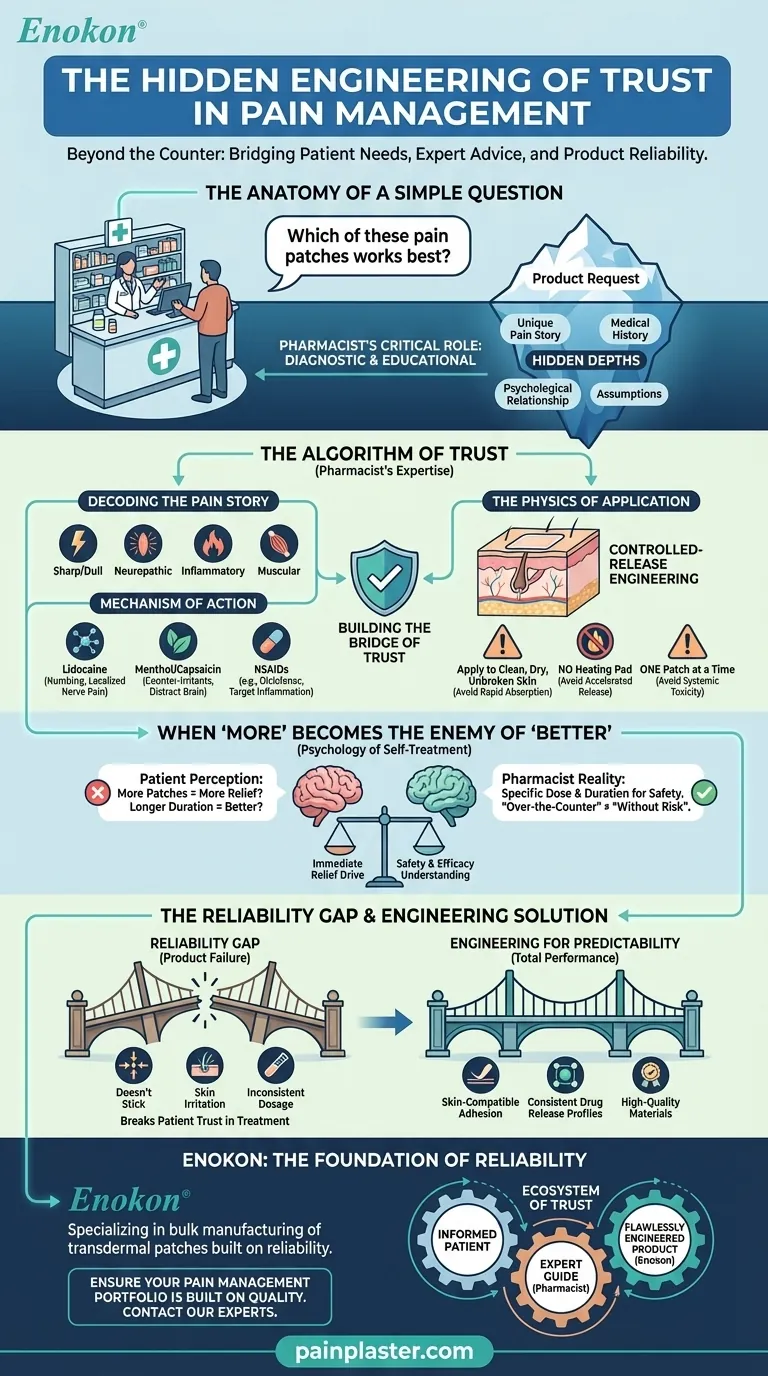
It begins with a question, one of the most common in any pharmacy: "Which of these pain patches works best?"
This isn't just a request for a product recommendation. It's the tip of a complex iceberg. Beneath the surface lies a patient's unique pain story, their medical history, their psychological relationship with discomfort, and their assumptions about how medicine works.
For the pharmacist, this moment is a critical junction. They are the last line of defense and the first point of expert contact in the world of over-the-counter (OTC) self-care. Their role is not merely transactional; it is deeply diagnostic and educational.
The Algorithm of Trust
A pharmacist doesn't just see a box on a shelf; they see a drug delivery system with specific parameters. When a patient asks for help, the pharmacist runs a rapid, internal algorithm built on years of expertise.
Decoding the Pain Story
Is the pain sharp or dull? Is it neuropathic, inflammatory, or muscular? The answer determines the ideal active ingredient.
- Lidocaine patches work by numbing the area, ideal for localized nerve pain.
- Menthol or Capsaicin act as counter-irritants, creating a warming or cooling sensation that distracts the brain from the underlying pain signal.
- NSAIDs (like Diclofenac) target inflammation directly at the source.
Recommending the right mechanism of action is the first step in building a bridge of trust between the patient and their treatment.
The Physics of Application
A transdermal patch is a marvel of controlled-release engineering. The pharmacist’s instructions—"apply to clean, dry, unbroken skin," "don't use a heating pad over it," "only wear one at a time"—aren't just cautious suggestions.
They are the operating manual for a sophisticated system.
Applying a patch to broken skin can cause rapid, uncontrolled absorption. Adding heat can dangerously accelerate the drug release rate. Using multiple patches can lead to systemic toxicity. The pharmacist is translating chemical engineering principles into simple, life-saving rules.
When "More" Becomes the Enemy of "Better"
Pain creates a powerful psychological drive for immediate relief. This can lead to a cognitive bias where "more" is instinctively perceived as "better."
The Psychology of Self-Treatment
A patient might think, "If one patch provides eight hours of relief, maybe two patches will provide more relief, or wearing it for 24 hours will be even better."
This logic is understandable but flawed. The pharmacist’s role is to gently recalibrate this thinking, explaining that these products are designed with a specific dose and duration for a reason. They must emphasize that "over-the-counter" does not mean "without risk." Overuse can overwhelm the body's ability to process the medication, turning a local solution into a systemic problem.
The Bridge Between Product and Protocol
A pharmacist can provide the most brilliant, empathetic guidance in the world, but it all falls apart if the product itself is unreliable.
The Pharmacist's Dilemma: The Reliability Gap
What happens when the patch doesn't stick for the full duration? What if the adhesive irritates the skin? What if the dosage delivered is inconsistent from one patch to the next?
In these moments, patient trust is broken—not in the pharmacist, but in the treatment itself. The entire therapeutic alliance is weakened by a failure in manufacturing quality. This is the reliability gap that healthcare distributors and pharmaceutical brands must solve.
Engineering for Predictability
The best therapeutic outcomes happen when expert advice is paired with a flawlessly engineered product. For distributors and brands, sourcing topical analgesics isn't just about the active ingredient; it's about the total performance of the delivery system.
This is where a manufacturer's technical expertise becomes paramount. Companies like Enokon specialize in the bulk manufacturing of transdermal patches and pain plasters built on a foundation of reliability. By focusing on critical factors like skin-compatible adhesion, consistent drug release profiles, and high-quality materials, they create products that pharmacists can recommend with unwavering confidence.
When a brand provides a patch that performs exactly as promised, it reinforces the pharmacist’s advice and solidifies the patient's trust in the path to relief. Effective pain management is an ecosystem, requiring an informed patient, an expert guide, and a product engineered for trust.
To ensure your pain management portfolio is built on a foundation of quality and reliability, Contact Our Experts.
Visual Guide
Related Products
- Far Infrared Heat Pain Relief Patches Transdermal Patches
- Icy Hot Menthol Medicine Pain Relief Patch
- Silicone Scar Sheets Patch Transdermal Drug Patch
- Menthol Gel Pain Relief Patch
- Mugwort Wormwood Pain Relief Patch for Neck Pain
Related Articles
- Engineering Certainty: The Invisible Architecture of a Gold-Standard Clinical Trial
- The Silent Workhorse: How Transdermal Patches Rewrote the Rules of Pain Management
- Beyond the Pill: The Silent Engineering of Safer Pain Relief
- Beyond Efficacy: The Psychology of Adherence in Topical Pain Relief
- Beyond the Molecule: The Behavioral Science of the Simple Pain Patch



















