
The Human Cost of Hormonal Swings
For a patient undergoing testosterone replacement therapy, the goal is not merely to correct a number on a lab report. It is to restore a sense of normalcy—a stable baseline of energy, mood, and well-being.
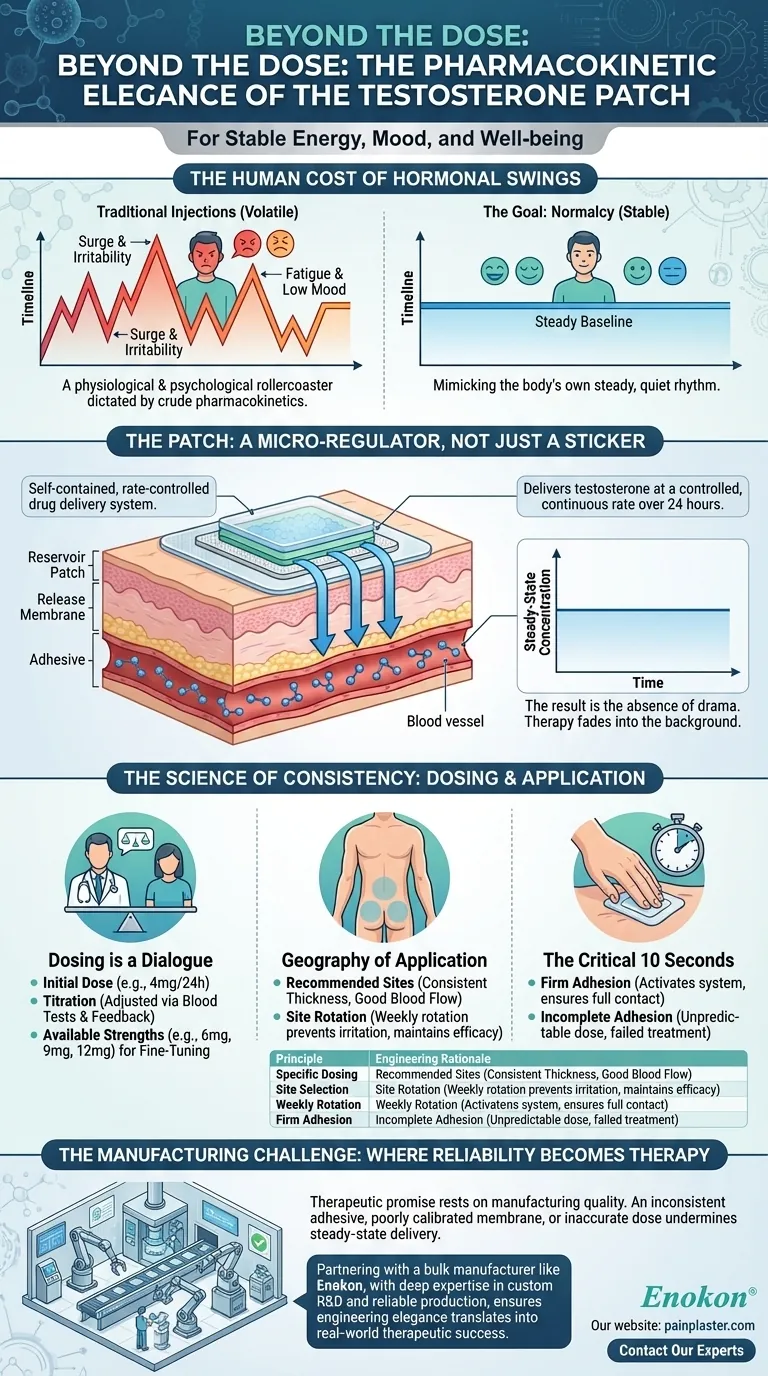
Traditional delivery methods, like injections, often create a volatile cycle of peaks and troughs. The patient might feel a surge of energy and irritability shortly after a dose, followed by a decline into fatigue and low mood as the next one nears. This is not normalcy. It's a physiological and psychological rollercoaster dictated by the delivery method's crude pharmacokinetics.
The fundamental challenge isn't just administering a hormone. It's mimicking the body's own steady, quiet rhythm.
The Patch: A Micro-Regulator, Not Just a Sticker
Enter the transdermal patch. It appears deceptively simple, but it represents an elegant feat of biomedical engineering—a self-contained, rate-controlled drug delivery system.
Unlike the flood of an injection, a patch delivers testosterone through the skin at a controlled, continuous rate over 24 hours. This design philosophy is about eliminating volatility. The patch works silently in the background, maintaining a steady-state concentration in the bloodstream that more closely resembles the body's natural production.
The result is the absence of drama. The therapy fades into the background of a patient's life, which is precisely the point.
The Science of Consistency: Dosing & Application
Achieving this therapeutic elegance depends on meticulous design and precise user application. Every guideline is rooted in the science of skin permeation and consistent absorption.
Why Dosing is a Dialogue, Not a Monologue
The typical starting dose, such as 4 mg per 24 hours, is just the beginning of a conversation between the patient's body and the physician.
- Initial Dose: A conservative starting point to assess individual response.
- Titration: The dosage is adjusted based on follow-up blood tests and patient feedback. Factors like metabolism, body mass, and even skin characteristics can influence absorption rates.
- Available Strengths: Formulations of varying strengths (e.g., 6 mg, 9 mg, 12 mg) allow for this fine-tuning, ensuring the therapy is tailored to the individual, not the other way around.
The Geography of Application
The instructions for where to place a patch are not arbitrary. They are based on skin physiology.
- Recommended Sites: The lower abdomen and upper buttocks are chosen for their optimal characteristics: a consistent stratum corneum thickness, good blood flow, and less likelihood of being rubbed off by clothing.
- Site Rotation: Applying a patch to the same spot repeatedly can lead to skin irritation and can temporarily "saturate" the local tissue, potentially reducing absorption efficiency. Weekly rotation allows the skin to fully recover, ensuring consistent delivery week after week.
The Critical 10 Seconds of Adhesion
Pressing the patch firmly for 10 seconds is the final, crucial step in activating the system. This action ensures full contact between the patch's adhesive drug matrix and the skin's surface.
Incomplete adhesion means a smaller surface area for drug transfer, leading to an unpredictable and insufficient dose. That 10-second press is the difference between reliable therapy and a failed treatment.
| Application Principle | The Engineering Rationale |
|---|---|
| Specific Dosing | Calibrated to achieve steady-state blood levels, adjustable to patient physiology. |
| Site Selection | Targets areas with optimal skin permeability for consistent drug flux. |
| Weekly Rotation | Prevents local skin exhaustion and irritation, maintaining long-term efficacy. |
| Firm Adhesion | Ensures the precise surface area required for the calculated dose is maintained. |
The Manufacturing Challenge: Where Reliability Becomes Therapy
The therapeutic promise of a transdermal patch rests entirely on its manufacturing quality. An inconsistent adhesive, a poorly calibrated release membrane, or an inaccurate dose in the reservoir undermines the entire principle of steady-state delivery.
This is where technical expertise in formulation and manufacturing becomes paramount. Creating a patch that adheres reliably for 24 hours through showers and daily activity, while consistently releasing a precise dose, is a complex materials science and engineering challenge.
For pharmaceutical distributors and healthcare brands, the reliability of their product is the foundation of patient trust. Partnering with a bulk manufacturer like Enokon, which has deep expertise in custom R&D and reliable production of transdermal systems, ensures that the engineering elegance of the patch translates into real-world therapeutic success.
The ultimate goal is to provide a therapy so reliable it becomes an unseen part of a patient's restored life. Contact Our Experts
Visual Guide
Related Products
- Prostate Pain Kidney Health Care Patch for Men
- Lidocaine Hydrogel Pain Relief Patch for Pain Relief
- Menthol Gel Pain Relief Patch
- Cooling Fever Patches Color Change Cold Fever Patch
- Heating Pain Relief Patches for Menstrual Cramps
Related Articles
- More Than a Sticker: The Hidden Engineering of a Safe Pain Patch
- The Architecture of Relief: Deconstructing the Modern Pain Patch
- The Unseen Calculus of a Simple Pain Patch
- The Silent Geography of Healing: Decoding the Global Demand for Transdermal Herbal Patches
- The Unseen Engineering Behind a Simple Medicated Patch













