
The Overburdened Pump
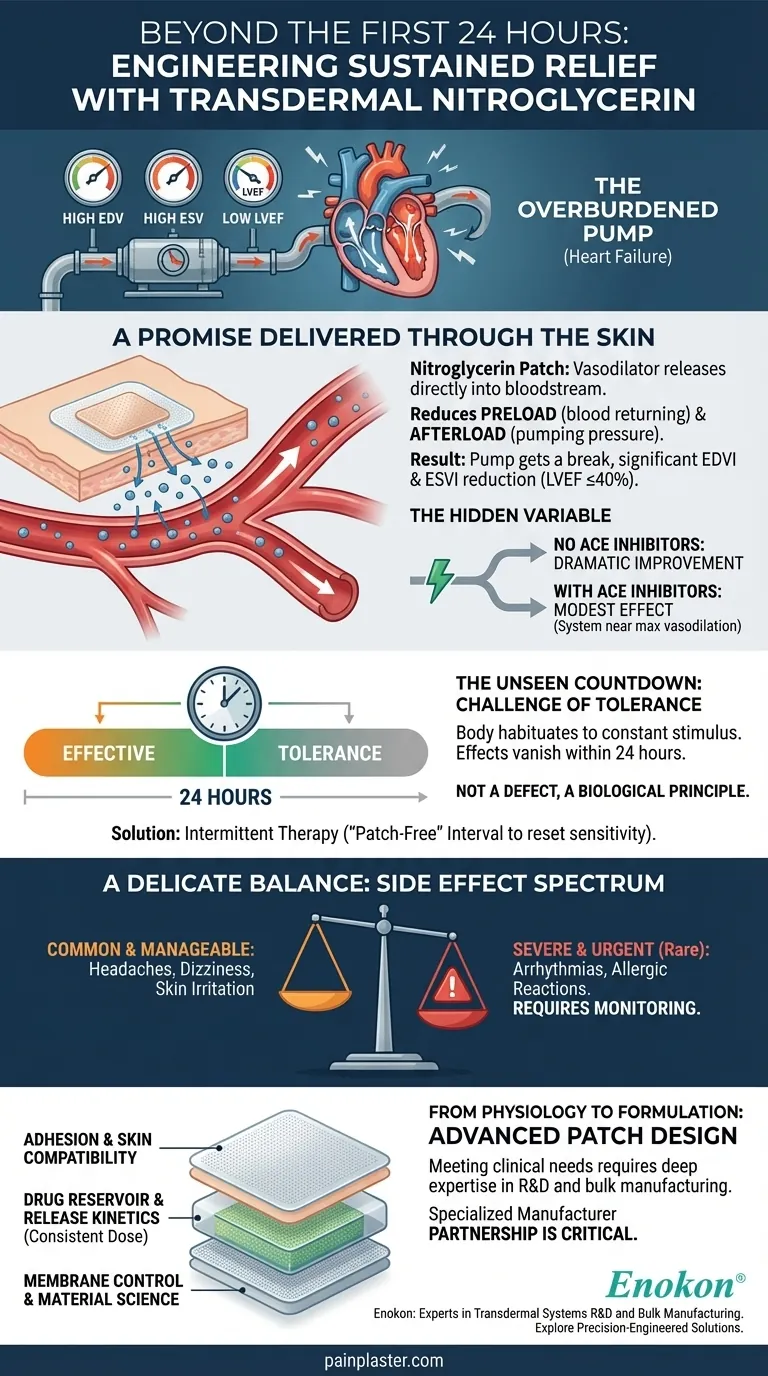
Imagine a water pump struggling to move more fluid than it was designed for. Its chamber stretches, its motor strains, and its efficiency plummets. This is the heart in a state of failure, specifically when its left ventricular ejection fraction (LVEF) is low.
The metrics we use—end-diastolic volume (EDV) and end-systolic volume (ESV)—are not just clinical jargon. They are the engineering specifications of this living pump. They measure the volume of blood in the ventricle at its most relaxed and most contracted states. When these numbers are too high, the heart is over-stretched and failing.
The goal of therapy is simple: to reduce the pump's workload.
A Promise Delivered Through the Skin
The transdermal nitroglycerin patch is an elegant solution. By releasing a vasodilator directly into the bloodstream, it widens blood vessels, reducing both the pressure the heart pumps against (afterload) and the volume of blood returning to it (preload).
The immediate effect is often remarkable. Studies show significant reductions in both end-diastolic and end-systolic volume indexes (EDVI and ESVI) in patients with an LVEF of ≤40%. The pump gets a break. It can contract more efficiently against less resistance.
The Hidden Variable: The Existing System
A fascinating detail emerges when we look closer. The most dramatic improvements are seen in patients not taking ACE inhibitors.
This isn't a failure of the patch. It’s a lesson in systems thinking. ACE inhibitors are also powerful vasodilators. In patients already taking them, the system's capacity for vasodilation may already be near its maximum. The patch still helps, but the effect is more modest. It's a reminder that no component works in isolation; the entire therapeutic regimen matters.
The Unseen Countdown: The Challenge of Tolerance
Here lies the paradox. The body is an incredibly adaptive system. When presented with a constant stimulus—like the steady release of nitroglycerin—it adjusts. It becomes less sensitive.
This phenomenon, known as tolerance, is the patch's greatest challenge. Within 24 hours of continuous wear, its profound effects can vanish completely. The heart's temporary relief disappears as the body habituates to the medicine.
This isn't a defect; it's a predictable biological principle, a physiological version of diminishing returns. The solution is not more drug, but smarter timing. Intermittent therapy—creating a "patch-free" interval each day—allows the body's sensitivity to reset. This simple act of removal is as critical as the application itself.
A Delicate Balance: The Side Effect Spectrum
Engineering any solution involves managing trade-offs. The nitroglycerin patch is no different. Its benefits must be weighed against its potential side effects.
- Common & Manageable: Headaches and dizziness are frequent as the body adjusts to changes in blood pressure. Skin irritation can occur at the application site.
- Severe & Urgent: In rare cases, more serious issues like arrhythmias or allergic reactions can occur, requiring immediate medical attention.
Careful patient monitoring is the feedback loop that ensures the system remains stable and the benefits outweigh the costs.
From Physiology to Formulation: The Role of Advanced Patch Design
The clinical need for intermittent dosing creates a new set of engineering challenges for the patch itself. It's no longer just about delivering a drug; it's about delivering it precisely within a specific therapeutic window, day after day.
This is where the science of formulation becomes paramount.
- Release Kinetics: The patch must be designed to release a consistent, predictable dose for a specific duration, before being removed.
- Adhesion & Skin Compatibility: It must adhere reliably for its intended wear-time without causing significant skin irritation, which could compromise compliance.
- Material Science: The drug reservoir, the membrane controlling the release rate, and the adhesive are all components that must work in concert to achieve the desired clinical outcome.
Meeting these demands at scale requires deep expertise in transdermal technology. For pharmaceutical brands and healthcare distributors, partnering with a specialized manufacturer is critical. At Enokon, we focus exclusively on the R&D and bulk manufacturing of transdermal systems, ensuring that each patch is engineered to overcome the inherent challenges of tolerance and deliver reliable, sustained relief.
The effectiveness of a simple patch is ultimately determined by the sophisticated science behind its design and production. To explore how precision-engineered transdermal solutions can enhance your cardiac therapy portfolio, Contact Our Experts.
Visual Guide
Related Products
- Icy Hot Menthol Medicine Pain Relief Patch
- Menthol Gel Pain Relief Patch
- Far Infrared Heat Pain Relief Patches Transdermal Patches
- Silicone Scar Sheets Patch Transdermal Drug Patch
- Mugwort Wormwood Pain Relief Patch for Neck Pain
Related Articles
- Beyond Efficacy: The Psychology of Adherence in Topical Pain Relief
- The 60-Minute Architecture: Engineering Predictability in Topical Pain Relief
- Beyond the Molecule: The Behavioral Science of the Simple Pain Patch
- The Human Interface of Pain Relief: Why Delivery Systems Define Success
- More Than a Sticker: The Hidden Engineering of a Safe Pain Patch



















