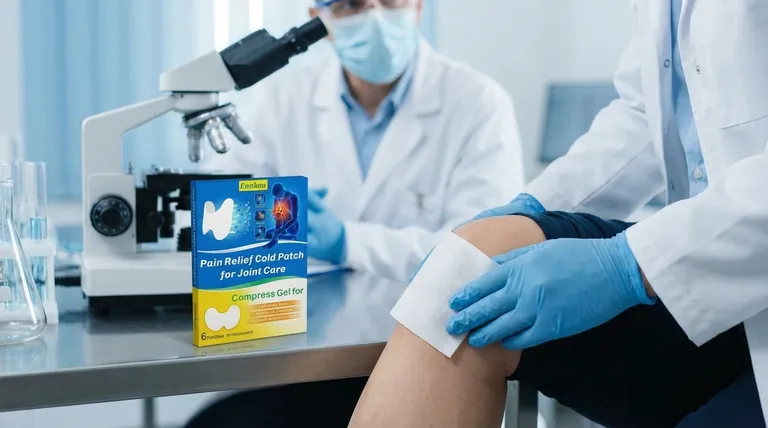
The Patient, The Pill, and The Paradox
A patient recovers from knee surgery. The pain is sharp, a constant barrier to rehabilitation. The standard protocol calls for an oral NSAID like diclofenac—effective, but a blunt instrument.
The patient has a history of gastritis. This creates a clinical paradox: the very tool used to manage pain could cause significant harm, inflaming the stomach lining and leading to complications.
This scenario isn't an exception; it's a daily challenge in pain management. The desire for potent, localized relief without systemic side effects is one of the most persistent problems in medicine. We have the tools, but they often come with a trade-off we are psychologically and physiologically reluctant to make.
From Promising Alternative to Proven Standard
The transdermal diclofenac patch enters as an elegant solution. By delivering the drug directly through the skin to the site of pain, it largely bypasses the gastrointestinal tract, promising the efficacy of an NSAID without its most common downside.
But a promise is not proof. For any new modality to shift clinical habit, it must walk the path from "promising alternative" to "proven standard." This journey is built on a foundation of rigorous, systematic research.
The Mandate for Robust Evidence
Current studies are encouraging, but often small. The medical community operates on the psychology of large numbers; trust is built on data from extensive, long-term clinical trials.
To become a first-line treatment, especially for post-traumatic pain, transdermal diclofenac needs validation across larger, more diverse patient cohorts. This expands the evidence base, turning confident assumptions into statistical certainties.
Engineering the Optimal Dose
Pain is not monolithic. The inflammation from a pulled muscle differs from the acute pain of a bone fracture. Consequently, a one-size-fits-all dosage may not be optimal.
Future research must focus on dose-response studies. What is the minimal effective concentration for chronic osteoarthritis versus acute post-operative pain? This is a precision engineering challenge: calibrating the delivery system to meet the specific demands of the condition, maximizing relief while minimizing any potential for side effects.
The Head-to-Head Challenge: Patch vs. Pill
The ultimate test is a direct comparison. Existing data shows the patch can match oral tablets in pain relief for certain conditions, like post-dental surgery pain.
But future trials must go deeper, comparing:
- Adherence: The simplicity of a once-daily patch holds a powerful psychological advantage over remembering to take pills multiple times a day. How does this impact real-world outcomes?
- Patient Satisfaction: Beyond efficacy, which method do patients prefer?
- Cost-Effectiveness: What is the total cost of care, factoring in the treatment of potential side effects from oral medication?
Expanding the Clinical Frontier
The true potential of a technology is realized when its application expands beyond its initial niche.
Protecting the Vulnerable Patient
For patients with gastric sensitivities, GERD, or those on polypharmacy, the transdermal patch isn't just a convenience—it's a vital tool for harm reduction. Research dedicated to these special populations is critical to establish safety and define its role as a protective therapeutic strategy.
New Arenas for Localized Pain Management
While much initial research focused on dental pain, the greatest need lies elsewhere. The future of the transdermal patch is in orthopedics, musculoskeletal injuries, and post-operative recovery, where targeted, non-systemic pain relief can accelerate healing and improve quality of life.
The Unseen Architecture of a Better Solution
This research roadmap isn't just an academic exercise. It's a blueprint for development, requiring a deep synergy between clinical researchers and manufacturing experts who can translate findings into a reliable, scalable product.
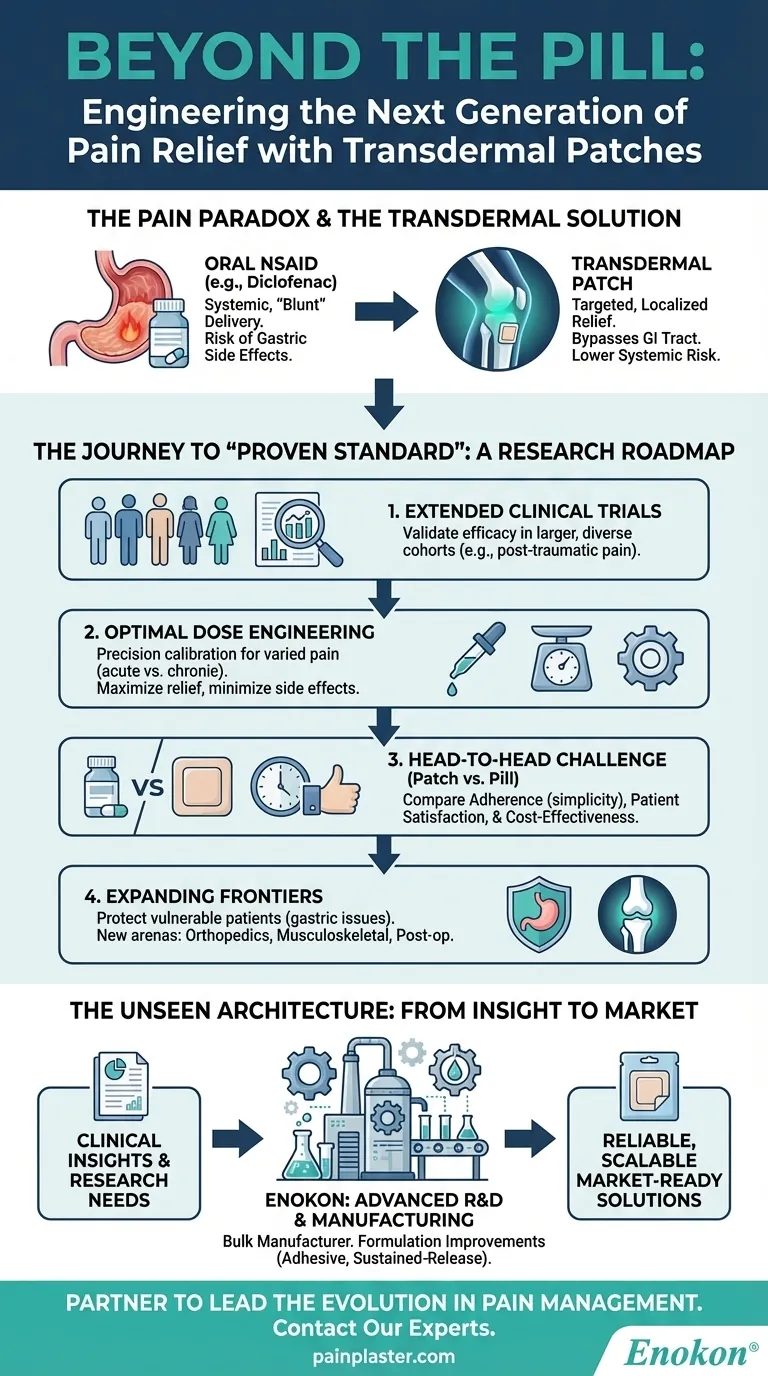
The table below outlines this strategic path forward:
| Research Focus | Key Objectives |
|---|---|
| Extended Clinical Trials | Validate efficacy in larger cohorts, especially for post-traumatic pain. |
| Drug Concentration Optimization | Identify optimal dosing for varied pain conditions to minimize side effects. |
| Comparative Studies | Compare patch vs. oral diclofenac on adherence, cost, and patient outcomes. |
| Special Populations | Assess safety in gastric-sensitive patients and for long-term use. |
| Broader Applications | Explore utility in orthopedic, musculoskeletal, and postoperative pain. |
| Formulation Improvements | Enhance adhesive properties and sustained-release mechanisms. |
| Economic & Accessibility | Evaluate the cost-benefit ratio, especially in low-resource settings. |
Bringing these advancements to life—from refining adhesive properties for better skin feel to engineering more sophisticated sustained-release mechanisms—requires specialized expertise.
As a bulk manufacturer of advanced transdermal patches, Enokon provides the technical R&D and development capabilities necessary to turn clinical insights into market-ready solutions. For pharmaceutical brands and healthcare distributors looking to lead this evolution in pain management, partnering with a technically proficient manufacturer is the first, most critical step.
Let's build the future of pain relief together. Contact Our Experts
Visual Guide
Related Products
- Silicone Scar Sheets Patch Transdermal Drug Patch
- Far Infrared Heat Pain Relief Patches Transdermal Patches
- Menthol Gel Pain Relief Patch
- Icy Hot Menthol Medicine Pain Relief Patch
- Mugwort Wormwood Pain Relief Patch for Neck Pain
Related Articles
- Beyond the Pouch: The Critical Engineering of Transdermal Patch Integrity
- Beyond the Adhesive: The Unseen Engineering of Safe Transdermal Drug Delivery
- The Paradox of the Patch: Deconstructing the Science of Skin-Contact Safety
- The Adhesion Paradox: Engineering Transdermal Patches for Real-World Human Behavior
- Beyond the Counter: The Hidden Engineering of Trust in Pain Management



















