The Patient's Paradox
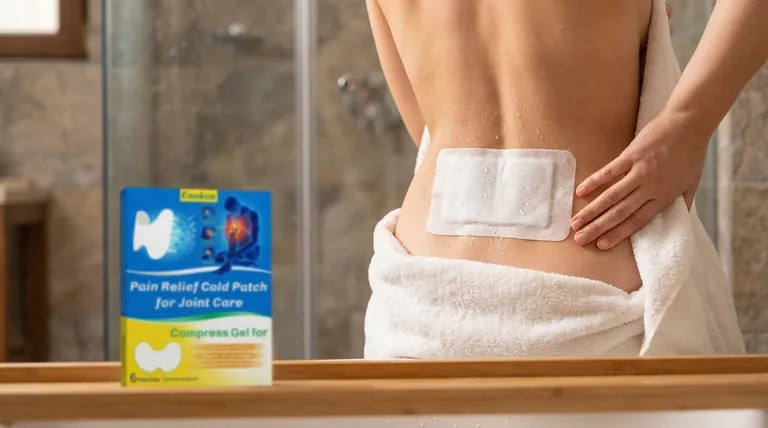
A person applies a pain-relief plaster to their lower back. The relief is welcome, but life doesn't stop. There are dishes to wash, a workout to complete, a much-needed shower at the end of the day.
This creates a paradox. We need a medical adhesive to stick tenaciously for hours or days, yet we also need to live in a world filled with the universal solvent: water. The question isn't just "Can it get wet?" The real question is, "What happens on a microscopic level when it does?"
Understanding this is to understand a fascinating feat of material science.
The First Hour: Forging a Microscopic Bond
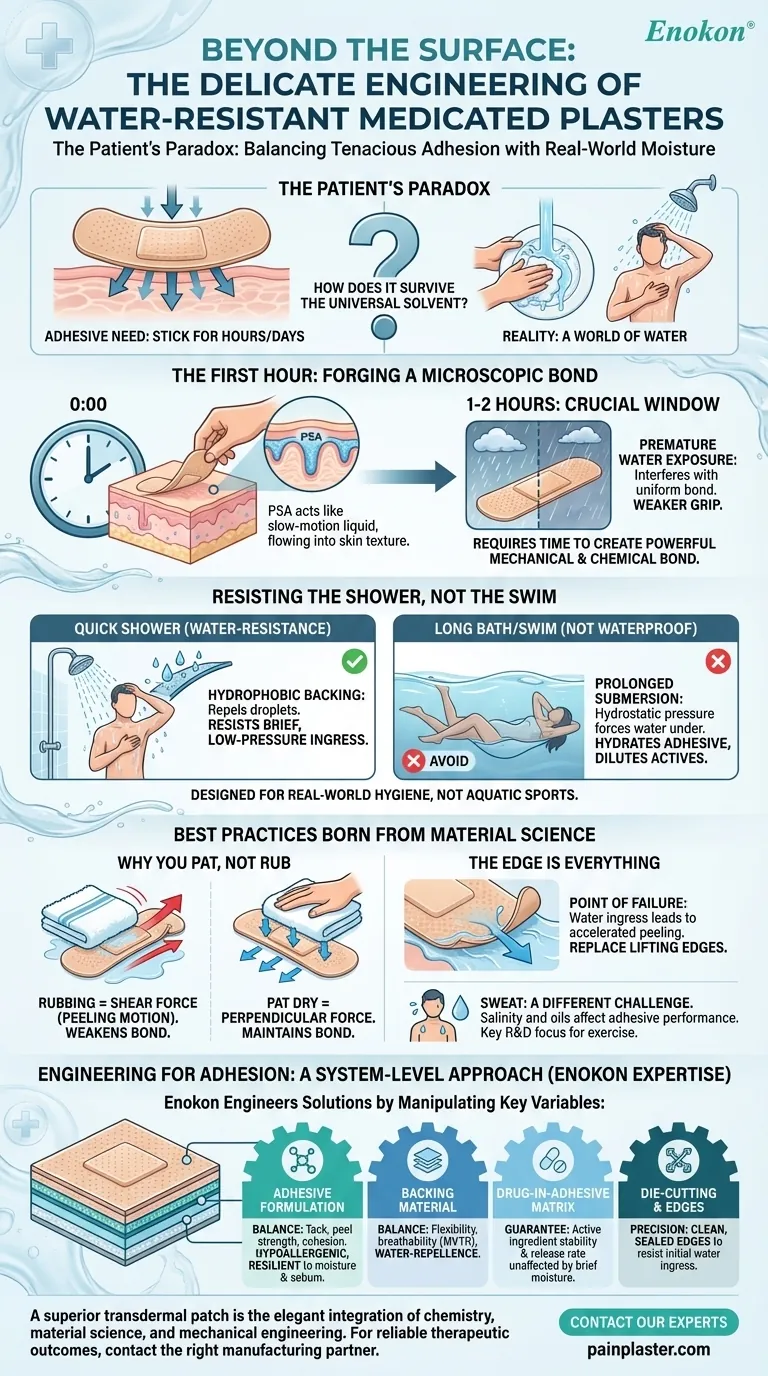
We often think of adhesives as instant. But the pressure-sensitive adhesives (PSAs) used in quality medicated plasters behave more like a liquid in super slow motion.
When you apply a patch, the adhesive begins to "wet out." It flows into the microscopic peaks and valleys of the stratum corneum, the outermost layer of your skin. This process creates a powerful mechanical and chemical bond, but it requires one crucial ingredient: time.
Exposing the plaster to water within the first 1-2 hours is like trying to paint in the rain. Water molecules interfere with the adhesive's ability to create a uniform, uninterrupted bond, leading to a weaker grip and potential failure.
Resisting the Shower, Not the Swim
Our modern minds have a binary understanding of "waterproof," conditioned by dive watches and IP-rated smartphones. But in dermal applications, the goal is "water-resistance"—a carefully engineered compromise.
-
A Quick Shower: The patch's backing material is typically hydrophobic, repelling water droplets. The adhesive is formulated to resist brief, low-pressure water ingress at the edges. For a few minutes, the bond holds strong.
-
A Long Bath or Swim: Prolonged submersion changes the physics entirely. Hydrostatic pressure actively forces water beneath the patch's edges. More critically, moisture can begin to hydrate the adhesive itself and, in some designs, dilute the active herbal or medicinal ingredients within the matrix, reducing its therapeutic payload.
The plaster wasn't designed to be a submarine. It was designed for real-world living, which means accommodating hygiene, not aquatic sports.
Best Practices Born from Material Science
The common advice for plaster care isn't arbitrary; it's a direct reflection of the underlying engineering.
Why You Pat, Not Rub
When a patch gets wet, rubbing it with a towel applies shear force across the surface. Adhesives are weakest against this peeling, sideways motion. Gently patting it dry applies perpendicular force, pressing the adhesive back into the skin and maintaining the bond.
The Edge is Everything
The perimeter of the patch is the primary point of failure. Once water gets under an edge, it creates a larger channel for more water to enter, and the peeling process can accelerate. This is why a patch with lifting edges should be replaced.
Sweat: A Different Challenge
Sweat is not just water. Its salinity and oils can present an entirely different chemical challenge to the adhesive, which is why performance during intense exercise is a key R&D focus.
Engineering for Adhesion: A System-Level Approach
Creating a plaster that survives daily life is not about finding the "stickiest glue." It's about system-level design, where every component is optimized to work in concert. This is where manufacturing expertise becomes the critical factor between a successful product and a frustrating user experience.
At Enokon, we engineer solutions by manipulating the key variables that determine performance:
| Engineering Pillar | Key Considerations |
|---|---|
| Adhesive Formulation | Balancing tack, peel strength, and cohesion. Ensuring it's hypoallergenic yet resilient to moisture and sebum. |
| Backing Material | Selecting for the right balance of flexibility, breathability (Moisture Vapor Transmission Rate), and water-repellence. |
| Drug-in-Adhesive Matrix | Guaranteeing the active ingredients remain stable and their release rate is unaffected by brief moisture exposure. |
| Die-Cutting & Edges | Precision manufacturing to ensure clean, perfectly sealed edges that resist initial water ingress. |
A superior transdermal patch is a testament to the elegant integration of chemistry, material science, and mechanical engineering. It must stick, deliver its payload, and then release gently, all while enduring the friction and moisture of daily life.
For brands seeking to deliver reliable therapeutic outcomes built on a foundation of superior material science, the conversation starts with the right manufacturing partner. Contact Our Experts
Visual Guide
Related Products
- Capsaicin Chili Medicated Pain Relief Patches
- Heat Relief Capsicum Patch for Lower Back Pain Relief
- Natural Herbal Wormwood Patch Pain Plaster
Related Articles
- The Capsaicin Paradox: How a Pain-Inducer Becomes a Pain-Reliever
- The Capsaicin Paradox: When the Cure Creates the Pain
- Beyond Efficacy: The Psychology of Adherence in Topical Pain Relief
- More Than a Sticker: The Hidden Engineering of a Safe Pain Patch
- The Architecture of Relief: Deconstructing the Modern Pain Patch


