The Illusion of Simplicity
A transdermal patch is an elegant piece of medical engineering. It promises a simple, non-invasive solution to a complex problem: delivering a steady, controlled dose of medication over days. For chronic pain, this consistency is a godsend. It seems like the perfect system—"set it and forget it."
But this simplicity is deceptive.
The patch itself is a controlled environment, but the human body is not. Every patient's life is a cascade of unpredictable variables—a hot bath, a new prescription, a pre-existing condition. The true challenge of transdermal technology isn't just formulating a drug; it's engineering a delivery system that remains stable amidst the chaos of real life.
Mismatching the Tool to the Task
The most fundamental error is a psychological one: misinterpreting the tool's purpose.
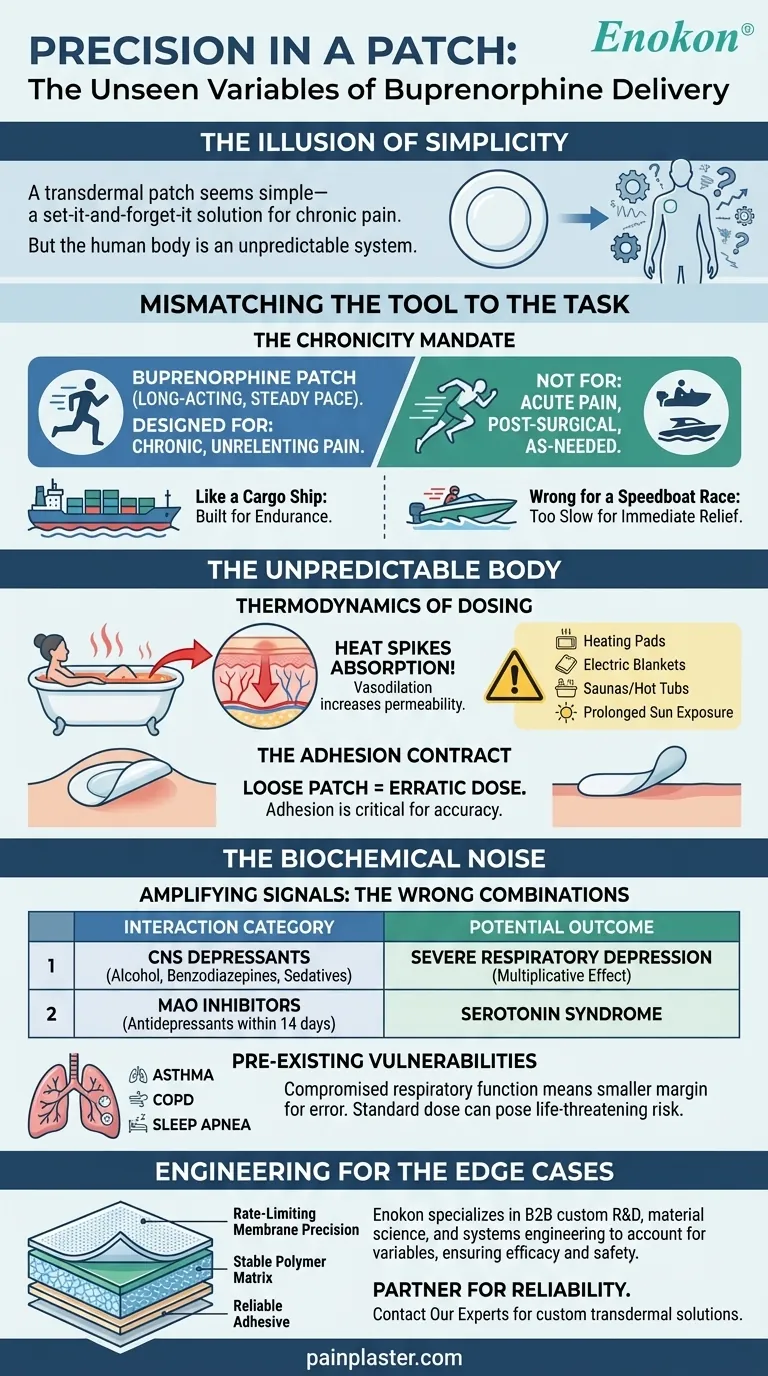
A buprenorphine patch is designed with a specific kinetic profile in mind. It's a marathon runner, built for endurance and a steady pace. Its polymer matrix and rate-limiting membrane are engineered to release the active pharmaceutical ingredient (API) slowly, maintaining a therapeutic concentration in the bloodstream for chronic, unrelenting pain.
The Chronicity Mandate
Using this long-acting system for short-term, acute pain—like post-surgical recovery—is like using a cargo ship in a speedboat race. It's the wrong tool for the job. The onset is too slow for immediate relief, and the prolonged action is unnecessary and introduces risk where none is required.
- Not for: Post-operative pain
- Not for: Mild or intermittent pain
- Not for: "As-needed" relief
The design dictates the use case. The patch's purpose is to manage a persistent state, not to react to a temporary event.
The Body as an Unpredictable System
Imagine a patient with chronic lower back pain. On a cold evening, they decide to take a long, hot bath to soothe their aching muscles. It’s a completely normal, intuitive thing to do.
But on their back is a buprenorphine patch.
The heat from the water dramatically increases blood flow to the skin (vasodilation) and enhances the skin's permeability. Suddenly, the carefully calibrated, slow-release system is put into overdrive. The rate of drug absorption spikes, turning a therapeutic dose into a potentially dangerous overdose.
The Thermodynamics of Dosing
This isn't a flaw in the patch; it's a principle of physics. Any external heat source can disrupt the system:
- Heating pads
- Electric blankets
- Saunas or hot tubs
- Prolonged sun exposure
The integrity of the dose depends on a stable thermal environment.
The Adhesion Contract
Similarly, the patch's adhesion is a physical contract with the skin. If it becomes loose or detached, the surface area for absorption changes, and the dose becomes erratic. A well-engineered adhesive isn't just for convenience; it's a critical component of dose accuracy.
The Biochemical Noise
Once the drug enters the bloodstream, it encounters another layer of complexity: the patient's unique internal biochemistry. Other medications and underlying health conditions can interfere with the intended action of buprenorphine, creating dangerous synergistic effects.
Amplifying Signals: The Wrong Combinations
Certain substances act as amplifiers, turning a safe dose into a hazardous one. The most critical interactions involve Central Nervous System (CNS) depressants, which, like buprenorphine, can slow respiratory function. Combining them is multiplicative, not additive.
| Interaction Category | Specific Agents to Avoid | Potential Outcome |
|---|---|---|
| CNS Depressants | Alcohol, Benzodiazepines, Sedatives | Severe Respiratory Depression |
| MAO Inhibitors | Antidepressants taken within 14 days | Serotonin Syndrome |
Pre-existing Vulnerabilities
For some patients, their own physiology is the primary contraindication. Conditions that compromise respiratory function mean their system has a much smaller margin for error.
- Asthma
- COPD (Chronic Obstructive Pulmonary Disease)
- Sleep Apnea
In these cases, even a standard therapeutic dose can pose a life-threatening risk.
Engineering for the Edge Cases
This is why creating a transdermal patch is about more than just pharmacology. It's about systems engineering. It requires a deep understanding of material science, human physiology, and patient behavior.
The responsibility of a manufacturer is to account for these variables. It means obsessing over the details: the stability of the polymer matrix, the reliability of the adhesive in different conditions, and the precision of the rate-limiting membrane. It's about building a product that is as robust and predictable as possible in an unpredictable world.
At Enokon, we specialize in this discipline. As a bulk manufacturer of transdermal patches, our expertise lies in translating complex pharmacological needs into reliable, high-quality delivery systems. We partner with pharmaceutical distributors and healthcare brands to conduct the custom R&D necessary to navigate these challenges, ensuring both efficacy and patient safety are engineered into the very core of the product.
For a partnership built on technical expertise and a deep understanding of the variables that matter, Contact Our Experts.
Visual Guide
Related Products
- Menthol Gel Pain Relief Patch
- Asthma Cough and Pain Relief Patch for Adults and Kids
- Lidocaine Hydrogel Pain Relief Patch for Pain Relief
- Herbal Medicated Anti Diarrhea Patch for Digestive Relief
- Icy Hot Menthol Medicine Pain Relief Patch
Related Articles
- Beyond Efficacy: The Psychology of Adherence in Topical Pain Relief
- The 60-Minute Architecture: Engineering Predictability in Topical Pain Relief
- More Than a Feeling: The Precise Engineering of Cold vs. Hot Pain Relief
- Beyond the Molecule: The Behavioral Science of the Simple Pain Patch
- The Human Interface of Pain Relief: Why Delivery Systems Define Success



















