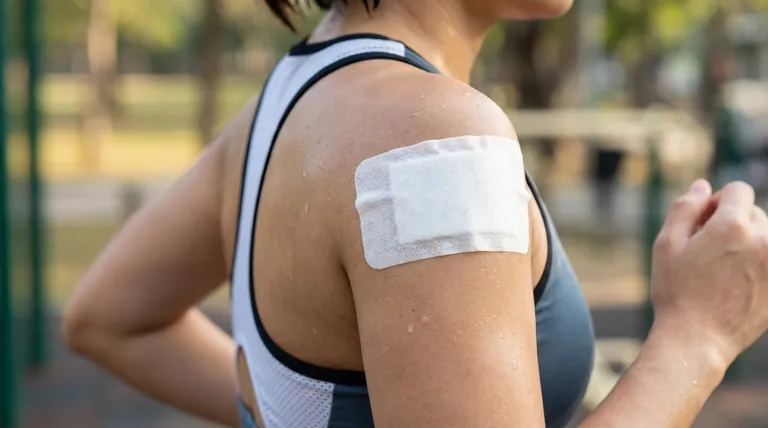
The Weakest Link in a Perfect System
A routine is a fragile thing.
We design our lives, and our medical regimens, around predictable cycles. A pill taken at the same time every day. An injection administered every Tuesday. A transdermal patch changed every three days. These systems work flawlessly until they collide with the unpredictability of human life.
A moment of forgetfulness. An unusually intense workout. The simple friction of clothing.
Suddenly, the system breaks. For a patient relying on an estradiol patch for hormone therapy or contraception, this break is not trivial. It's a disruption in a carefully calibrated hormonal balance, a moment where the technology's promise of steady, continuous delivery is broken. The immediate question is practical: What do I do now? But the more profound question, for engineers and manufacturers, is systemic: How do we build a system that anticipates and forgives this inevitable human reality?
A Protocol for Imperfection
When a transdermal patch detaches or a change is forgotten, the user is forced into a decision-making process that was never part of the plan. The goal is to restore hormonal stability as quickly and safely as possible.
The immediate response follows a clear logic of triage.
Step 1: Assess and Act
The first step is a physical assessment of the patch and the time elapsed.
- If the patch is still adhesive and has been detached for less than a day: The solution is simple. Reapply it to a clean, dry area of skin. The system is restored.
- If the patch has lost its stickiness or has been off for more than 24 hours: The original patch is now compromised. It must be discarded and replaced with a new one. Attempting to secure a non-adhesive patch with tape is a false economy; it disrupts the precise skin contact required for effective drug delivery.
Step 2: Recalibrate the Schedule
Applying a new patch off-cycle creates a scheduling dilemma. The guiding principle is to avoid two things: hormonal gaps and hormonal spikes.
- Maintain the Original "Change Day": Even if you apply a replacement patch on a Monday, if your scheduled change day is Thursday, you should still replace the patch on Thursday. This keeps the long-term routine intact.
- Never Double Dose: The temptation to "catch up" by applying two patches is dangerous. Transdermal systems are designed for a specific release rate. Doubling the dose can lead to excessive hormone levels and amplify side effects.
Step 3: Deploy the Safety Net
If the system has been compromised for more than 24 hours, especially for contraceptive patches, its primary function may be impaired.
- Backup Contraception: For the next seven days after applying a new patch, a backup method (e.g., condoms) is critical to ensure protection.
- Professional Consultation: Uncertainty breeds risk. When in doubt, consulting a pharmacist or healthcare provider is the most reliable course of action.
Here is a simple decision-making framework:
| Situation | Recommended Action |
|---|---|
| Patch falls off, but is still sticky | Reapply immediately to clean, dry skin. |
| Patch is no longer sticky or off for >24 hrs | Discard old patch. Apply a new one immediately. |
| Forgot to change patch on schedule | Apply a new patch as soon as you remember. Never wear two. |
| Patch off for >24 hrs (contraceptive) | Apply new patch + use backup contraception for 7 days. |
| Unsure about any step | Contact a healthcare provider for personalized guidance. |
Beyond User Error: The Engineering Mandate
It's easy to frame patch failure as a user problem. But the most robust solutions are found not in user manuals, but in the lab. The challenge of keeping a small, medicated adhesive on a living, moving, sweating person for days at a time is a profound engineering puzzle.
This is the manufacturer's responsibility: to design for life's inevitable interruptions.
It involves a deep understanding of biocompatible adhesives that can withstand moisture and friction without causing skin irritation. It requires precision in drug matrix formulation to ensure consistent release, even if skin contact is briefly suboptimal. It means designing a product so reliable that the user's only task is to follow a simple, predictable routine.
The ultimate goal is to make the "What do I do?" scenario exceptionally rare. This is achieved not just by manufacturing a product, but by engineering a reliable therapeutic system. For brands and distributors committed to providing technology that accounts for human reality, the first step is partnering with a manufacturer who understands this delicate balance. Contact Our Experts to build reliability from the ground up.
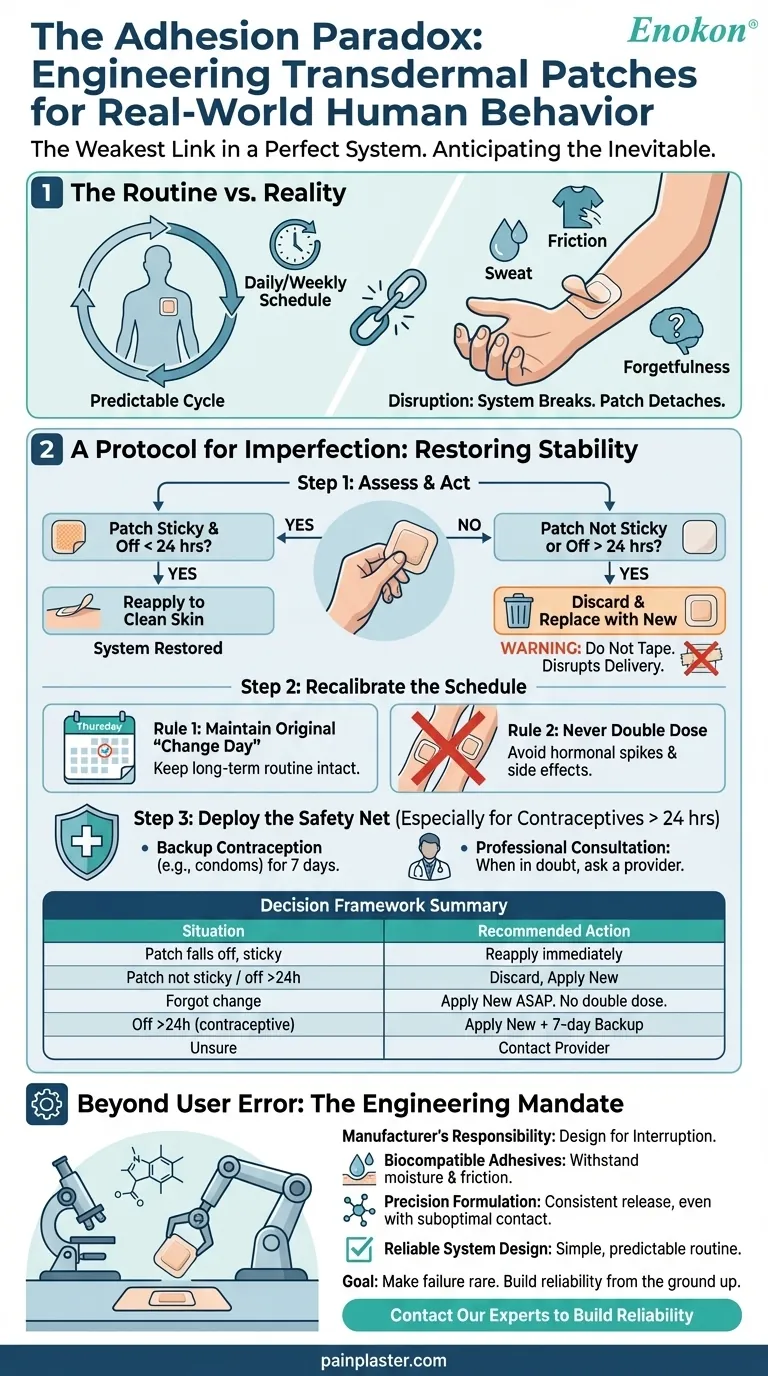
Visual Guide
Related Products
- Far Infrared Heat Pain Relief Patches Transdermal Patches
- Icy Hot Menthol Medicine Pain Relief Patch
- Silicone Scar Sheets Patch Transdermal Drug Patch
- Menthol Gel Pain Relief Patch
- Mugwort Wormwood Pain Relief Patch for Neck Pain
Related Articles
- Engineering Certainty: The Invisible Architecture of a Gold-Standard Clinical Trial
- The Silent Workhorse: How Transdermal Patches Rewrote the Rules of Pain Management
- Beyond the Pill: The Silent Engineering of Safer Pain Relief
- Beyond Efficacy: The Psychology of Adherence in Topical Pain Relief
- Beyond the Molecule: The Behavioral Science of the Simple Pain Patch



















