The Fragility of a Promise
A transdermal patch is a quiet promise. It promises steady relief, freedom from pills, and a return to normalcy for someone managing chronic pain. It is a marvel of simplicity—peel, stick, and forget.
But what happens when that promise is broken?
When a lidocaine patch begins to peel at the edges or falls off completely, the patient's world shrinks. The immediate problem isn't just the loss of medication; it's the intrusion of doubt. Is it working? Did I do it wrong? What do I do now? This moment of failure reveals a deep engineering truth: simplicity for the user is the result of immense complexity in design.
More Than Just Sticky Tape: The Transdermal Trilemma
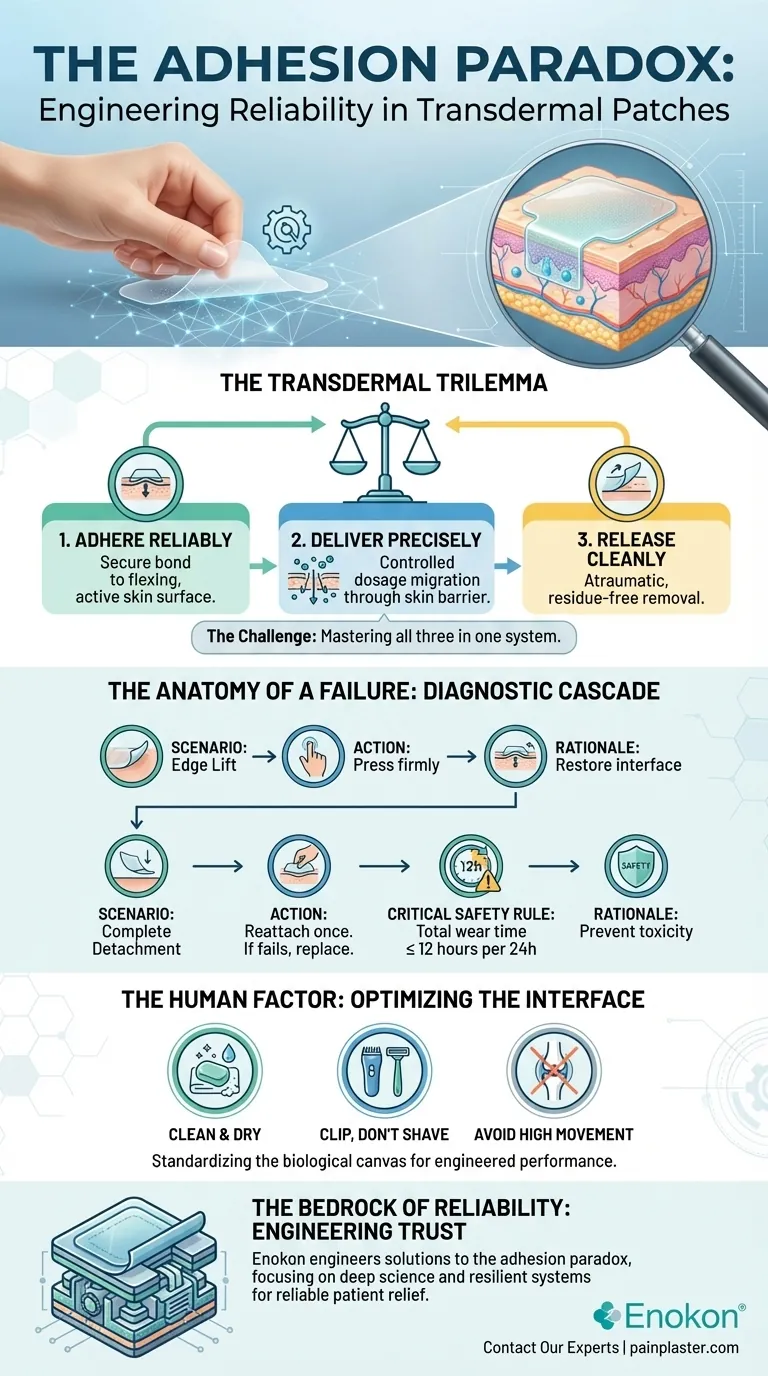
A transdermal system is not merely an adhesive bandage with medicine. It is a sophisticated delivery platform governed by a delicate balance—an engineering trilemma.
The patch must:
- Adhere Reliably: It must bond securely to skin, a surface that is constantly flexing, shedding cells, and secreting oils.
- Deliver Precisely: It must facilitate the controlled migration of a specific drug dose through the skin barrier over a designated period.
- Release Cleanly: After its job is done, it must peel away without causing trauma, irritation, or leaving a stubborn residue.
Mastering one of these is hard enough. Mastering all three in a single, cost-effective product is the central challenge of transdermal technology. A patch that falls off represents a failure in the first and most fundamental of these pillars.
The Anatomy of a Failure: A Diagnostic Cascade
When a patch detaches, the user is forced to become a troubleshooter. The prescribed steps are not just instructions; they are a diagnostic protocol that reveals the system's design limits and safety features.
The First Signal: Edge Lift
If the edges of the patch begin to lift, the immediate action is simple: press them firmly back down.
Psychologically, this is a minor course correction. From an engineering standpoint, it’s the first sign of stress at the adhesive-skin interface. It could be due to movement, moisture, or suboptimal skin preparation. It’s a moment where the system’s physical integrity is tested.
Critical Detachment: When the System Breaks Down
When a patch detaches completely and fails to re-adhere, the system has failed. The user's response is governed by a critical safety parameter: the maximum dosage window.
- The Protocol: Discard the failed patch and apply a new one. Crucially, the total combined wear time for both patches must not exceed 12 hours in a 24-hour period.
- The Unseen Logic: This rule isn't arbitrary. It’s a guardrail against potential lidocaine toxicity. The engineers and pharmacologists who designed the system anticipated this failure mode. The 12-hour limit is a non-negotiable safety feature, acknowledging that in the real world, things go wrong.
The Human Factor: Preparing the Interface
The most common cause of adhesion failure is the application site itself. The skin is not a passive substrate; it's a dynamic, living organ.
To ensure success, the interface must be optimized:
- The site must be clean, dry, and free of oils or lotions.
- Hair should be clipped, not shaved, to avoid micro-abrasions that can alter drug absorption.
- High-movement areas like joints should be avoided.
This isn't just about "making it stick." It's about standardizing the biological canvas to ensure the engineered system can perform as designed.
The Bedrock of Reliability: Engineering for Trust
The difference between a patch that stays on and one that doesn't comes down to expertise. It’s about understanding the deep science of pressure-sensitive adhesives, skin physiology, and drug-excipient compatibility.
This is where specialized manufacturing becomes critical. At Enokon, we don't just produce transdermal patches; we engineer solutions to the adhesion paradox. Our R&D is focused on creating systems that are resilient to the variables of daily life, ensuring that the promise of steady, reliable relief is kept. For healthcare distributors and pharmaceutical brands, partnering with a manufacturer that obsesses over these details means delivering a product that builds—rather than erodes—patient trust.
The following table summarizes the user-facing protocol for adhesion failure, a process built on a foundation of unseen engineering and safety considerations.
| Scenario | Recommended Action | Underlying Rationale |
|---|---|---|
| Partial Detachment | Firmly press edges to reattach. | Minor correction to maintain the adhesive-skin interface. |
| Complete Detachment | Reattach once. If it fails again, replace. | The adhesive's initial bond has been critically compromised. |
| Repeated Detachment | Apply new patch; total wear time ≤12 hours per 24h. | Enforces the maximum dosage safety limit to prevent toxicity. |
| Persistent Adhesion Issues | Consult a healthcare provider. | The patient may require a different formulation or adhesive technology. |
Ultimately, a patch that stays put is a testament to meticulous design and manufacturing excellence. It's the physical embodiment of a promise kept. If your goal is to provide transdermal solutions that patients can truly rely on, the engineering behind that simple act of adhesion matters more than anything.
To develop a product that meets the highest standards of reliability and patient trust, Contact Our Experts.
Visual Guide
Related Products
- Far Infrared Heat Pain Relief Patches Transdermal Patches
- Silicone Scar Sheets Patch Transdermal Drug Patch
- Icy Hot Menthol Medicine Pain Relief Patch
- Menthol Gel Pain Relief Patch
- Mugwort Wormwood Pain Relief Patch for Neck Pain
Related Articles
- Engineering Certainty: The Invisible Architecture of a Gold-Standard Clinical Trial
- The Silent Workhorse: How Transdermal Patches Rewrote the Rules of Pain Management
- Beyond the Pill: The Silent Engineering of Safer Pain Relief
- Beyond Efficacy: The Psychology of Adherence in Topical Pain Relief
- Beyond the Molecule: The Behavioral Science of the Simple Pain Patch



















