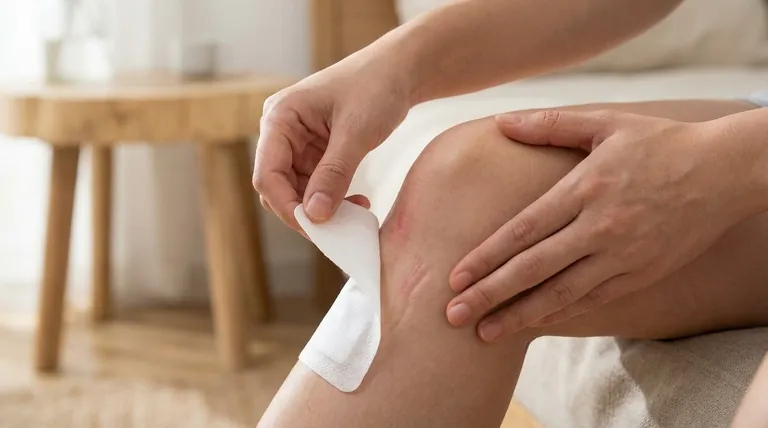
The Moment of Truth
Imagine the scene. Someone has been wearing a pain relief patch for eight hours. The active ingredients have done their work, and now, it’s time for removal. The instinct is simple: grip a corner and rip it off quickly. Get it over with.
What follows is a familiar sting, a patch of angry red skin, and sometimes, a lingering irritation that outlasts the original pain.
This small, private moment reveals a profound disconnect. We treat a sophisticated drug delivery system like a cheap sticker. The problem isn’t just user error; it’s a failure to appreciate the complex interface between a piece of medical technology and our body’s largest organ.
The Psychology of the Rip
Our bias for speed and efficiency works against us here. We perceive the task as "removing a patch," a binary action that is either done or not done. The faster, the better.
But the skin doesn’t operate on a binary schedule. It’s a living, layered biological system. The adhesive that makes a patch effective—forming a secure seal to ensure consistent transdermal delivery—creates a powerful bond with the outermost layer of our skin, the stratum corneum.
A quick, forceful pull doesn't just remove the patch. It aggressively strips away excess layers of epidermal cells, causing micro-trauma and compromising the skin's natural barrier. We trade a moment of impatience for hours or days of discomfort.
An Engineered Disengagement
Viewing patch removal not as a single action but as a deliberate protocol changes everything. It’s an act of careful disengagement from a biological interface. The goal is to separate two bonded surfaces while minimizing system disruption.
This requires a methodical approach, much like undocking a spacecraft.
Phase 1: The Initial Separation
Force is the enemy. The key is to persuade the patch to release its grip, not force it.
- Start at the Edge: Gently lift one corner of the patch. If it resists, applying a bit of warm water, baby oil, or lotion can help dissolve the adhesive's grip.
- Peel, Don't Pull: Once a corner is loose, fold it back over itself and peel it away slowly and parallel to the skin. Pulling the patch straight up, perpendicular to the skin, concentrates all the tensile force on a small area, maximizing skin tearing and pain. A slow, parallel peel distributes that force.
- Support the Skin: Use your other hand to press down on the skin adjacent to the peeling patch. This simple bracing action provides counter-pressure and dramatically reduces stretching and irritation.
Phase 2: Site Decontamination and Recovery
Once the patch is off, the job isn't done. The site has been under occlusion for hours, and adhesive residue may remain.
- Cleanse Gently: Use mild soap and warm water to wash the area, removing any leftover adhesive or herbal remnants. Avoid harsh scrubbing.
- Soothe and Hydrate: Apply a neutral, calming agent like aloe vera or an unscented lotion. This helps to rehydrate the skin and soothe any low-level inflammation caused by the removal process.
Phase 3: System Monitoring
Your skin provides crucial feedback. Observing it is part of the protocol.
- Read the Signals: A little pinkness that fades quickly is normal. Severe redness, swelling, persistent itching, or rashes are not. These are error signals, indicating either an allergic reaction to the adhesive or the ingredients, or damage from improper removal.
- Rotate Sites: To prevent cumulative irritation, avoid applying a new patch to the exact same spot until the skin has fully recovered.
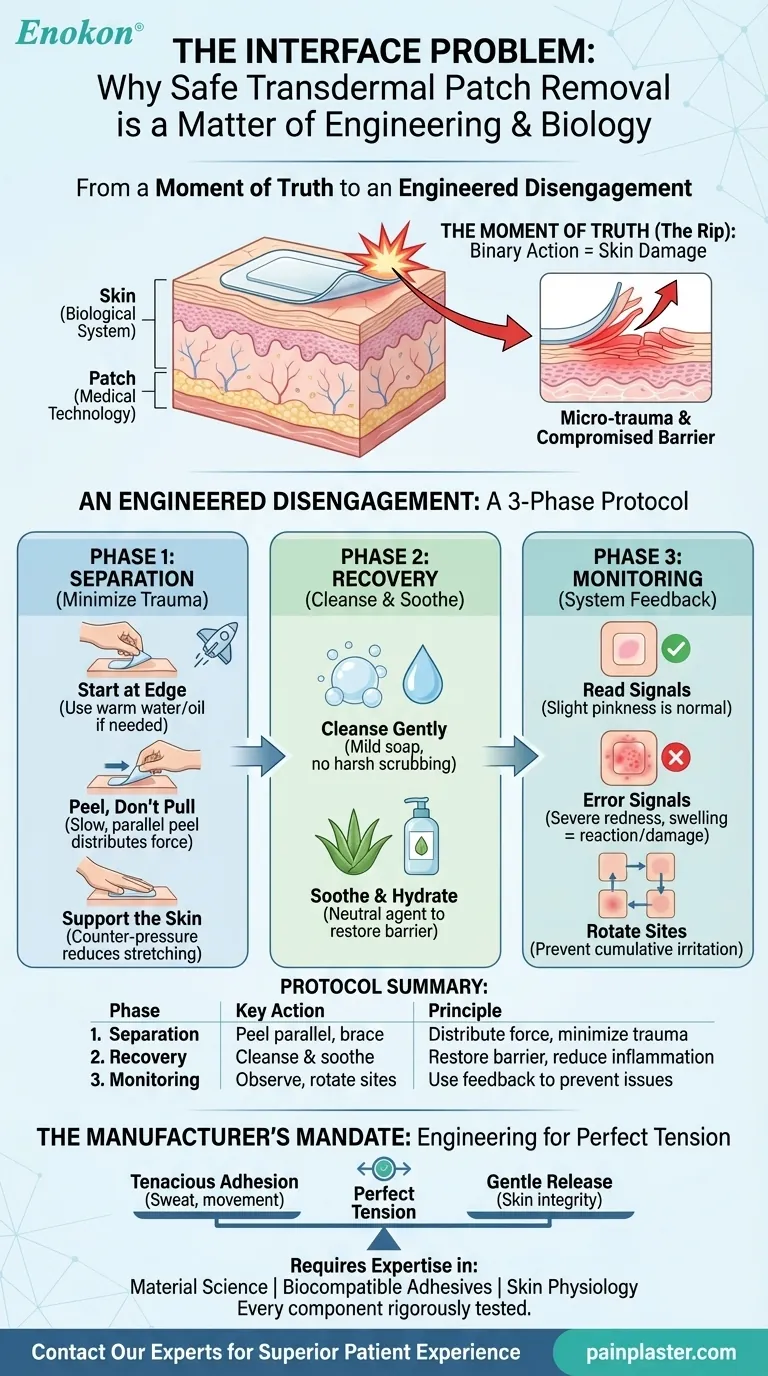
This protocol can be summarized simply:
| Phase | Key Action | The Underlying Principle |
|---|---|---|
| 1. Separation | Peel slowly, parallel to the skin, while bracing. | Distribute force; minimize trauma to the epidermis. |
| 2. Recovery | Cleanse gently and apply a soothing lotion. | Restore the skin barrier and reduce inflammation. |
| 3. Monitoring | Observe for severe reactions; rotate application sites. | Use skin feedback to prevent future issues. |
The Manufacturer's Mandate
Ultimately, a positive user experience begins long before the patch is ever applied. It starts with the engineering of the patch itself.
The ideal transdermal patch exists in a state of perfect tension: its adhesive must be tenacious enough to survive sweat, movement, and friction for its entire prescribed duration, yet gentle enough to be released without damaging the delicate skin it’s bonded to.
This is not a simple challenge. It requires deep expertise in material science, biocompatible adhesives, and the physiology of the skin. It involves selecting backing materials that breathe, formulating adhesives that balance sheer strength with peel adhesion, and ensuring every component is rigorously tested for sensitivity.
For healthcare brands and distributors committed to providing a superior patient experience from start to finish, the engineering of the patch itself is paramount. Contact Our Experts
Visual Guide
Related Products
- Far Infrared Heat Pain Relief Patches Transdermal Patches
- Silicone Scar Sheets Patch Transdermal Drug Patch
- Icy Hot Menthol Medicine Pain Relief Patch
- Menthol Gel Pain Relief Patch
- Mugwort Wormwood Pain Relief Patch for Neck Pain
Related Articles
- Engineering Certainty: The Invisible Architecture of a Gold-Standard Clinical Trial
- The Silent Workhorse: How Transdermal Patches Rewrote the Rules of Pain Management
- Beyond the Pill: The Silent Engineering of Safer Pain Relief
- Beyond Efficacy: The Psychology of Adherence in Topical Pain Relief
- Beyond the Molecule: The Behavioral Science of the Simple Pain Patch



















