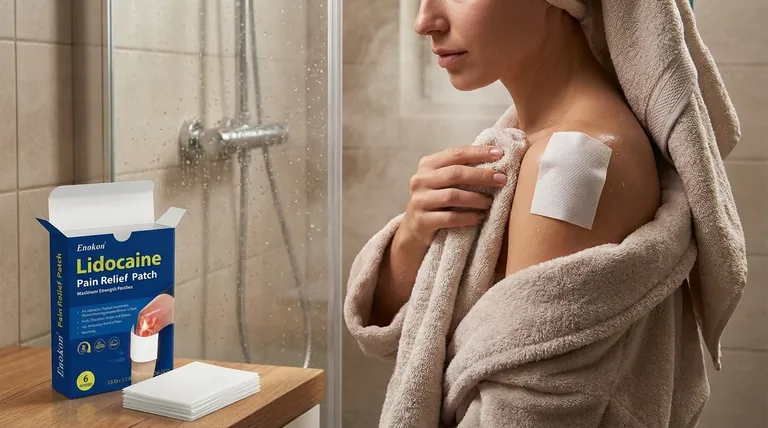
The Morning Dilemma
For someone managing chronic pain, the daily routine is a series of careful calculations. The simple act of taking a morning shower becomes a strategic question: will this moment of comfort compromise the hours of relief provided by a transdermal patch?
The fear is not unfounded. A patch that peels off is a dose lost. This isn't a simple question of adhesive strength; it's a complex interaction between skin, water, and a sophisticated drug delivery system. The answer, it turns out, is a lesson in medical engineering.
Not All Patches Are Created Equal
The first and most critical point is that "lidocaine patch" is not a monolithic category. The ability to withstand water is determined entirely by the patch's specific design and formulation.
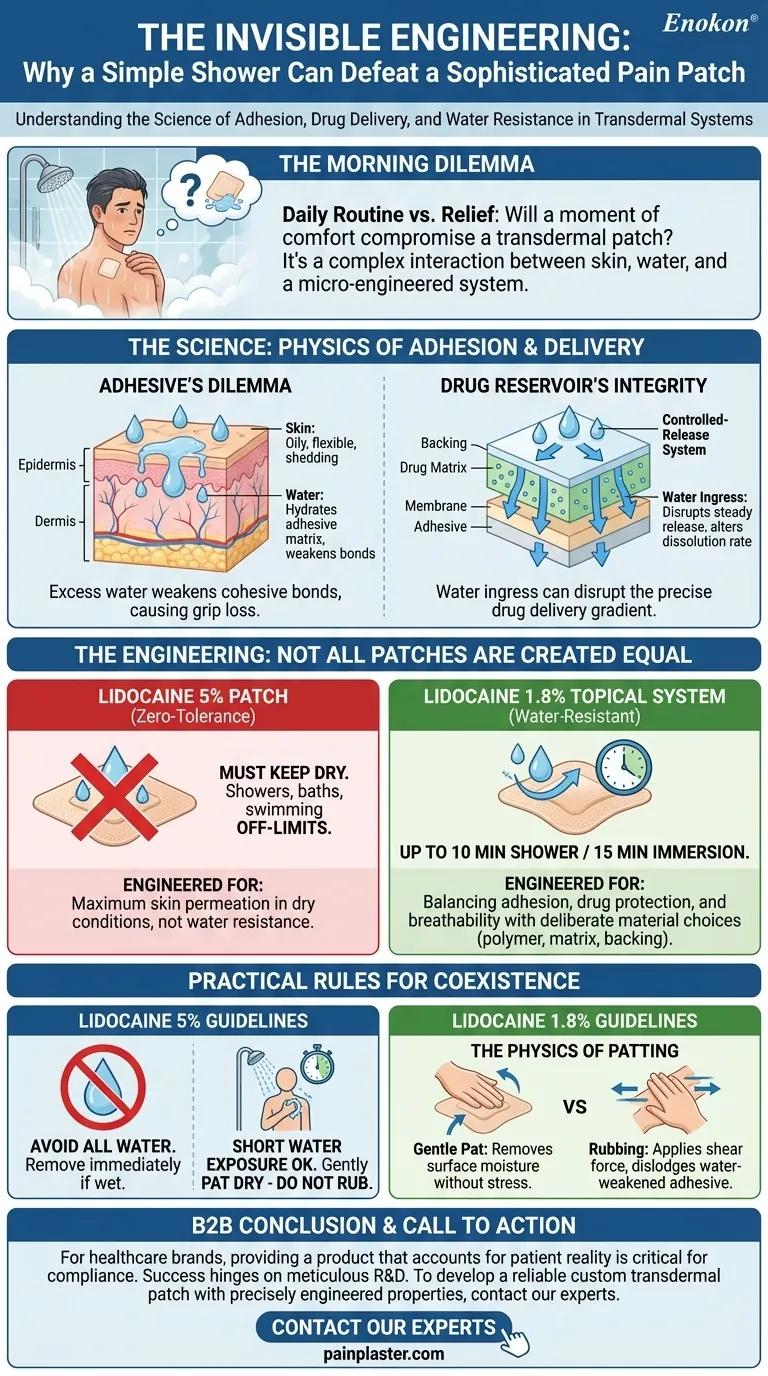
- The Lidocaine 5% Patch: This is a zero-tolerance system. It must be kept completely dry. Showers, baths, and swimming are off-limits while wearing it.
- The Lidocaine 1.8% Topical System: This system is engineered for a degree of water resistance. It can typically endure up to 10 minutes in a shower or 15 minutes of immersion.
This difference isn't arbitrary. It reflects fundamental trade-offs in the engineering of the patch itself.
The Physics of Adhesion and Drug Delivery
A transdermal patch has two primary jobs: stick to the skin and deliver a precise dose of medication through it. Water is a natural enemy to both of these functions.
The Adhesive's Dilemma
Skin is a challenging surface—it's flexible, it secretes oils, and it's constantly shedding cells. Medical adhesives are designed to navigate this environment. But introducing excess water upsets this delicate balance. It can hydrate the adhesive matrix, weakening its cohesive bonds and causing it to lose its grip.
The Drug Reservoir's Integrity
More importantly, a patch is a controlled-release reservoir. Its layers—the backing, the drug matrix, the membrane, and the adhesive—are all engineered to release the active ingredient at a steady, predictable rate. Water ingress can disrupt this system, potentially altering the drug's dissolution rate or the concentration gradient that drives absorption into the skin.
The patch isn't just a sticker with medicine on it; it's a micro-engineered system. Protecting that system is paramount.
A System Engineered for Reality
The reason the 1.8% patch can handle water while the 5% patch cannot lies in the total system design. Manufacturers make deliberate choices about the type of adhesive polymer, the composition of the drug matrix, and the properties of the backing layer.
Creating a water-resistant patch requires a formulation that can maintain adhesion and protect the drug reservoir without compromising efficacy or causing skin irritation. It’s a high-stakes balancing act that requires deep material science and pharmaceutical expertise. This is the invisible engineering that separates a patch that fails in the shower from one that holds fast.
Practical Rules for Coexistence
For patients, this engineering translates into a simple set of rules. Understanding them ensures they receive the full therapeutic benefit without disruption.
| Patch Type | Water Exposure Guidelines | Handling If Wet |
|---|---|---|
| Lidocaine 5% | Avoid all water (no showers, baths, or swimming). | Remove immediately if it gets wet. |
| Lidocaine 1.8% | Up to 10 min in shower / 15 min immersed. | Gently pat dry—do not rub. |
The instruction to "pat, don't rub" is rooted in physics. Rubbing applies shear force to a water-weakened adhesive, virtually guaranteeing it will dislodge. A gentle pat removes surface moisture without stressing the bond between the patch and the skin.
For healthcare brands and distributors, providing a product that accounts for the realities of a patient's daily life is a critical factor in compliance and satisfaction. The success of a transdermal solution hinges on this meticulous, behind-the-scenes R&D. To develop a reliable patch that meets specific clinical and lifestyle needs, the right manufacturing partner is essential.
If you are looking to develop a custom transdermal patch with precisely engineered properties for your market, Contact Our Experts.
Visual Guide
Related Products
- Lidocaine Hydrogel Pain Relief Patch for Pain Relief
- Far Infrared Heat Pain Relief Patches Transdermal Patches
- Silicone Scar Sheets Patch Transdermal Drug Patch
- Icy Hot Menthol Medicine Pain Relief Patch
- Menthol Gel Pain Relief Patch
Related Articles
- Beyond the Adhesive: The Precarious Balance of Transdermal Drug Delivery
- The Unseen Dangers of Numbness: Navigating the Physics and Psychology of Lidocaine Patches
- The Efficacy Paradox: Why Lower-Dose Lidocaine Patches Are Redefining Pain Management
- Beyond the Patch: The Hidden Dialogue Between Lidocaine, Your Body, and Your Lifestyle
- Beyond Efficacy: The Psychology of Adherence in Topical Pain Relief












