The Psychology of a Simple Patch
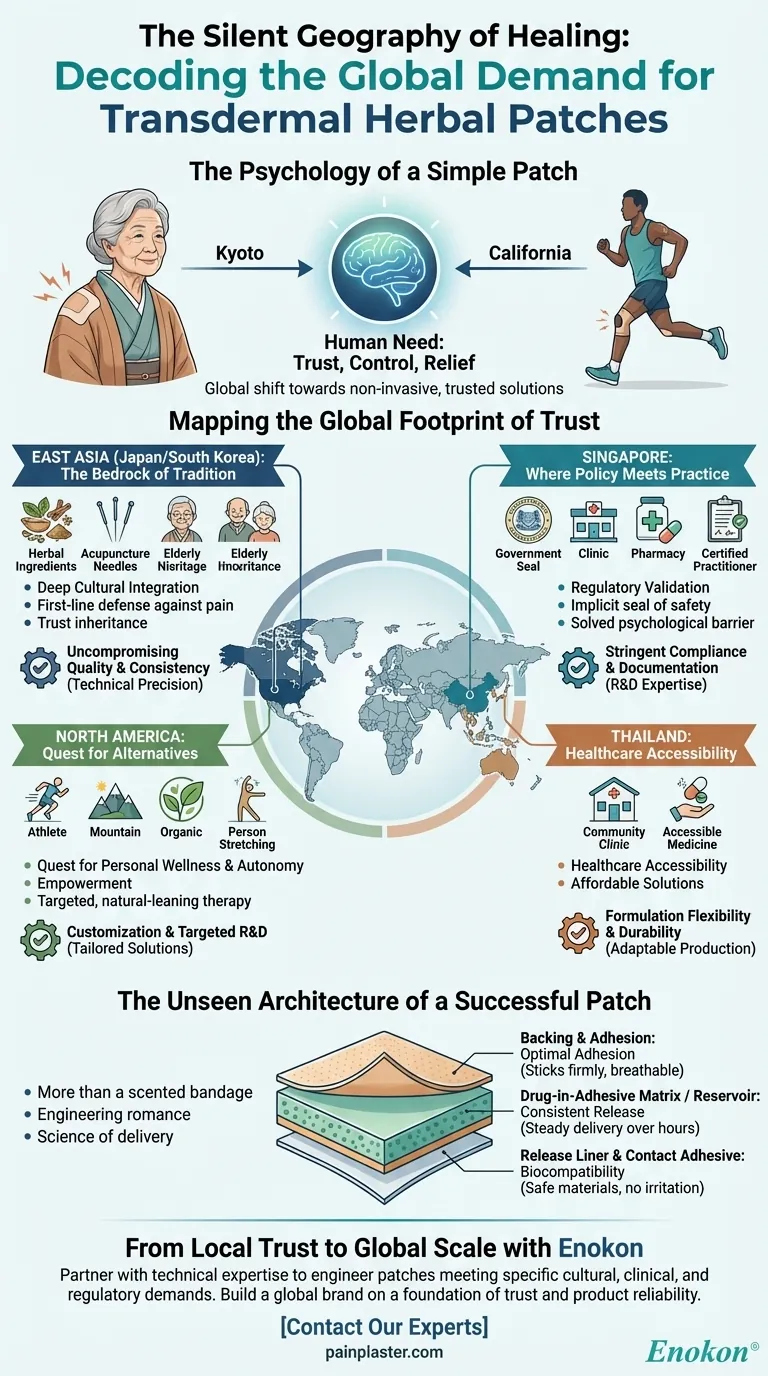
An elderly woman in Kyoto applies a plaster to her aching shoulder, a ritual as familiar as her morning tea. A marathon runner in California places a patch on his knee, seeking a natural edge for recovery.
On the surface, these are simple acts. But beneath lies a complex intersection of culture, trust, and technology. The humble herbal patch represents a global shift towards non-invasive, trusted solutions—a desire for tangible relief in a world saturated with complex pharmaceuticals.
This isn't just about tradition. It's about a deep-seated human need for remedies we can understand and control. The success of a patch in one country and its slow adoption in another is a story about psychology, policy, and the silent engineering that makes it all possible.
Mapping the Global Footprint of Trust
The journey of an herbal patch from a niche remedy to a global wellness staple is not accidental. It follows a map drawn by cultural history, consumer behavior, and regulatory foresight.
The Bedrock of Tradition: East Asia's Enduring Embrace
In Japan and South Korea, traditional Chinese medicine (TCM) is not "alternative"; it is a deeply integrated part of the healthcare landscape. For generations, herbal plasters have been a first-line defense against musculoskeletal pain.
This acceptance is not just cultural—it's psychological. The plaster is a trusted inheritance, a remedy validated by grandparents and pharmacists alike. For the region's aging population, it offers a gentle, non-systemic alternative to oral painkillers.
But this deep trust comes with high expectations. To succeed here, a product must meet exacting standards of quality and consistency, a challenge that begins with a manufacturer's technical precision.
Where Policy Meets Practice: The Singapore Model
Singapore presents a different model. Here, the government has formally recognized and regulated TCM, creating a robust infrastructure of clinics and certified practitioners.
This state-level validation solves a critical psychological barrier for consumers: fear of the unregulated. When a herbal patch is prescribed in a clinic or sold in a reputable pharmacy, it carries an implicit seal of safety and efficacy.
This creates a powerful market, but one with high barriers to entry. For healthcare brands, navigating this environment requires a product that is not only effective but also meticulously documented and compliant—a feat that hinges on a manufacturing partner's R&D and regulatory expertise.
The New Frontier: North America's Quest for Alternatives
The rise of herbal patches in the United States since the 1980s is driven by a different psychology: the quest for personal wellness and autonomy.
Consumers, particularly athletes and those with chronic pain, are actively seeking alternatives to mainstream pharmaceuticals. The patch represents a form of empowerment—a targeted, natural-leaning therapy they can administer themselves.
This market demands customization. A patch designed for an athlete’s high-stress joint needs different adhesion and formulation properties than one for chronic, low-level back pain. Success here isn't about a one-size-fits-all product; it's about sophisticated R&D that can tailor solutions to specific needs.
The Unseen Architecture of a Successful Patch
The global appeal of an herbal patch is clear. But the story of its ingredients is only half the tale. The other half is an engineering romance—the science of a delivery system that turns ancient herbs into a modern medical device.
The Science of Delivery
A transdermal patch is more than a scented bandage. It is a marvel of material science, designed for:
- Consistent Release: The active ingredients must be delivered steadily over hours.
- Optimal Adhesion: It must stick firmly through movement and perspiration without irritating the skin.
- Biocompatibility: The materials must be safe, preventing allergic reactions or discomfort.
The trust a user places in a patch is ultimately a trust in this unseen architecture. The "magic" is not just in the herbs, but in the technology that delivers their benefits reliably and safely.
From Local Trust to Global Scale
For pharmaceutical distributors and healthcare brands, this global map reveals a massive opportunity. Yet, each region presents a unique maze of consumer expectations and regulatory hurdles.
| Country | Core Driver | Key Manufacturing Challenge |
|---|---|---|
| Japan | Deep Cultural Integration | Uncompromising Quality & Consistency |
| Singapore | Regulatory Validation | Stringent Compliance & Documentation |
| USA | Quest for Wellness Alternatives | Customization & Targeted R&D |
| Thailand | Healthcare Accessibility | Formulation Flexibility & Durability |
Entering these markets requires more than a good product; it demands a manufacturing partner who understands this complex geography. A partner like Enokon provides not just bulk production, but the technical expertise and custom development capabilities to engineer a patch that meets the specific cultural, clinical, and regulatory demands of your target market.
Building a global brand is built on a foundation of trust—trust that starts with the reliability of the product itself. To explore how tailored transdermal solutions can meet your market's unique needs, Contact Our Experts.
Visual Guide
Related Products
- Herbal Eye Protection Patch Eye Patch
- Natural Herbal Patch for Motion Sickness and Car Sickness Relief
- Natural Herbal Wormwood Patch Pain Plaster
- Herbal Medicated Anti Diarrhea Patch for Digestive Relief
- Mugwort Wormwood Pain Relief Patch for Neck Pain
Related Articles
- Beyond the Pill: The Engineering and Psychology of Modern Fever Relief
- Beyond Size: The Hidden Physiology in Cooling Patch Design
- The Last Centimeter: Why How You Apply a Transdermal Patch Defines Its Success
- The Physics of Comfort: Why Engineered Cooling Patches Outperform Traditional Fever Care
- The Quiet Engineering of Comfort: Decoding the 8-Hour Lifespan of a Cooling Patch



















