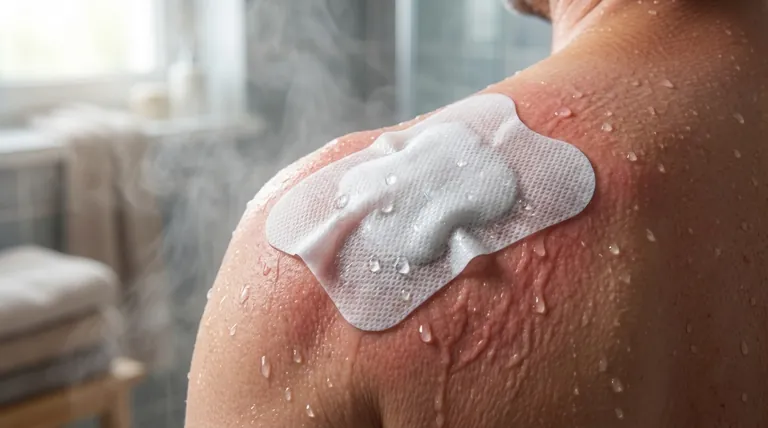
The Smallest Point of Failure
Imagine a patient relying on a medicated plaster for consistent, round-the-clock pain relief. The technology is a quiet marvel—a sophisticated drug delivery system adhering to their skin.
Yet, its entire therapeutic promise hinges on one simple, mechanical fact: it must stay put.
A single shower, a sweaty workout, or an accidental splash can introduce the system's biggest adversary: water. Suddenly, the patient is no longer just managing their pain; they are managing the device itself. This isn't just a practical nuisance; it's a psychological burden. It introduces doubt and erodes trust in the treatment.
The Cascade of Failure: What Moisture Really Does
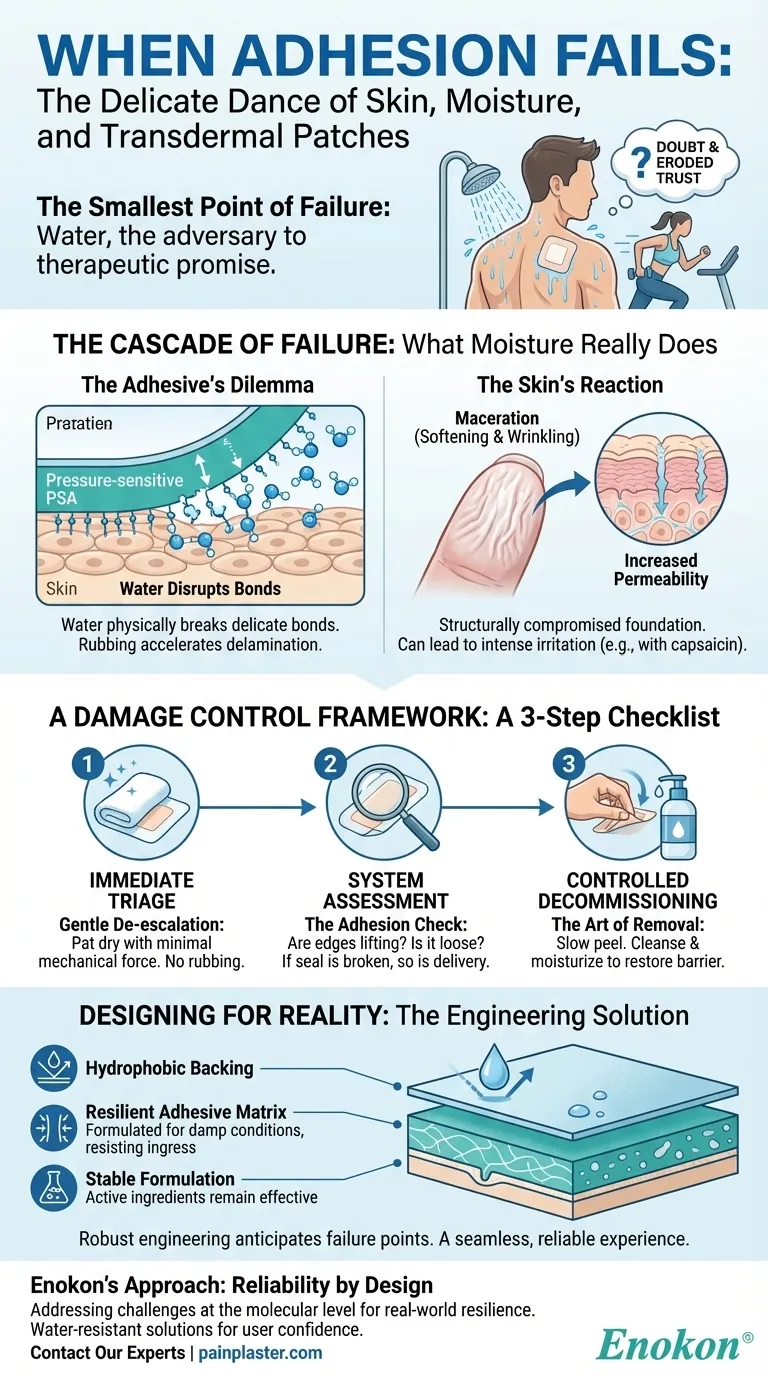
When a patch gets wet, a series of subtle but critical failures begins. It’s not simply a matter of "getting less sticky." It’s a complex interaction at the intersection of material science and human biology.
The Adhesive's Dilemma
Most transdermal patches use a pressure-sensitive adhesive (PSA). At a microscopic level, its bond with the skin relies on intimate surface contact, governed by weak intermolecular forces.
Water is a powerful disruptor. It works its way between the adhesive and the epidermis, physically breaking these delicate bonds. The adhesive loses its grip not because it "dissolves," but because its fundamental mechanism of action has been interrupted. Rubbing the patch in an attempt to dry it only introduces mechanical stress, accelerating this process of delamination.
The Skin's Reaction
Simultaneously, the skin itself begins to change. Prolonged contact with moisture leads to maceration—the same softening and wrinkling you see on your fingertips after a long bath.
This waterlogged skin is a poor foundation for adhesion. It's structurally compromised. Furthermore, this over-hydrated state can temporarily increase the skin's permeability, which sounds good but can be problematic. For medicated plasters containing active ingredients like capsaicin (from chili), this heightened permeability can lead to a more intense, irritating sensation rather than controlled relief.
A Damage Control Framework
When a patch's integrity is compromised by moisture, the user is forced into a damage control protocol. It’s a checklist that acknowledges the system is in a fragile state.
-
Immediate Triage: Gentle De-escalation The first step is to gently pat the area dry with a soft towel. The goal is not just to remove surface water but to do so with minimal mechanical force. Every rub is a shearing force that further weakens the already compromised adhesive bond.
-
System Assessment: The Adhesion Check Once dry, an honest assessment is required. Are the edges lifting? Does the patch feel loose? If the seal is broken, so is the consistent delivery of medication. The patch is no longer performing its primary function.
-
Controlled Decommissioning: The Art of Removal If the patch has failed, it must be removed. This should be a controlled process. Peeling it back slowly, folding it over on itself, minimizes skin trauma. Afterward, the skin needs care—cleansing with mild soap and water to remove residue, followed by a moisturizer to help restore its natural barrier.
Designing for Reality: The Engineering Solution
The fundamental problem isn't that people get wet. It's that the product wasn't designed for the full reality of a person's life. Expecting a user to perfectly shield a patch from moisture is a flawed strategy.
True reliability comes from robust engineering that anticipates failure points.
Beyond Simple Adhesion: The Science of Resilience
Creating a patch that withstands moisture is a multi-layered engineering challenge. It requires:
- A Hydrophobic Backing: An outer layer that acts as an impermeable barrier to water.
- A Resilient Adhesive: A sophisticated adhesive matrix formulated to maintain its bond in damp conditions, resisting moisture ingress at the edges.
- A Stable Formulation: The active ingredients must remain stable and effective, even when faced with the temperature and humidity fluctuations of daily life.
This is the quiet romance of great engineering: creating a seamless, reliable experience by solving complex, hidden problems. The user shouldn't have to think about the patch; they should only feel its benefit.
Enokon's Approach: Reliability by Design
For healthcare distributors and pharmaceutical brands, user trust is paramount. A patch that peels off is a broken promise.
At Enokon, we address these challenges at the molecular level. As bulk manufacturers specializing in transdermal technology, we focus our R&D on creating patches built for real-world resilience. Our expertise in custom formulations allows us to develop water-resistant solutions that maintain both adhesion and therapeutic efficacy, ensuring the end-user's confidence is never washed away.
Building a better patch means designing for life's inevitable realities. If you're looking to provide a product that offers reliability as a core feature, Contact Our Experts.
Visual Guide
Related Products
- Far Infrared Heat Pain Relief Patches Transdermal Patches
- Silicone Scar Sheets Patch Transdermal Drug Patch
- Icy Hot Menthol Medicine Pain Relief Patch
- Menthol Gel Pain Relief Patch
- Mugwort Wormwood Pain Relief Patch for Neck Pain
Related Articles
- Engineering Certainty: The Invisible Architecture of a Gold-Standard Clinical Trial
- The Silent Workhorse: How Transdermal Patches Rewrote the Rules of Pain Management
- Beyond the Pill: The Silent Engineering of Safer Pain Relief
- Beyond Efficacy: The Psychology of Adherence in Topical Pain Relief
- Beyond the Molecule: The Behavioral Science of the Simple Pain Patch



















