
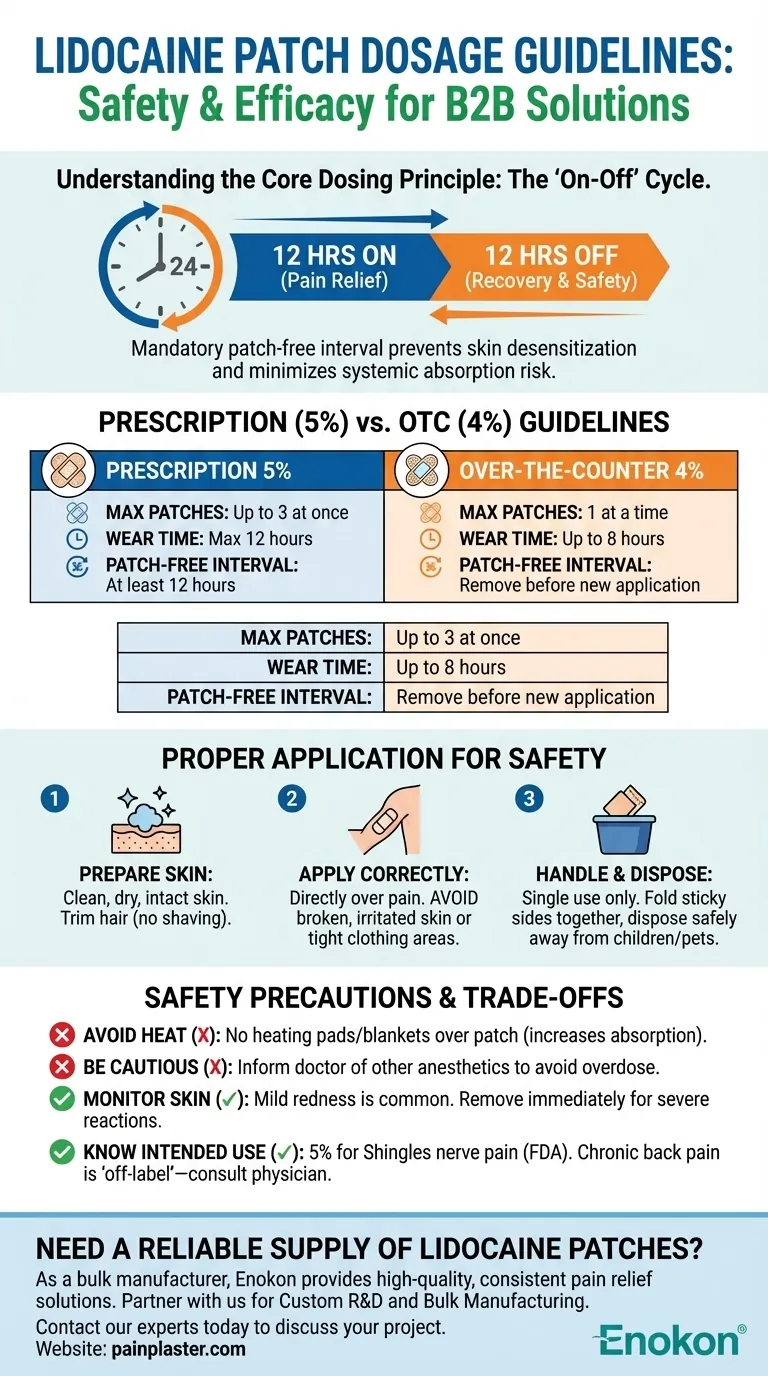
To safely use lidocaine patches, you must follow distinct guidelines based on whether they are prescription or over-the-counter (OTC). For the prescription 5% patch, a maximum of three patches can be applied to the painful area for up to 12 hours within a 24-hour period. This must be followed by a patch-free period of at least 12 hours. For OTC 4% patches, you can wear a patch for up to 8 hours, up to three times a day.
The core principle of lidocaine patch safety is not just the dose, but the timing. The mandated "patch-free" interval is critical to prevent skin desensitization and minimize the risk of the anesthetic being absorbed into your bloodstream.

Understanding the Core Dosing Principle
How Lidocaine Patches Work
Lidocaine is a local anesthetic. The patch delivers the medication directly through your skin to the nerves underneath.
This action blocks local pain signals from reaching your brain. Unlike oral medications, it is not processed through your stomach and is designed to act on a specific area.
The Critical "On-Off" Cycle
The recommended wear time is based on balancing pain relief with safety. For the 5% prescription patch, the 12 hours on, 12 hours off cycle is mandatory.
This rest period allows your skin to recover and reduces the potential for systemic side effects that can occur if too much lidocaine is absorbed into your body.
Prescription (5%) vs. OTC (4%) Guidelines
The dosage rules are different for the two main types of patches.
- Prescription 5% Patches: Apply up to three patches at one time. Wear for a maximum of 12 hours, then remove and wait at least 12 hours before applying new patches.
- Over-the-Counter 4% Patches: Wear one patch for up to 8 hours. You can repeat this up to three times in a 24-hour period, but you should remove the old patch before applying a new one.
Proper Application for Safety and Efficacy
Preparing the Skin
For the patch to work effectively, it must make full contact with clean, dry, and intact skin.
Before application, gently wash and dry the area. If hair is present, you should trim it with scissors—do not shave, as this can create small cuts and increase medication absorption.
Where to Apply (and Where Not To)
Apply the patch directly over the area of pain. Avoid placing it where it will be rubbed by tight clothing.
Never apply a lidocaine patch to broken, cut, irritated, or inflamed skin. This includes areas with rashes, burns, or open wounds, as it can lead to excessive absorption and adverse effects.
Handling and Disposal
Each patch is for single use only. After its recommended wear time, remove it carefully.
Fold the used patch in half so the sticky sides press together, and dispose of it immediately in a location out of reach of children and pets. Even used patches contain enough medication to be harmful if ingested.
Understanding the Trade-offs and Safety Precautions
Avoid Combining Heat
Never apply a heating pad, electric blanket, or other heat source over a lidocaine patch.
Heat increases blood flow to the skin, which can cause your body to absorb a dangerously high amount of lidocaine very quickly.
Be Cautious with Other Anesthetics
If you are using any other products containing local anesthetics—such as creams, sprays, or gels—you must inform your doctor.
The total dose from all sources must be considered to prevent an accidental overdose.
Monitor for Skin Irritation
Mild redness or irritation at the application site is a common side effect.
However, if you experience a more severe reaction like blistering, swelling, or burning, remove the patch immediately. Do not apply a new patch until the irritation has completely resolved.
Know the Intended Use
Lidocaine 5% patches are FDA-approved specifically for the nerve pain that can follow a shingles infection (postherpetic neuralgia).
They are often used "off-label" for other conditions like chronic back pain, but the evidence for their effectiveness in these cases is limited. Always consult a physician for chronic pain management.
Making the Right Choice for Your Goal
To use lidocaine patches safely, you must align the product with your specific medical need and follow all instructions.
- If your primary focus is managing post-shingles nerve pain: Use the prescription 5% patch and strictly adhere to the 12-hour on, 12-hour off cycle as directed by your doctor.
- If your primary focus is treating a minor, localized muscle ache: The OTC 4% patch, worn for up to 8 hours, may provide adequate temporary relief.
- If your primary focus is managing chronic back pain: Consult your physician first, as this is an off-label use and other treatments may be more effective.
- If your primary focus is safety: Never use heat over a patch, never apply it to broken skin, and always dispose of used patches where children or pets cannot reach them.
Ultimately, understanding these guidelines empowers you to use this medication correctly and in partnership with your healthcare provider.
Summary Table:
| Patch Type | Max Patches | Max Wear Time | Patch-Free Interval |
|---|---|---|---|
| Prescription (5%) | Up to 3 | 12 hours | At least 12 hours |
| OTC (4%) | 1 at a time | 8 hours | Remove before next application |
Need a reliable supply of lidocaine patches?
As a bulk manufacturer of transdermal patches, Enokon provides pharmaceutical distributors and healthcare brands with high-quality, consistent pain relief solutions. Our technical expertise ensures your products meet precise dosage and safety standards.
Partner with us for:
- Custom R&D to develop patches tailored to your specific requirements.
- Bulk manufacturing with a focus on reliability and patient safety.
Contact our experts today to discuss your project and how we can support your brand's success.
Visual Guide
Related Products
- Lidocaine Hydrogel Pain Relief Patch for Pain Relief
- Capsaicin Chili Medicated Pain Relief Patches
- Menthol Gel Pain Relief Patch
- Icy Hot Menthol Medicine Pain Relief Patch
- Herbal Medicated Anti Diarrhea Patch for Digestive Relief
People Also Ask
- How does the aqueous base in a lidocaine patch contribute to drug delivery? Unlocking Sustained Pain Relief Technology
- What are the advantages of topical anesthetics over invasive Lidocaine infiltration? Discover Safer, Scalable Relief
- Which pain patch is most effective for arthritis? Find the Best Relief for Your Joint Pain
- How should lidocaine patches be applied for optimal use? Maximize Pain Relief with Proper Application
- Will a GP routinely continue prescribing lidocaine patches after the initial period? Understanding Short-Term Pain Relief



















