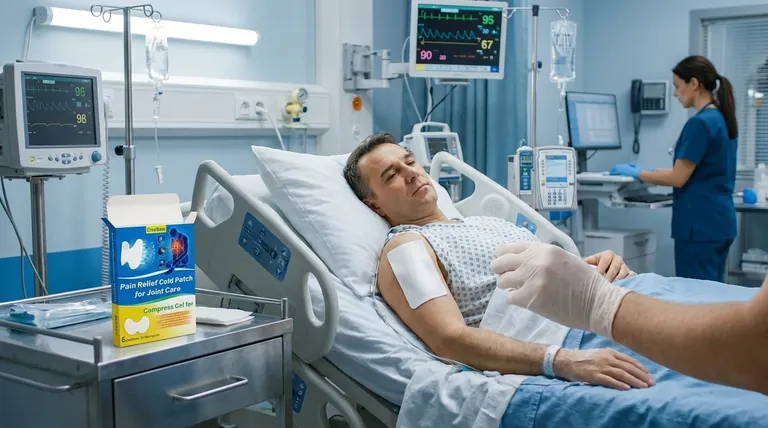
The First Barrier is The Body Itself
An emergency room is a battle against time and physiology.
A patient arrives with crushing chest pain, nauseated and barely conscious. An oral nitroglycerin tablet is a risk—they might not be able to swallow. An IV line takes precious moments to secure and carries an infection risk.
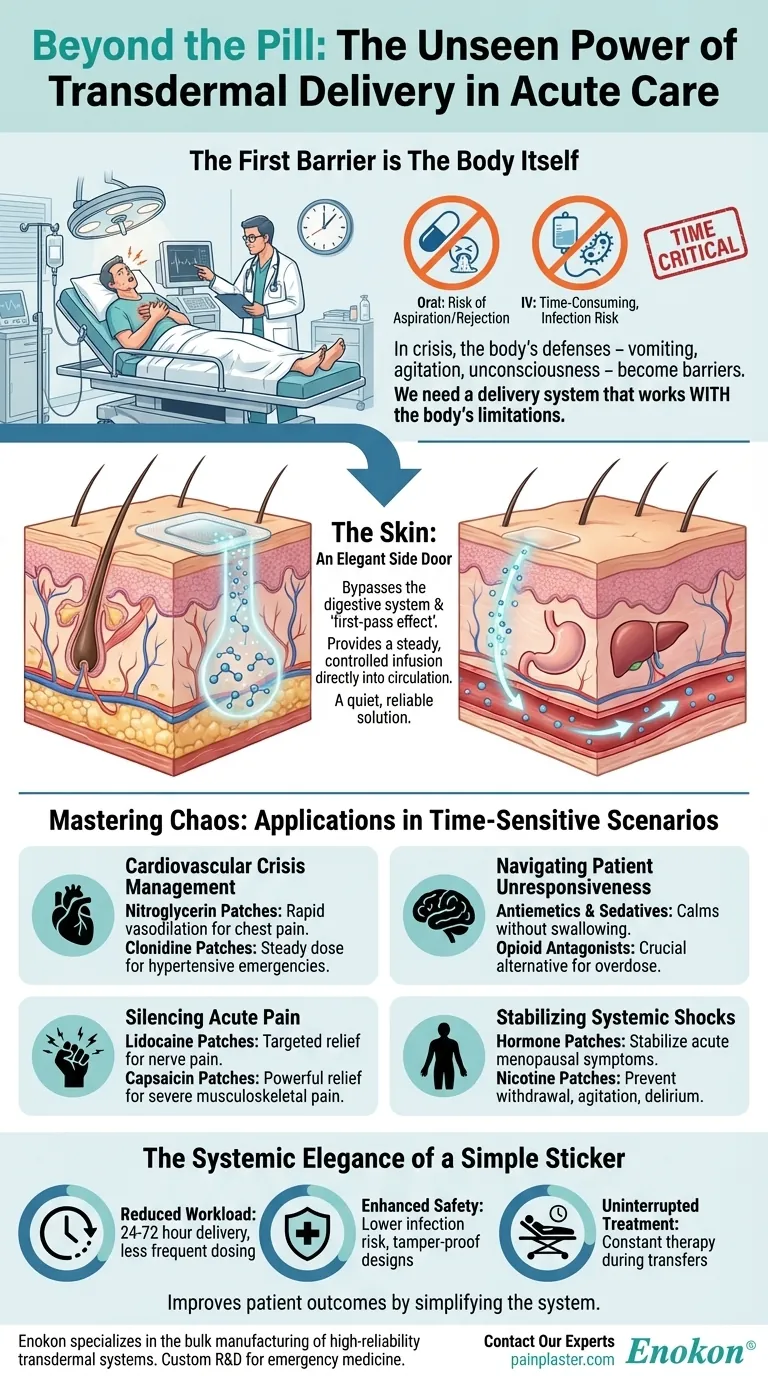
The most direct route for medication is often the most compromised. In moments of crisis, the body's own defense mechanisms—vomiting, agitation, unconsciousness—become barriers to treatment. This is a fundamental paradox of acute care.
We need a delivery system that works with the body's limitations, not against them.
The Skin: An Elegant Side Door
The skin is our largest organ, yet we often see it only as a protective barrier. Engineers and pharmacologists, however, see it as a superhighway.
A transdermal patch is a marvel of controlled engineering. It sidesteps the chaos of the digestive system entirely. There is no risk of aspiration, no concern about a nauseated stomach rejecting a life-saving drug, and no "first-pass effect" where the liver metabolizes a significant portion of a drug before it ever reaches the bloodstream.
Instead, the patch provides a steady, controlled infusion of medication directly into circulation. It’s a quiet, reliable solution in a loud, unpredictable environment.
Mastering Chaos: Applications in Time-Sensitive Scenarios
This technology isn't a novelty; it's a cornerstone of modern emergency medicine, solving distinct problems with precision.
Cardiovascular Crisis Management
When a patient has an angina attack, every second counts.
- Nitroglycerin Patches: Provide rapid vasodilation to relieve chest pain, often acting faster than sublingual tablets while maintaining stable blood levels for up to 24 hours.
- Clonidine Patches: Manage hypertensive emergencies with a steady dose, avoiding the peaks and troughs of oral medication.
This is about delivering stability in the face of cardiovascular volatility.
Navigating Patient Unresponsiveness
An unconscious or severely agitated patient presents a unique challenge.
- Antiemetics & Sedatives: Patches delivering drugs like scopolamine or antipsychotics can calm a patient or prevent vomiting without requiring them to swallow or receive an injection.
- Opioid Antagonists: In overdose situations, transdermal delivery can be a crucial alternative route for life-saving intervention.
The patch does its work silently, requiring no cooperation from a patient who cannot give it.
Silencing Acute Pain
Severe pain requires immediate and sustained relief.
- Lidocaine Patches: Applied directly to the source of pain, they are invaluable for post-surgical neuropathic pain or the intense neuralgia from shingles.
- Capsaicin Patches: High-concentration formulas provide powerful relief for severe musculoskeletal pain or diabetic neuropathy crises, targeting the pain at its source.
Stabilizing Systemic Shocks
Acute care isn't just about the primary crisis; it's about preventing secondary ones.
- Hormone Patches: Estradiol patches can quickly stabilize severe menopausal symptoms that present as an acute event.
- Nicotine Patches: For hospitalized smokers, a nicotine patch is a simple, effective tool to prevent withdrawal, which can otherwise lead to agitation and delirium, complicating their primary treatment.
The Systemic Elegance of a Simple Sticker
The genius of the transdermal patch extends beyond its pharmacology to its operational impact. In the high-stress ecosystem of a hospital, it introduces a calming efficiency.
- Reduced Workload: One patch can deliver medication for 24 to 72 hours, freeing nursing staff from the cycle of repeated dosing.
- Enhanced Safety: The risk of infection is significantly lower compared to IV lines. Tamper-proof designs also help prevent drug diversion.
- Uninterrupted Treatment: The patch stays on the patient, ensuring continuous therapy even during transfers between departments or facilities.
It's a solution that improves patient outcomes by simplifying the system around them. This level of reliability and precision isn't accidental; it's the result of specialized manufacturing and deep technical expertise in polymer matrices, adhesion, and controlled-release mechanisms.
For healthcare distributors and pharmaceutical brands looking to integrate this advanced technology into their acute care offerings, the quality of the patch itself is paramount. At Enokon, we specialize in the bulk manufacturing of high-reliability transdermal systems, offering custom R&D to meet the exacting demands of emergency medicine.
To explore how our technical expertise can enhance your product line, Contact Our Experts.
Visual Guide
Related Products
- Far Infrared Heat Pain Relief Patches Transdermal Patches
- Silicone Scar Sheets Patch Transdermal Drug Patch
- Icy Hot Menthol Medicine Pain Relief Patch
- Menthol Gel Pain Relief Patch
- Mugwort Wormwood Pain Relief Patch for Neck Pain
Related Articles
- Engineering Certainty: The Invisible Architecture of a Gold-Standard Clinical Trial
- The Silent Workhorse: How Transdermal Patches Rewrote the Rules of Pain Management
- Beyond the Pill: The Silent Engineering of Safer Pain Relief
- Beyond Efficacy: The Psychology of Adherence in Topical Pain Relief
- Beyond the Molecule: The Behavioral Science of the Simple Pain Patch



















