
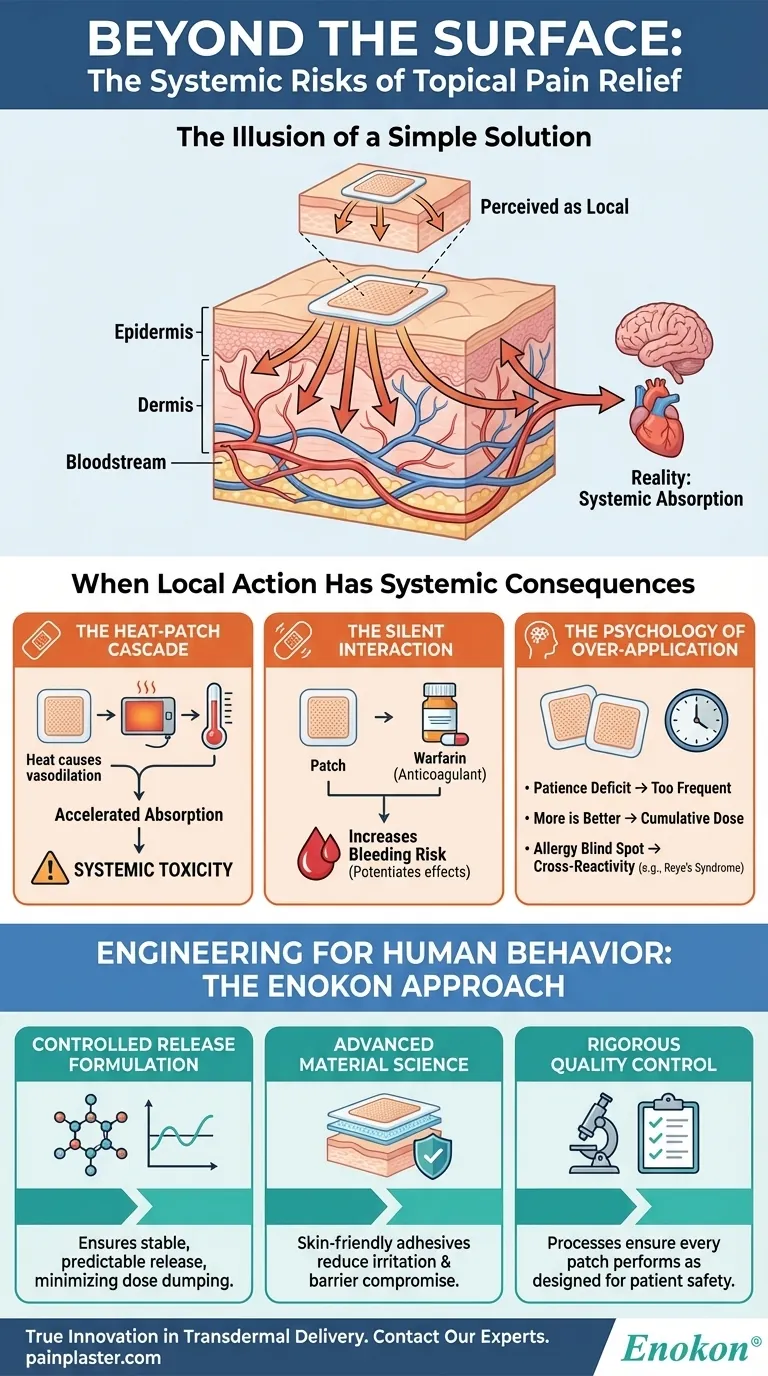
The Illusion of a Simple Solution
The transdermal patch is a quiet marvel of medical engineering. It delivers medication steadily, bypasses the digestive system, and offers a level of convenience that a pill simply cannot match. Yet, this elegant simplicity creates a dangerous psychological blind spot.
Because it’s applied to the skin, we perceive a patch as a localized, topical treatment—a sophisticated bandage. We mentally categorize it as less potent, less risky, and less "medical" than oral medication. This fundamental misunderstanding is where systemic failures begin.
When Local Action Has Systemic Consequences
A product containing methyl salicylate (MS) doesn't just work on the surface. Its active ingredients are designed to permeate the skin barrier and enter the bloodstream. This is the "transdermal" mechanism, and it's what makes the patch effective.
It is also what makes it hazardous when used incorrectly. The safety of the patch is predicated on a controlled, predictable rate of absorption. When that system is disrupted, the consequences can be severe.
The Heat-Patch Cascade: A Common Mistake
Imagine someone with chronic lower back pain on a cold day. They apply a pain patch and, seeking extra comfort and relief, place a heating pad over it. It feels logical. Heat soothes muscles, and the patch relieves pain.
But physiologically, this combination is a recipe for an overdose.
- Increased Blood Flow: The heat causes vasodilation, dramatically increasing blood flow to the skin beneath the patch.
- Accelerated Absorption: This surge in circulation acts as an accelerant, pulling the methyl salicylate into the bloodstream far faster than the designed rate.
- Systemic Toxicity: A therapeutic dose quickly becomes a toxic one, potentially leading to salicylate poisoning with symptoms like tinnitus, nausea, or worse.
This isn't a failure of the product itself, but a failure in understanding the system. The user, acting with good intentions, inadvertently broke the controlled-release mechanism.
The Silent Interaction
Consider another common scenario: a patient on warfarin to prevent blood clots. They develop shoulder pain and apply an over-the-counter MS patch, seeing it as a harmless, unrelated treatment. They may not even think to mention it to their doctor.
However, methyl salicylate, like its chemical cousin aspirin, can interact with anticoagulants. Even when absorbed through the skin, it can potentiate the effects of warfarin, significantly increasing the risk of serious bleeding. The danger is invisible, stemming from two treatments that seem to operate in entirely different worlds.
The Psychology of Over-Application
Human behavior, driven by the desire for immediate relief, often clashes with the slow, steady mechanism of a transdermal patch.
- The Patience Deficit: Unlike a pill, which we expect to work within an hour, a patch can have a delayed onset. When the pain persists, our instinct is to "do more." This leads to applying a second patch or changing it too frequently, both of which can lead to an overdose.
- The "More is Better" Fallacy: If one patch provides some relief, two must be better. This intuitive but flawed logic fails to account for the cumulative dose entering the bloodstream.
- The Allergy Blind Spot: A person may know they are allergic to aspirin pills but fail to connect that allergy to a wintergreen-scented patch. This mental categorization error can trigger severe cross-reactivity, from hives to life-threatening reactions. This risk is especially acute for children, for whom salicylates are linked to the rare but deadly Reye's syndrome.
Engineering for Human Behavior
These risks highlight that user error is often a symptom of a system that fails to account for human psychology. Creating a safer transdermal product is not just a matter of chemical formulation; it's a challenge of systems engineering.
It requires a manufacturing partner who understands these deep complexities.
At Enokon, we specialize in the bulk manufacturing of transdermal patches and pain plasters, but our true expertise lies in building safety and reliability into the core of the product.
- Controlled Release Formulation: We develop formulations that ensure a stable, predictable release of active ingredients, minimizing the risk of dose dumping even under variable conditions.
- Advanced Material Science: We select skin-friendly adhesives and backing materials to reduce the likelihood of irritation and severe skin reactions, which can compromise the skin barrier and increase absorption.
- Rigorous Quality Control: As a partner to healthcare distributors and pharmaceutical brands, we recognize our role in the patient safety chain. Our processes ensure that every patch performs exactly as designed.
True innovation in transdermal delivery is about closing the gap between the product’s design and the patient’s real-world behavior. It requires a deep, systematic approach to both chemistry and human factors. Building safer, more effective transdermal solutions demands this level of expertise from R&D through to final production. Contact Our Experts
Visual Guide
Related Products
- Menthol Gel Pain Relief Patch
- Herbal Medicated Anti Diarrhea Patch for Digestive Relief
- Asthma Cough and Pain Relief Patch for Adults and Kids
- Detox Foot Patches for Detoxification
- Icy Hot Menthol Medicine Pain Relief Patch
Related Articles
- Beyond Efficacy: The Psychology of Adherence in Topical Pain Relief
- The 60-Minute Architecture: Engineering Predictability in Topical Pain Relief
- More Than a Feeling: The Precise Engineering of Cold vs. Hot Pain Relief
- Beyond the Molecule: The Behavioral Science of the Simple Pain Patch
- The Human Interface of Pain Relief: Why Delivery Systems Define Success



















