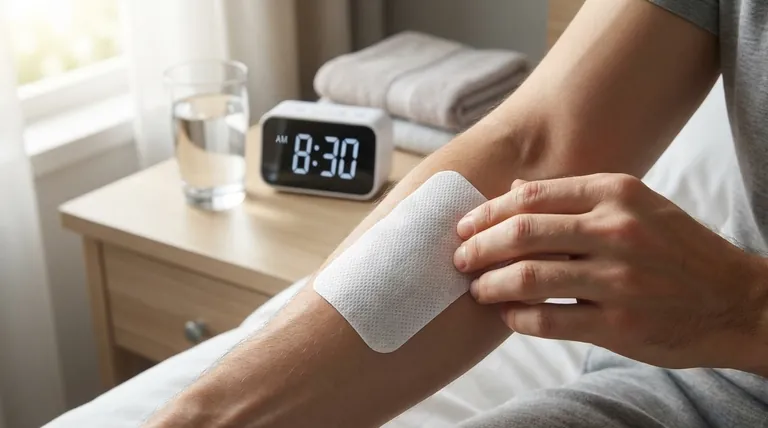
The Moment of Forgetting
Imagine a patient managing chronic pain. Midway through their day, a sudden jolt of realization: they forgot to apply their lidocaine patch this morning. Hours have passed.
The immediate, almost primal, human instinct is to correct the mistake. To compensate. This urge to "catch up" on a missed medication is a powerful psychological driver, rooted in a desire to maintain control over one's health.
But a transdermal patch is not a pill. It's a marvel of controlled-release engineering—a silent, continuous dialogue between the patch and the skin. Its therapeutic power lies in its steadiness, and understanding this system is key to navigating the inevitable moments of human error.
Why "Catching Up" Is a Flawed Instinct
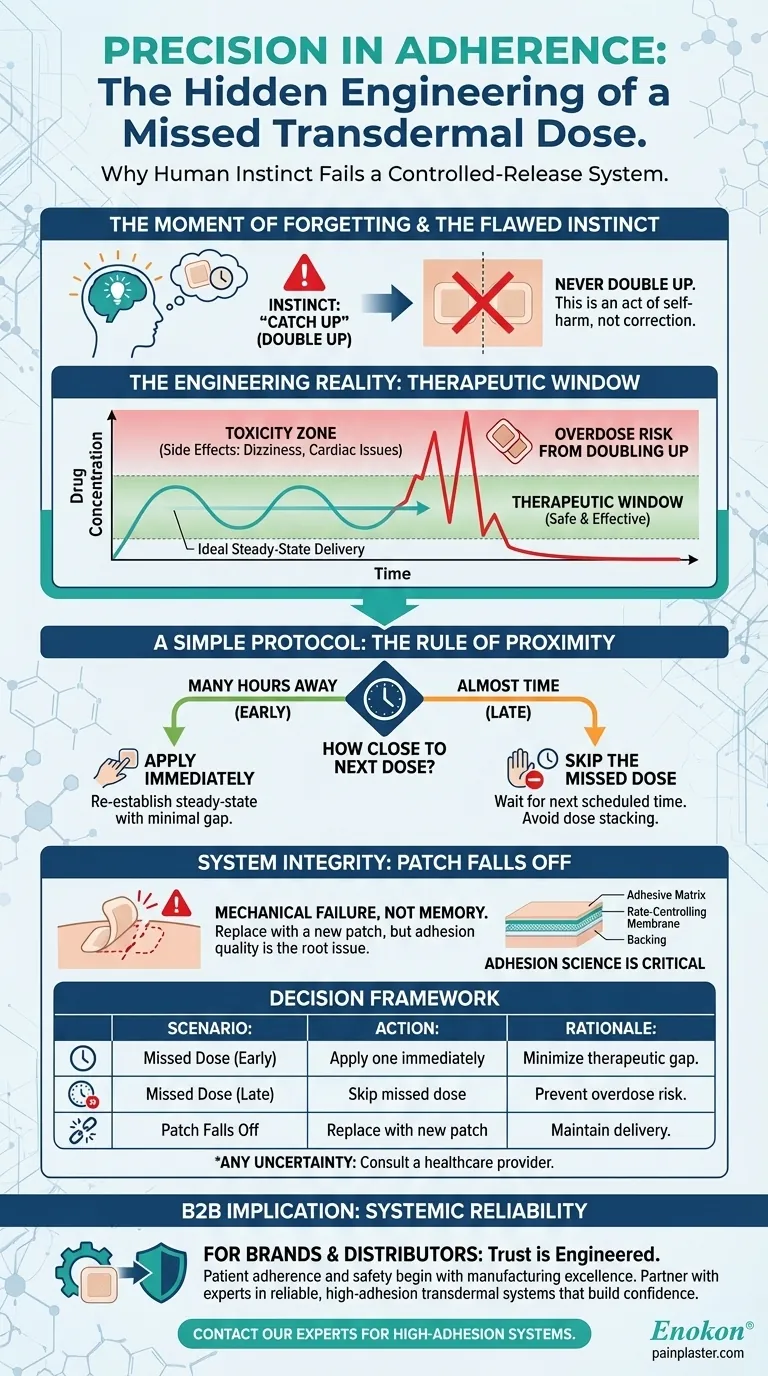
The core principle for a missed transdermal dose is simple and unyielding: never double up.
This isn't arbitrary advice. It's a directive born from the elegant logic of pharmacokinetics. A transdermal system is designed to maintain a drug's concentration in the bloodstream within a specific "therapeutic window"—high enough to be effective, low enough to be safe.
Applying two patches introduces a sudden, massive influx of the active ingredient. It overwhelms the carefully calibrated system, pushing the concentration past the safety ceiling and into the zone of potential toxicity. This can lead to systemic side effects like dizziness, numbness, or even cardiac complications. The well-intentioned act of "catching up" becomes an act of self-harm.
A Simple Protocol for a Complex System
The correct response to a missed dose is not about impulse; it's about respecting the system's design. The protocol is a simple decision tree.
The Rule of Proximity
The first question is one of timing: How close is it to your next scheduled dose?
- If you remember early: If you're still many hours away from the next application time, apply the patch immediately. This allows the system to resume its steady-state delivery with minimal disruption.
- If it's almost time: If you're within a few hours of your next scheduled dose, simply skip the one you missed. Wait and apply the next patch at its regular time.
This rule is designed to prevent dose stacking, ensuring the drug concentration never spikes dangerously. Trusting the schedule is more effective than reacting to the mistake.
The Integrity of the System
A different kind of failure occurs when a patch falls off prematurely. This isn't a memory error, but a mechanical one—a failure of adhesion.
When this happens, the system's integrity is compromised. The continuous delivery of medication stops abruptly. While the protocol is similar (replace it unless it's near the next dose time), the root cause points to a deeper issue: the quality of the patch itself.
Adhesion science is a critical, often overlooked, aspect of transdermal technology. A patch must adhere firmly through movement, sweat, and friction without causing skin irritation. This requires a sophisticated balance of material science and biomedical engineering.
Decision Framework for a Missed Transdermal Dose
For healthcare brands and distributors, ensuring patient adherence and safety begins at the manufacturing level. The reliability of the patch itself is the first line of defense against dosing errors.
| Scenario | Recommended Action | Rationale |
|---|---|---|
| Missed Dose (Early) | Apply one patch immediately. | Re-establish the therapeutic level with minimal gap. |
| Missed Dose (Late) | Skip the missed dose entirely. | Avoid overdose risk from dose stacking. |
| Patch Falls Off | Replace with a new patch. | Maintain continuous delivery and system integrity. |
| Any Uncertainty | Consult a healthcare provider. | Ensure personalized advice and safety. |
From a Single Dose to Systemic Reliability
The protocol for a missed dose reveals a profound truth: the effectiveness of a transdermal therapy rests on the system's predictability and reliability. Every component, from the rate-controlling membrane to the adhesive matrix, is engineered to account for the realities of daily life.
For healthcare distributors and pharmaceutical brands, providing a product that patients can trust is paramount. This trust is built on the consistency of each patch, the reliability of its adhesion, and the precision of its drug delivery. It's about engineering a system so robust that it can gracefully accommodate the small, inevitable moments of human forgetfulness. Partnering with a manufacturer who understands this intricate balance is essential.
For expertise in developing and manufacturing reliable, high-adhesion transdermal systems that build patient confidence, Contact Our Experts
Visual Guide
Related Products
- Far Infrared Heat Pain Relief Patches Transdermal Patches
- Silicone Scar Sheets Patch Transdermal Drug Patch
- Icy Hot Menthol Medicine Pain Relief Patch
- Menthol Gel Pain Relief Patch
- Mugwort Wormwood Pain Relief Patch for Neck Pain
Related Articles
- Engineering Certainty: The Invisible Architecture of a Gold-Standard Clinical Trial
- The Silent Workhorse: How Transdermal Patches Rewrote the Rules of Pain Management
- Beyond the Pill: The Silent Engineering of Safer Pain Relief
- Beyond Efficacy: The Psychology of Adherence in Topical Pain Relief
- Beyond the Molecule: The Behavioral Science of the Simple Pain Patch



















