The Illusion of Simplicity
To a patient, a transdermal patch is a marvel of convenience. A small, adhesive square applied once a week offers a steady promise: freedom from the peaks and valleys of oral medication, and a return to normalcy from the grip of chronic pain.
This perceived simplicity is a triumph of design. But beneath the surface lies a complex system of pharmacology, material science, and human psychology. The patch is not just a container for a drug; it is a sophisticated, rate-controlled delivery engine. And its success depends entirely on managing the intricate interface between the device and the human body.
The Skin: A Gateway, Not Just a Barrier
Our skin is an incredible organ designed to keep things out. For a transdermal system like a Buprenorphine patch to work, it must elegantly subvert this primary function. It must transform the body's protective barrier into a predictable gateway for a potent opioid.
This requires engineering a delicate balance. The formulation must allow the drug to pass through the skin's outer layers at a precise, consistent rate for 168 straight hours. Too slow, and the pain is not managed. Too fast, and the risk of overdose becomes critical. This is where the unseen engineering truly begins.
The Protocol is the Product
The detailed instructions that accompany a patch are not mere suggestions; they are an integral part of the delivery system's calibration. Human behavior is the most significant variable, and the protocol is designed to standardize it.
The Interface: Site Selection and Preparation
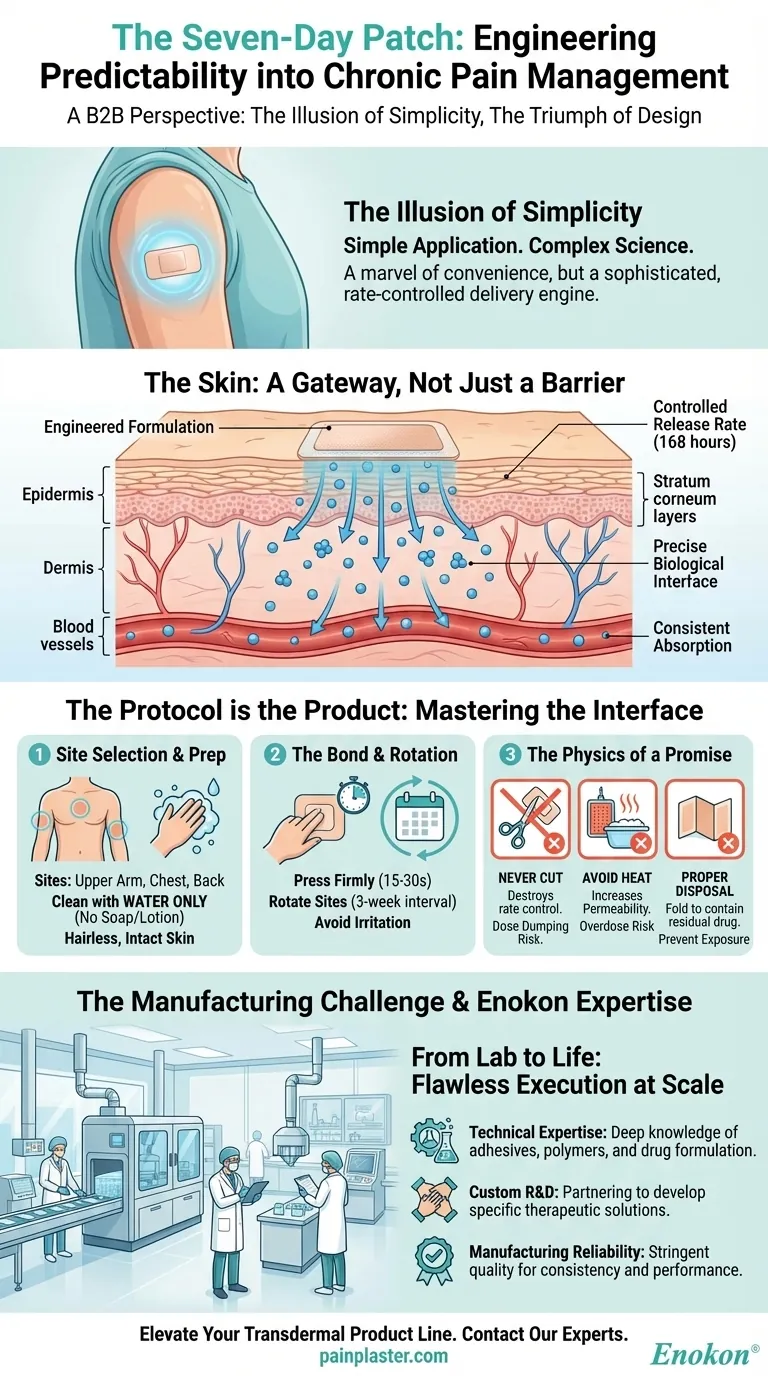
The choice of where to place the patch is the first critical step. The instructions are specific:
- Application Sites: Upper arm, chest, or back.
- Skin Condition: Must be intact, non-irritated, and preferably hairless.
- Preparation: Clean with water only—no soaps, oils, or lotions.
Why such precision? Soaps and lotions can leave chemical residues that alter skin permeability or compromise adhesion. Shaving can cause micro-abrasions that accelerate drug absorption unpredictably. The system is designed for a specific biological canvas, and deviation changes the outcome.
The Bond: Adhesion and Rotation
Pressing the patch firmly for 15-30 seconds ensures full contact, creating the perfect bond for molecular diffusion to begin. The requirement to rotate the application site, with a minimum three-week interval before reusing a spot, addresses a biological reality: the skin needs time to recover. Continuous application could lead to irritation or changes in the skin that would make future doses unreliable.
The Physics of a Promise: Controlled Release
The real magic happens within the layers of the patch itself. It's a system designed to release micrograms per hour with unwavering consistency.
Calibrating the Dose Without Dials
Different strengths—5, 10, 15, or 20 mcg/hr—are not just different amounts of medicine. Each is a distinct system, calibrated with a specific drug concentration and membrane permeability.
This is why a patch must never be cut. Doing so destroys the rate-controlling mechanism, instantly turning a seven-day extended-release system into an unpredictable, high-risk dose.
The Unforeseen Accelerator: The Danger of Heat
The system's most significant vulnerability is thermodynamics. Applying an external heat source like a heating pad or even taking a very hot bath can dramatically increase skin permeability and blood flow. This accelerates drug absorption, potentially leading to an overdose. The patient's environment becomes a factor in their dosage, a powerful reminder of the delicate physics at play.
| Precaution | Rationale |
|---|---|
| Never Cut Patch | Destroys the engineered rate-control membrane, causing dose dumping. |
| Avoid Heat Sources | Increases blood flow and skin permeability, leading to rapid, unsafe absorption. |
| Rotate Sites | Prevents skin irritation and ensures consistent absorption over time. |
| Proper Disposal | Folding the patch in half contains residual drug, preventing accidental exposure. |
The Manufacturing Challenge: From Lab to Life
Delivering on the promise of a seven-day patch requires more than a clever design; it demands flawless execution at scale. For every single patch, the adhesive properties, drug matrix consistency, and membrane integrity must be perfect. Any variation could compromise patient safety and therapeutic effectiveness.
This is the challenge faced by pharmaceutical brands and healthcare distributors. The solution is not just to find a supplier, but to partner with a manufacturing expert who understands the deep science involved.
This is where Enokon excels. As a bulk manufacturer of transdermal systems, we specialize in:
- Technical Expertise: Deep knowledge of adhesives, polymers, and drug formulation for reliable, rate-controlled delivery.
- Custom R&D: Collaborating with brands to develop and refine custom patch formulations for specific therapeutic needs.
- Manufacturing Reliability: Ensuring every batch meets the most stringent quality standards for consistency and performance.
The elegant simplicity of a transdermal patch is the result of immense technical complexity. For brands and distributors committed to providing safe and effective chronic pain solutions, partnering with a specialist manufacturer is essential. To explore how expert R&D and reliable bulk manufacturing can elevate your transdermal product line, Contact Our Experts.
Visual Guide
Related Products
- Far Infrared Heat Pain Relief Patches Transdermal Patches
- Silicone Scar Sheets Patch Transdermal Drug Patch
- Icy Hot Menthol Medicine Pain Relief Patch
- Menthol Gel Pain Relief Patch
- Mugwort Wormwood Pain Relief Patch for Neck Pain
Related Articles
- Engineering Certainty: The Invisible Architecture of a Gold-Standard Clinical Trial
- The Silent Workhorse: How Transdermal Patches Rewrote the Rules of Pain Management
- Beyond the Pill: The Silent Engineering of Safer Pain Relief
- Beyond Efficacy: The Psychology of Adherence in Topical Pain Relief
- Beyond the Molecule: The Behavioral Science of the Simple Pain Patch



















