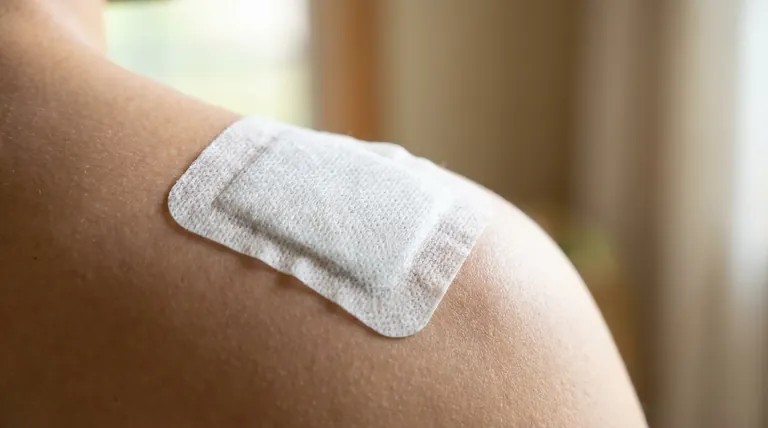
We’ve all been there. You apply a pain relief patch, expecting hours of comfort, only to find a corner peeling away within minutes.
It feels like a personal failure. Did I apply it wrong? Is my skin too oily?
This small annoyance isn't just a user error; it’s a failure in a surprisingly complex system. A medicated patch isn’t just a sticker. It's a sophisticated transdermal delivery system, and its success hinges on a delicate balance of biology, chemistry, and physics.
The Skin as a Dynamic Interface
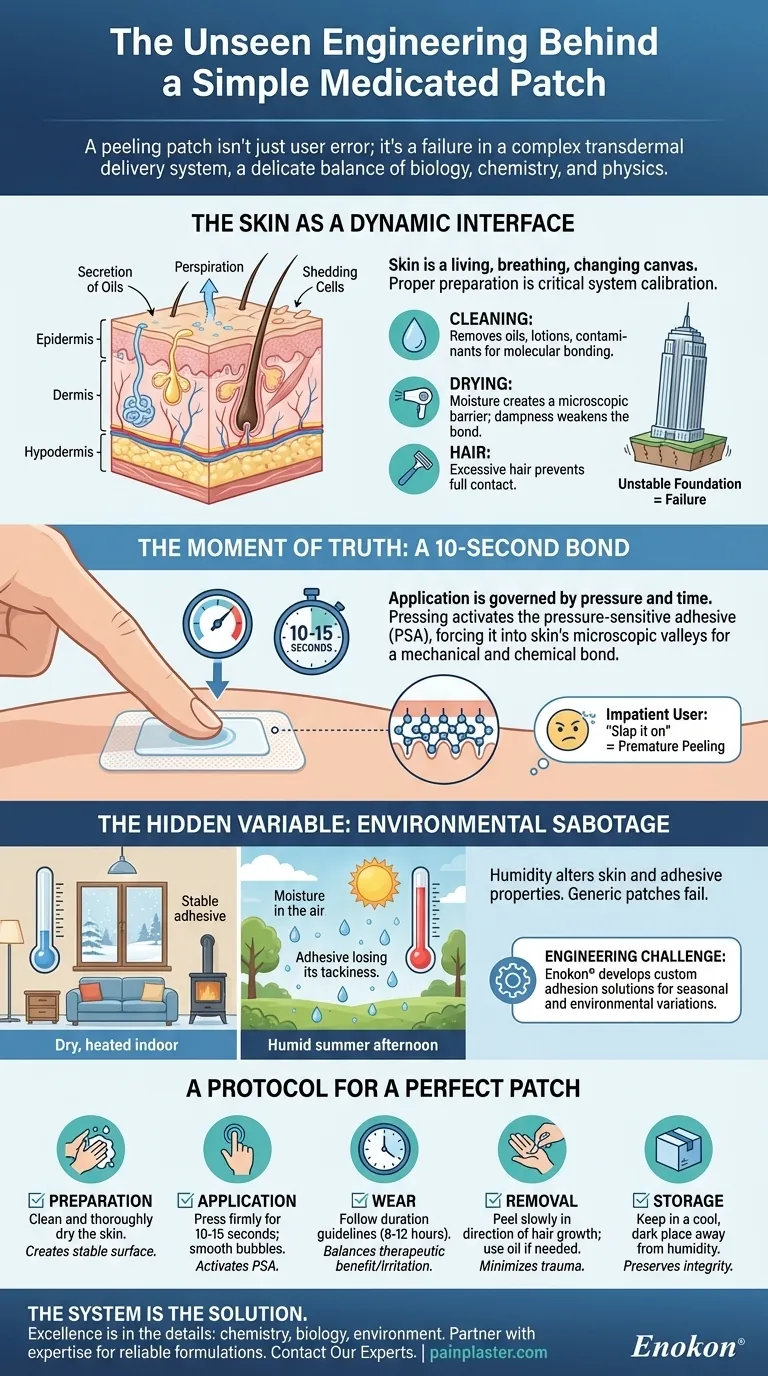
We think of our skin as a simple surface, but it's a living, breathing, and constantly changing interface. It secretes oils, perspires, and sheds cells.
For a patch to work, its adhesive must form a perfect bond with this dynamic canvas. This is why proper preparation is not just a suggestion; it's a critical system calibration.
- Cleaning: Removing surface oils and lotions isn't just for hygiene. It clears contaminants that would otherwise prevent the adhesive's molecules from making direct contact with the epidermis.
- Drying: Moisture is the enemy of adhesion. A damp surface creates a microscopic barrier of water, weakening the bond and potentially trapping bacteria.
- Hair: Excessive hair creates thousands of tiny gaps, preventing the patch from achieving the full, uninterrupted contact it needs.
Failing to prepare the skin is like building a skyscraper on an unstable foundation. The entire structure is destined to fail.
The Moment of Truth: A 10-Second Bond
The application itself is a physical process governed by pressure and time. When you press a patch onto your skin for those crucial 10 seconds, you are activating the pressure-sensitive adhesive (PSA).
This isn't just about making it "stick." You are physically forcing the adhesive to flow into the microscopic valleys of your skin, creating a mechanical and chemical bond. Smoothing out air bubbles ensures this contact is uniform across the entire surface.
Our psychology works against us here. We are impatient. We want to "slap it on" and go. But that rushed application is the single biggest reason for premature peeling. It sacrifices a secure bond for a few seconds of saved time.
The Hidden Variable: Environmental Sabotage
Here is the factor that both users and many manufacturers overlook: the environment.
An adhesive that performs perfectly in the dry air of a heated winter home can fail spectacularly in the humidity of a summer afternoon. Humidity alters both the skin's surface and the adhesive's chemical properties. The adhesive can absorb moisture from the air, losing its tackiness.
This is not a problem the user can solve. It’s an engineering challenge.
It requires deep expertise in polymer science to formulate adhesives that remain stable across different climates and seasons. This is where the difference between a generic patch and a professionally engineered one becomes clear. Advanced manufacturers like Enokon develop custom adhesion solutions specifically designed to account for these seasonal and environmental variations, ensuring reliability year-round.
A Protocol for a Perfect Patch
While the product's engineering is paramount, proper application ensures you get the performance you paid for. Think of it as a pre-flight checklist for a sophisticated piece of equipment.
| Phase | Critical Action | The Engineering "Why" |
|---|---|---|
| Preparation | Clean and thoroughly dry the skin. | Creates a stable, uncontaminated surface for molecular bonding. |
| Application | Press firmly for 10-15 seconds; smooth out all bubbles. | Fully activates the pressure-sensitive adhesive for maximum contact. |
| Wear | Follow duration guidelines (e.g., 8-12 hours). | Balances therapeutic benefit against the risk of skin irritation. |
| Removal | Peel slowly in the direction of hair growth. | Minimizes skin trauma and discomfort. Use oil to dissolve stubborn adhesive. |
| Storage | Keep in a cool, dark place away from humidity. | Preserves the chemical integrity of the active ingredients and adhesive. |
The System is the Solution
A peeling patch is a frustratingly simple problem that reveals a deeply complex truth: excellence is found in the details. From the chemistry of the adhesive to the biology of the skin and the humidity in the air, every element matters.
While users can control the application, the foundation of a reliable transdermal patch lies in its design and manufacturing. It requires a partner who understands the complete system, not just the components. For brands that demand this level of reliability, the solution starts at the source.
If your goal is to deliver a product that works every time, regardless of the season, the conversation must go deeper than just the price per unit. It's about the unseen engineering that builds trust. To explore custom formulations designed for real-world reliability, Contact Our Experts.
Visual Guide
Related Products
- Herbal Medicated Anti Diarrhea Patch for Digestive Relief
- Capsaicin Chili Medicated Pain Relief Patches
- Far Infrared Deep Heat Relief Patches Medicated Pain Relief Patches
- Menthol Gel Pain Relief Patch
- Far Infrared Heat Pain Relief Patches Transdermal Patches
Related Articles
- The Silent Geography of Healing: Decoding the Global Demand for Transdermal Herbal Patches
- Beyond Efficacy: The Psychology of Adherence in Topical Pain Relief
- The Evidence Gap: Navigating the Risks and Opportunities in OTC Analgesic Patches
- More Than a Sticker: The Hidden Engineering of a Safe Pain Patch
- The Physics of Comfort: Why Engineered Cooling Patches Outperform Traditional Fever Care



















