
The Paradox of Discontinuation
In medicine, we often focus on the active phase of treatment. We measure a drug's efficacy by what it does when present. But what happens when it's gone? The moments after discontinuation are often more revealing, showing us the true, lasting impact on the system.
For patients with cardiac conditions, the nitroglycerin patch is a constant, silent partner, working to ease the heart's burden. Removing it isn't just a neutral act; it's an event that triggers a cascade of physiological responses. The body begins to revert, but surprisingly, it doesn't go all the way back. It remembers the therapy.
Quantifying the Rebound
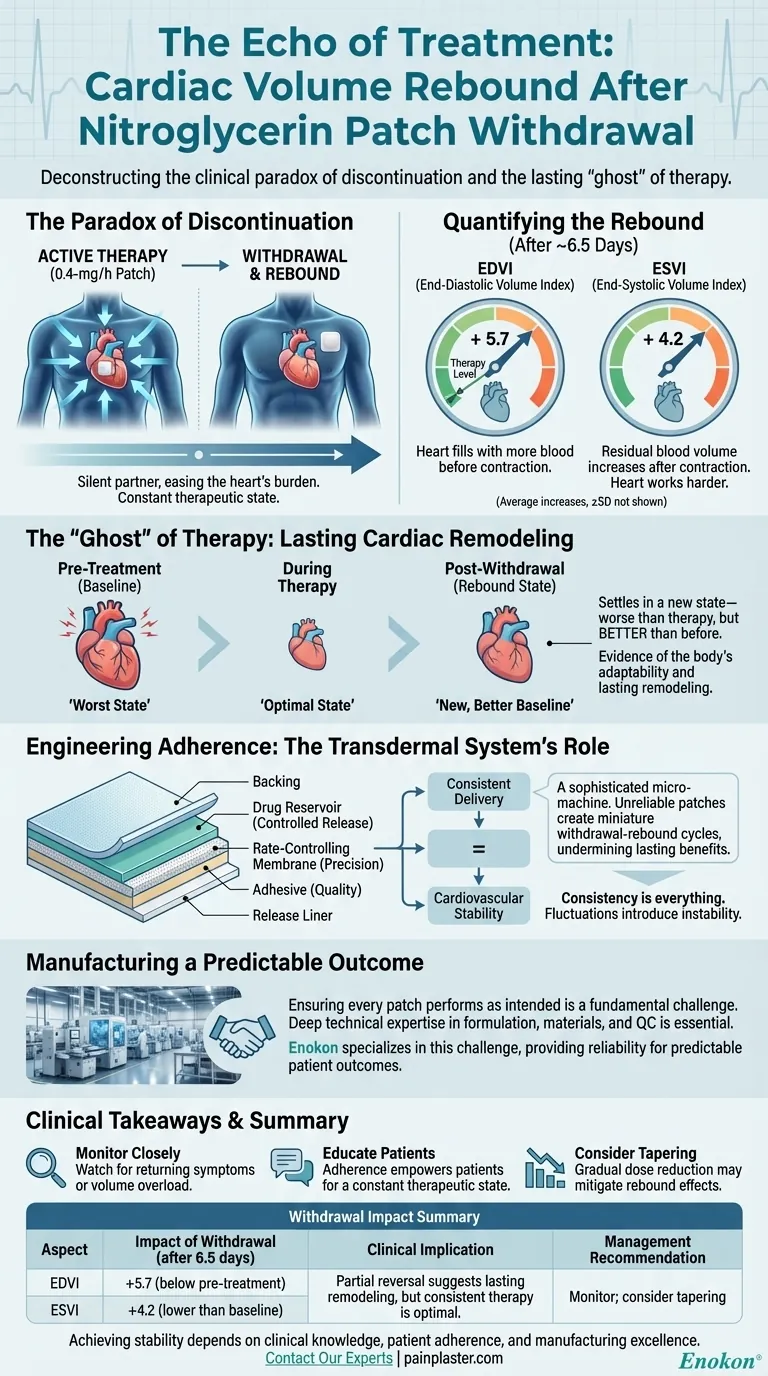
When a 0.4-mg/h nitroglycerin patch is discontinued, the heart's mechanics begin to shift within days. Studies show that after approximately 6.5 days, key cardiac volume metrics increase, signaling a partial reversal of the patch's benefits.
- End-Diastolic Volume Index (EDVI): This measures the volume of blood in the left ventricle just before it contracts. It increases by an average of 5.7.
- End-Systolic Volume Index (ESVI): This measures the residual blood volume in the ventricle after contraction. It increases by an average of 4.2.
These numbers confirm a rebound. The heart is working harder again as it fills with more blood (higher EDVI) and pumps less of it out with each beat (higher ESVI).
The 'Ghost' of Therapy: Evidence of Lasting Change
Here lies the critical insight. While EDVI and ESVI rise, they do not return to their original, pre-treatment levels. They settle in a new state—worse than during therapy, but better than before it began.
This phenomenon suggests that nitroglycerin therapy induces a form of lasting cardiac remodeling. The constant reduction in preload (the heart's filling pressure) and afterload (the resistance it pumps against) doesn't just provide temporary relief. It allows the heart muscle and surrounding vasculature to achieve a more efficient baseline, an echo of which persists even after the drug is withdrawn.
This "memory" is a testament to the body's incredible adaptability. It's also a crucial data point for clinicians.
From a Molecule to a Mandate: The Engineering of Adherence
The partial rebound effect underscores a powerful psychological and clinical truth: consistency is everything. The benefits of nitroglycerin therapy are not stored in a vault; they are actively maintained. Fluctuations in drug delivery, whether from missed doses or inconsistent patch performance, can introduce cardiovascular instability.
The Role of the Transdermal System
This places immense importance on the engineering of the delivery system itself. A transdermal patch is not just a sticker; it's a sophisticated micro-machine designed for controlled, sustained release.
The quality of the adhesive, the stability of the drug reservoir, and the precision of the rate-controlling membrane all dictate whether the patient receives a therapeutic dose or a placebo effect. An unreliable patch can inadvertently create miniature withdrawal-rebound cycles, undermining the potential for lasting cardiac remodeling.
Manufacturing a Predictable Outcome
Ensuring every patch performs exactly as intended, from the first to the last in a batch, is a fundamental manufacturing challenge. It requires deep technical expertise in formulation, materials science, and quality control. As a bulk manufacturer of transdermal systems, Enokon specializes in this very challenge. We provide the reliability that healthcare brands and distributors depend on, ensuring the therapeutic promise of a molecule is consistently delivered through the skin.
Clinical Takeaways for Managing Transitions
The nuanced behavior of the cardiovascular system during nitroglycerin withdrawal leads to clear clinical imperatives.
- Monitor Closely: Patients discontinuing therapy should be monitored for any signs of returning symptoms or volume overload.
- Educate Patients: Adherence is not just about taking a pill on time. It's about maintaining a constant therapeutic state, which the patch is designed to do. This knowledge empowers patients.
- Consider Tapering: Rather than abrupt cessation, a gradual tapering of the dose may help mitigate the rebound effect, allowing the cardiovascular system to readjust more smoothly.
Summary of Withdrawal Impact
| Aspect | Impact of Nitroglycerin Patch Withdrawal |
|---|---|
| End-Diastolic Volume Index (EDVI) | Increased by 5.7±12.1 after 6.5 days, but remains below pre-treatment levels. |
| End-Systolic Volume Index (ESVI) | Increased by 4.2±7.7 after 6.5 days, but stays lower than baseline. |
| Clinical Implication | Partial reversal suggests lasting cardiac remodeling, but consistent therapy is optimal for sustained benefits. |
| Management Recommendation | Monitor patients during withdrawal; consider tapering to mitigate rebound effects. |
Understanding the echo of treatment allows us to manage cardiac therapy with greater precision. The goal is not just to apply a drug, but to create a stable physiological environment where the body can heal and adapt. Achieving that stability depends on the unbreakable chain of clinical knowledge, patient adherence, and manufacturing excellence.
If your organization is looking to provide reliable and effective transdermal therapeutic solutions, our technical expertise can help you deliver predictable patient outcomes. Contact Our Experts
Visual Guide
Related Products
- Herbal Medicated Anti Diarrhea Patch for Digestive Relief
- Asthma Cough and Pain Relief Patch for Adults and Kids
- Menthol Gel Pain Relief Patch
- Icy Hot Menthol Medicine Pain Relief Patch
- Lidocaine Hydrogel Pain Relief Patch for Pain Relief
Related Articles
- The Unseen Engineering Behind a Simple Medicated Patch
- The Silent Geography of Healing: Decoding the Global Demand for Transdermal Herbal Patches
- Beyond Efficacy: The Psychology of Adherence in Topical Pain Relief
- The Evidence Gap: Navigating the Risks and Opportunities in OTC Analgesic Patches
- More Than a Sticker: The Hidden Engineering of a Safe Pain Patch



















